

Super RIGI: a historic turn for Argentina

Super RIGI: a historic turn for Argentina
Imagen de Editorial Team
porEditorial Team
Argentina

It is the crowning achievement of a macroeconomic and political transformation process that could culminate in a true neo-industrial revolution that definitively changes the productive matrix.

Nuevo
Agregar La Derecha Diario en
Compartir:

Let's start from the beginning. Can a country that seemed doomed to a hyperinflationary crisis, with a semi-defaulted debt and a nearly bankrupt Central Bank transform in two years into a coveted piece for the world's major investors? It can, but not by chance. With a tornado sweeping away bureaucracy, unproductive public spending, and unprecedented laws for an oxidized Argentina, it is becoming possible.

Perhaps, the magnitude of the change is hard to appreciate from up close, but it does not go unnoticed by a world that is stiff and eager for business opportunities. And, as without “risks there are no profits,” everything that has played in favor so far, and that consolidates for the remainder of this promising 2026, has an inevitable negative side implicit in the doubt of a relatively near future: will Argentines want to continue betting on growth and sustained progress in 2027 while accepting the challenges that come with embracing market rules and letting go of the false illusions of protection from a state that is almost never there when they really need it?

There lies probably the greatest dilemma of the sustainability of this new model, which does not raise doubts in the long term but imposes challenges in the immediate term. Making the change feasible also implies resigning some of the deeply rooted egalitarian gene of being Argentine, which positioned us discursively as a progressive society in the last century, but mercilessly condemned us to stagnation that systematically resigned growth opportunities to most of our Latin American neighbors.

Let's take a quick look at these two years of government. The first thing Javier Milei did was to set up a consistent and credible fiscal, exchange rate, and monetary stabilization plan that achieved quite immediate results: monthly inflation dropped from 25% to 2.5%, the fiscal surplus crystallized very quickly with a brutal reduction of public spending close to 30%, and the exchange rate managed to remain at fairly stable values in real terms, even after the lifting of the capital controls and despite the most brutal dollarization of portfolios in Argentine history between June and October 2025, close to 50% of the money supply and bank deposits.

Ah, but then, surely he did it by “manipulating” the dollar and sacrificing both competitiveness and economic activity. Let's see what AI tells us about this for the last 30 years:
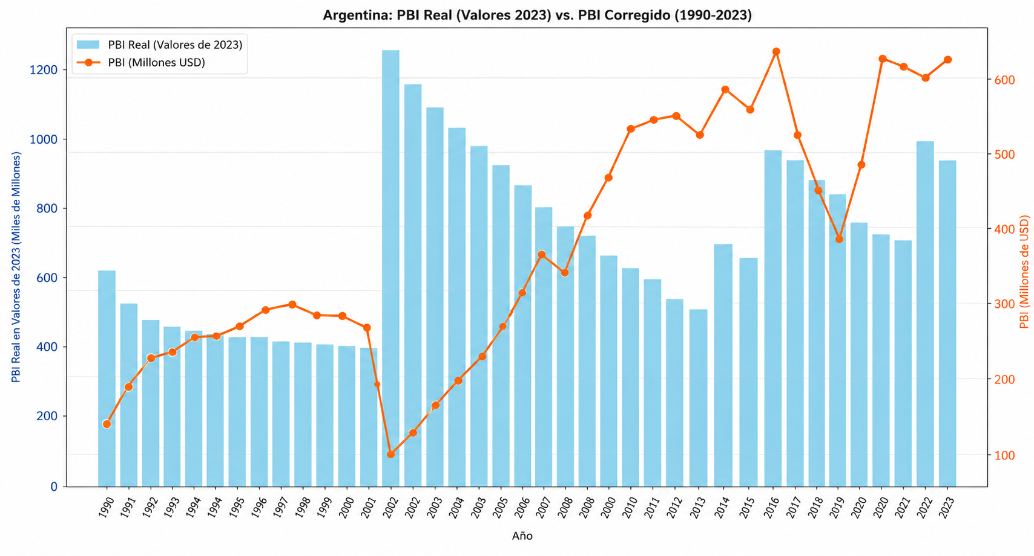
Imagen 1401364

It not only seems that when the exchange rate stabilizes, production grows, but also that we are not even close to a low real exchange rate today. Averaging an exchange rate during times of capital controls with another in years of freedom to calculate a supposed dollar more representative of the last decades is a fallacy that statistical science can afford but not responsible economic science.

Quickly, the horsemen of the apocalypse will come to tell us that perhaps this new model does not paralyze economic activity, but concentrates it in a few dynamic and privileged sectors, expelling a large number of people into poverty and indigence.

We asked AI about this again, and this is what it reproduced based on the official data from the National Institute of Statistics and Censuses:
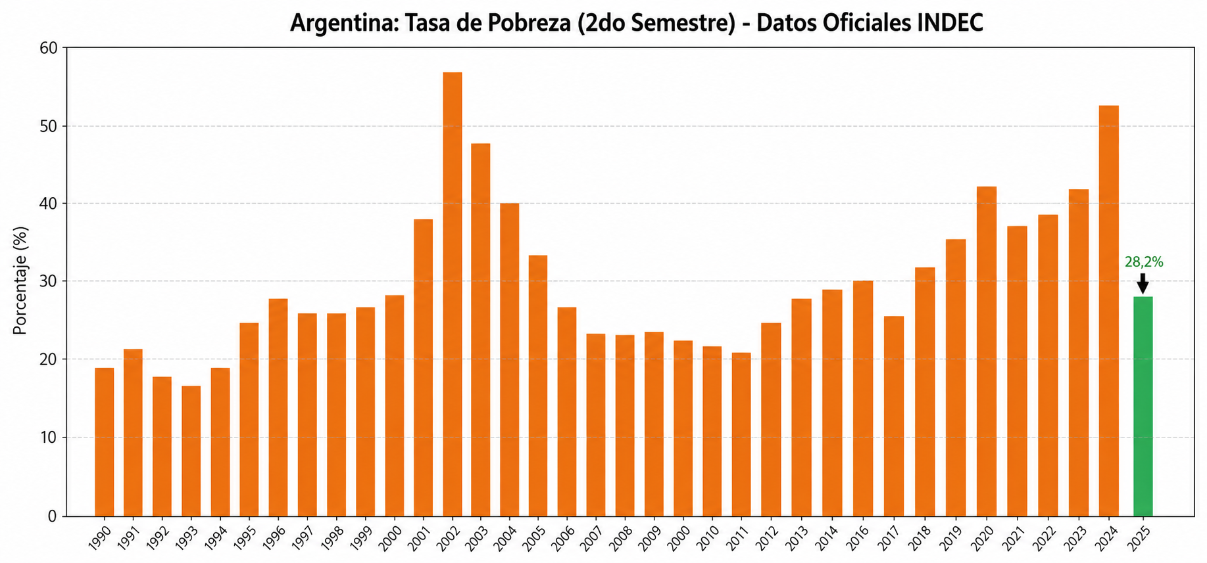
Imagen 1401365

Far from it, in these two years the poverty rate measured in the same way as decades ago has decreased significantly. A good part of this decrease is explained because macro stabilization facilitated that food prices grew well below general inflation and due to a very efficient social policy, both in terms of the monetary value secured and in the elimination of “bureaucracies in social movements,” which drained a good part of the resources that should have been directed directly to vulnerable people.

Now, was a successful stabilization process enough to transform the expectations of a country that had spent two decades ruining its reputation regarding compliance with its commitments and respect for private property?


Clearly, it was not enough. A mega deregulation process was necessary that, at times, needed to overact the incentives and shield the guarantees to “rent” the trust that we had squandered over the years.

And thus came the Bases and Starting Points Law, the Labor Reform Law, the State Reform Law, the Glaciers Law, the Law of presumption of fiscal innocence, and now two key projects are being sent to Congress: one on private property (which will likely include some regulation regarding patents), and the SUPER RIGI announced this week by Minister Luis Caputo.

The first RIGI approved in 2024 aimed to incentivize large investments in the most strategic sectors for export growth such as oil, gas, mining, lithium, and agriculture; with the exception of the latter, the others had been sleeping the sleep of the just, caught up in eternal discussions that coexisted within Peronist progressivism: the productive wing and the environmentalist wing, which were responsible for eternalizing the status quo of productive stagnation.

With the RIGI, nearly $100B of investment requests were unlocked, of which 30% has already been approved and is in the execution process. Then came the RIMI, which came to address similar needs in a sector traditionally very hard-hit in Argentina: that of small and medium-sized enterprises, which are still waiting for financing rates closer to inflation to operationalize or scale their business.

Now, the Super RIGI

Completely defeated in the morass of a transformation they do not understand, and without arguments to object to the stabilization plan beyond the normal difficulties that a program of such complexity and challenges may face, the opposition's criticism has focused in recent months on an “anti-industry” characterization erroneously (or intentionally) assigned to the new model of the country.

It is not possible to promote a sector if it lacks any minimal competitive advantage that could eventually make it successful in the world. After 30 years of having the most closed economy in the world, it began to become clear that paying double the price for clothing or appliances would not give these activities the time they needed to reconvert.

The process of re-industrialization of Argentina had to be of new, dynamic activities with high demand and where the country started from a base with comparative advantages over other nations, as agriculture had demonstrated for 30 years with its thriving food industry associated with abundant and cheap raw materials available.

Today this SUPER RIGI aims to achieve greater industrialization by promoting the development of new value chains, transforming the productive matrix of our natural resources. Lithium batteries, onshore LNG, nuclear reactors, solar panels and wind turbines, electric vehicles, fertilizers, copper laminates, AI data centers, etc.

The benefits are concentrated in the tax realm, where the Income Tax drops from a RIGI of 25% to a SUPER RIGI of 15%, accelerated depreciation, elimination of withholdings and import tariffs, and especially in the provinces that adhere: Gross Income with a maximum rate of 0.5% and Municipal Taxes unrelated to sales.

Incredible that the most liberal government in the world manages to consolidate an industrialization project, which could have been a Peronist banner in the last ten years, but which never saw the light in the sad tangles of the internal struggles of the political caste.


La Derecha Diario logo
ESX logoInstagram logoYouTube logoTikTok logoFacebook
ARGENTINABOLIVIAECUADORISRAELMEXICOURUGUAYDERECHA DIARIO TV
  • ES
    XInstagramYouTubeTikTokFacebook
  • DERECHA DIARIO TV
  • Secciones
  • ARGENTINA
  • BOLIVIA
  • ECUADOR
  • ISRAEL
  • MEXICO
  • URUGUAY
  • Países
  • La Derecha Diario logoLA DERECHA DIARIO
  • La Derecha Diario México logoLA DERECHA DIARIO MÉXICO
  • La Derecha Diario Uruguay logoLA DERECHA DIARIO URUGUAY
  • La Derecha Diario Ecuador logoLA DERECHA DIARIO ECUADOR
  • La Derecha Diario Bolívia logoLA DERECHA DIARIO BOLÍVIA
  • La Derechadiario República Dominicana logoLA DERECHADIARIO REPÚBLICA DOMINICANA
  • La Derecha Diario Israel logoLA DERECHA DIARIO ISRAEL
  • La Derecha Diario Estados Unidos logoLA DERECHA DIARIO ESTADOS UNIDOS
  • Temas
  • GUERRA EN IRÁN
  • JUICIO POR YPF
  • El Diario
  • QUIENES SOMOS
  • AUTORES
  • PUBLICIDAD
  • DONAR
La Derecha Diario logo
TwitterInstagramYouTubeTikTokFacebook
Derecha Diario TV

Nosotros

  • Quienes Somos
  • Autores
  • Donar

Privacidad

  • Protección de datos
  • Canales
  • Sitemap
  • RSS

Contacto

  • info@derechadiario.com.ar
PUBLICIDAD

Noticias relacionadas

Claudio Úbeda was self-critical after Boca's elimination against Huracán: 'We lost it ourselves'

Claudio Úbeda was self-critical after Boca's elimination against Huracán: 'We lost it ourselves'

Claudio Úbeda was self-critical after Boca's elimination against Huracán: 'We lost it ourselves'

Claudio Úbeda was self-critical after Boca's elimination against Huracán: 'We lost it ourselves'

The woke Odyssey: Nolan is questioned for choosing Zendaya, Lupita Nyong'o, and Ellen Page in key roles of classical Greece.

The woke Odyssey: Nolan is questioned for choosing Zendaya, Lupita Nyong'o, and Ellen Page in key roles of classical Greece.

Trump is preparing a new round of bombings in Iran if the Islamic regime rejects the agreement it received.

Trump is preparing a new round of bombings in Iran if the Islamic regime rejects the agreement it received.

Sergio Berni criticized Axel Kicillof's candidacy and accused him of "not having enough guts."

Sergio Berni criticized Axel Kicillof's candidacy and accused him of "not having enough guts."

The success of The Knight of the Seven Kingdoms exposes the weariness against the woke agenda.

The success of The Knight of the Seven Kingdoms exposes the weariness against the woke agenda.