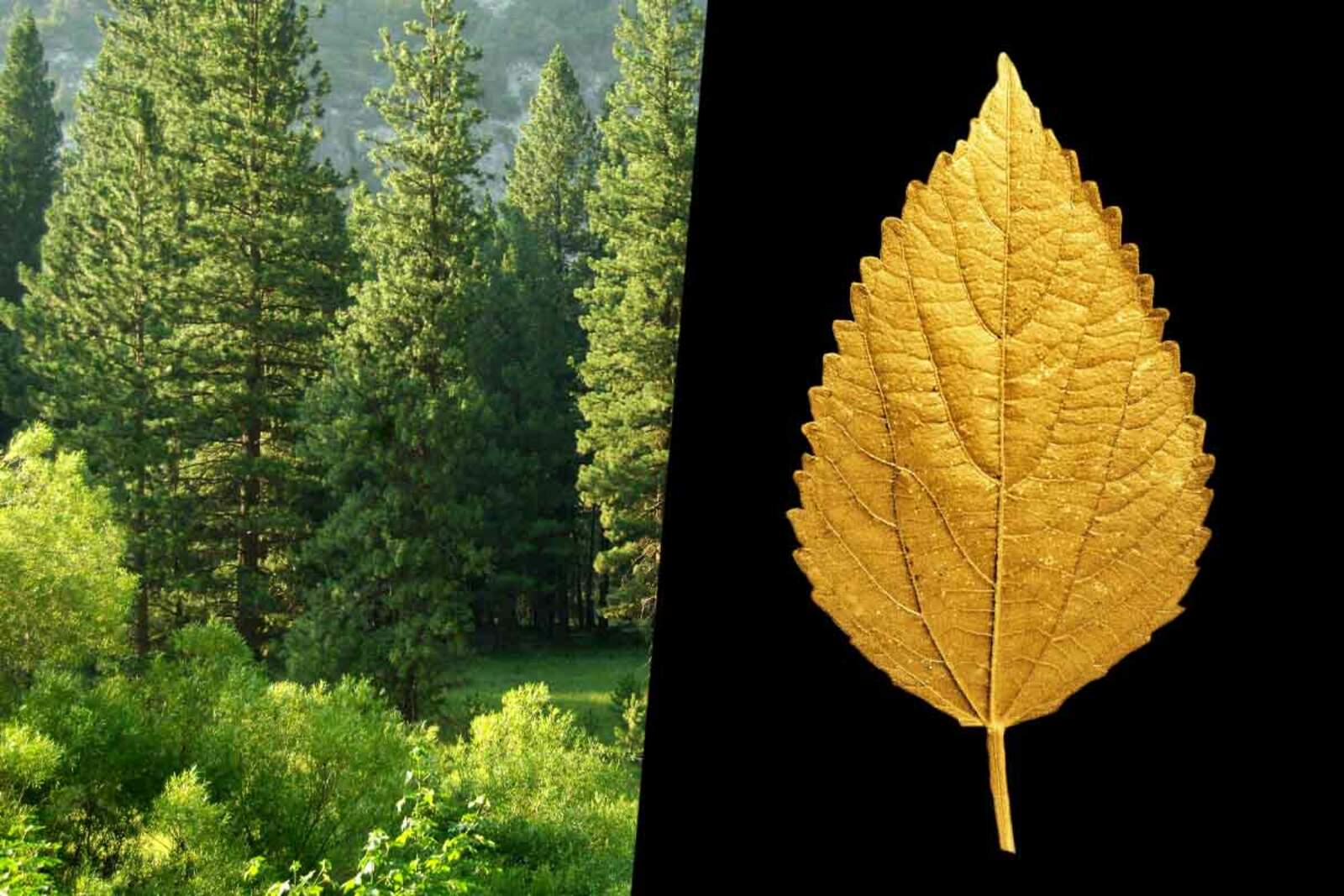
A team of scientists from northern Europe made a surprising discovery: certain trees can contain gold nanoparticles in their leaves and branches. It is not magic or alchemy, but a natural biological process driven by bacteria.
The study, published in Environmental Microbiome, suggests that this biomineralization could open new ways to exploit minerals.
Ciertos árboles pueden contener nanopartículas de oro en sus hojas y ramas
How trees generate gold
The secret lies in endophytic bacteria that live inside the tree, mainly in roots and leaves. These bacteria convert the gold dissolved in the soil water into solid particles, which are then trapped in the plant tissues.
The process allows trees to neutralize the toxicity of gold while accumulating it in small amounts, detectable only with high-resolution microscopes. The concentrations range from 0.2 to 2.8 micrograms per kilogram (0.2 to 2.8 micrograms per 2.2 pounds) of dry leaves, amounts that are economically insignificant but valuable for science.
Trees as subsurface sensors
The researchers emphasize that this technique could be used to detect mineral deposits without excavation. By analyzing leaves or pollen, it would be possible to identify the presence of metals beneath the surface in an environmentally friendly way.
El secreto está en bacterias endófitas que viven dentro del árbol
In addition, similar experiments with mosses and other plants show that nature can act as a detector and filter at the same time.
The discovery was made near an ancient gold deposit by scientists from the University of Oulu and the Geological Institute of Finland. The microbe-plant interaction demonstrates that biological processes have influenced the planet's chemistry for millions of years.