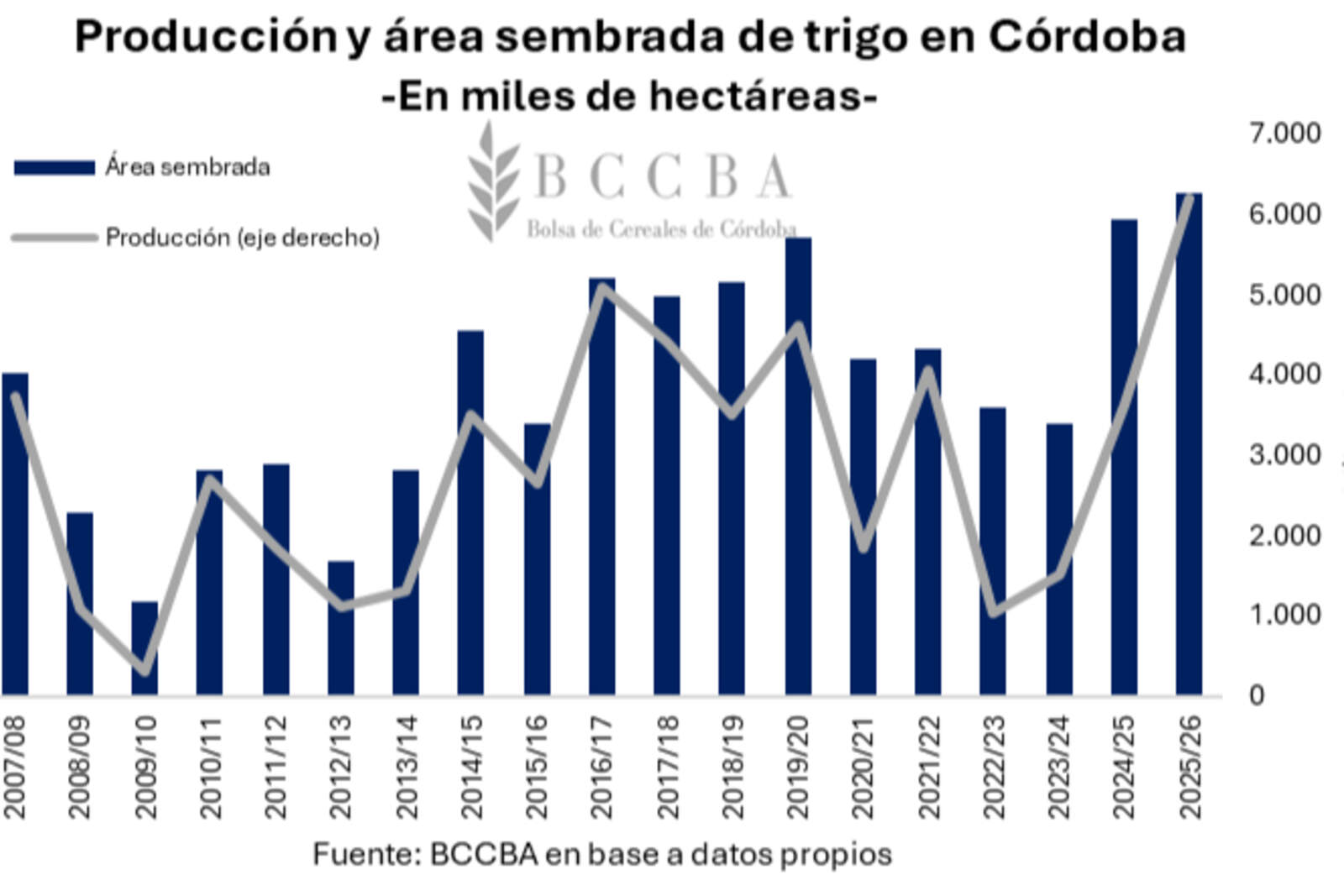
Meanwhile, at the national level, a (also historic) production is expected to be around 24.7 and 25.5 million tons, while the province would reach 6.2 million tons with a yield of 37.4 quintals per hectare (qq/ha).
In a context of relatively low international prices, the Gross Production Value (GPV) of Córdoba's grain would be at the highest recorded levels with USD 1.32 billion, driven by an investment of approximately USD 500 million by producers, according to a report from the Córdoba Grain Exchange.
Record wheat season in Argentina
During the last four seasons, national wheat production has shown sustained growth.
Córdoba espera una gran campaña de trigo.
For the current 25/26 cycle, this trend would continue, with a projected record output of 24.7 million tons, 33% above what was obtained in the previous season and 9 million tons above the average, according to data provided by the National Secretariat of Agriculture, Livestock, and Fisheries.
Other estimates, such as that of the Buenos Aires Grain Exchange, are more optimistic and estimate a harvest of 25.5 million tons.
Regarding harvest activities, they are developing around average levels; by the first days of December, 47% of the harvest would already have been threshed.
Córdoba espera una gran campaña de trigo.
The current unprecedented harvest would be achieved in a context of lower international prices, with a world production that would be a record (829 million tons), accompanied by a stock-to-use ratio that would be above average.
The aforementioned would result in a high supply of global grain according to data provided by the United States Department of Agriculture (USDA).
Wheat export price
In terms of quotations, this abundance of wheat would be reflected in the different markets.
Locally, the export price for December 2025 is estimated at USD 177 per ton, USD 15 below December 2024, continuing the downward trend of recent cycles and standing as the lowest harvest price in the last 5 years.
Meanwhile, for international prices (FOB), Argentina has the lowest quotation compared to the United States and France, trading at USD 208/ton at the end of November.
This position places Argentine wheat in a more competitive position, allowing it to offset the high freight cost required to place local production in different destinations and the differences in quality compared to other competitors.
Estimated Argentine wheat exports for 2026 would stand at 15.5 milliontons, the highest volume recorded.
This would be reflected in a foreign currency inflow of USD 3.1 billion, standing USD 1 billion above the annual average, yet it would not reach historic income levels given the lower quotations in the different markets.
Wheat outlook in Córdoba
In the province of Córdoba, the result of the new wheat cycle would follow the national trend.
According to estimates from the Agronomic Information Department of the Córdoba Grain Exchange (DIA), an excellent season is expected that would make it the best in history for the grain since records began at the institution.
In this regard, production would stand at 6.2 million tons, 133% above the average, with around 1.8 million hectares sown and an unprecedented yield of 37.4 qq/ha.
These results could be achieved due to the general condition of the grain in the province, which ranges from excellent to very good.
Wheat: gross production value and producers' gross income
Considering the quotation and expected volume, the gross production value (GPV) for the 2025/26 season of the grain can be estimated.
This indicator expresses the total income caused by the actors in the chain, including export duties.
The GPV can be taken as an aggregate billing measure of the volume produced, regardless of its sales destination (domestic or foreign market), and constitutes a tool to assess the economic impact of agriculture on the local economy.
In this context, the estimated GPV of wheat in Córdoba for this season would reach USD 1.32 billion, achieving the highest result recorded, 60% above the previous season and USD 660 million above the average.
It is also possible to calculate the producers' gross income (PGI), which represents the portion of total income retained by those agents who participated in the grain activity, and is obtained by multiplying the volume produced by the available market price at the time of harvest.
For the aforementioned season, the PGI in the province would stand at USD 1.08 billion, 55% above the previous season, being the highest in the recorded historical series and, in this way, the aggregate harvest would more than offset the low prices.
Meanwhile, the investment made by Córdoba's producers would be around USD 500 million.