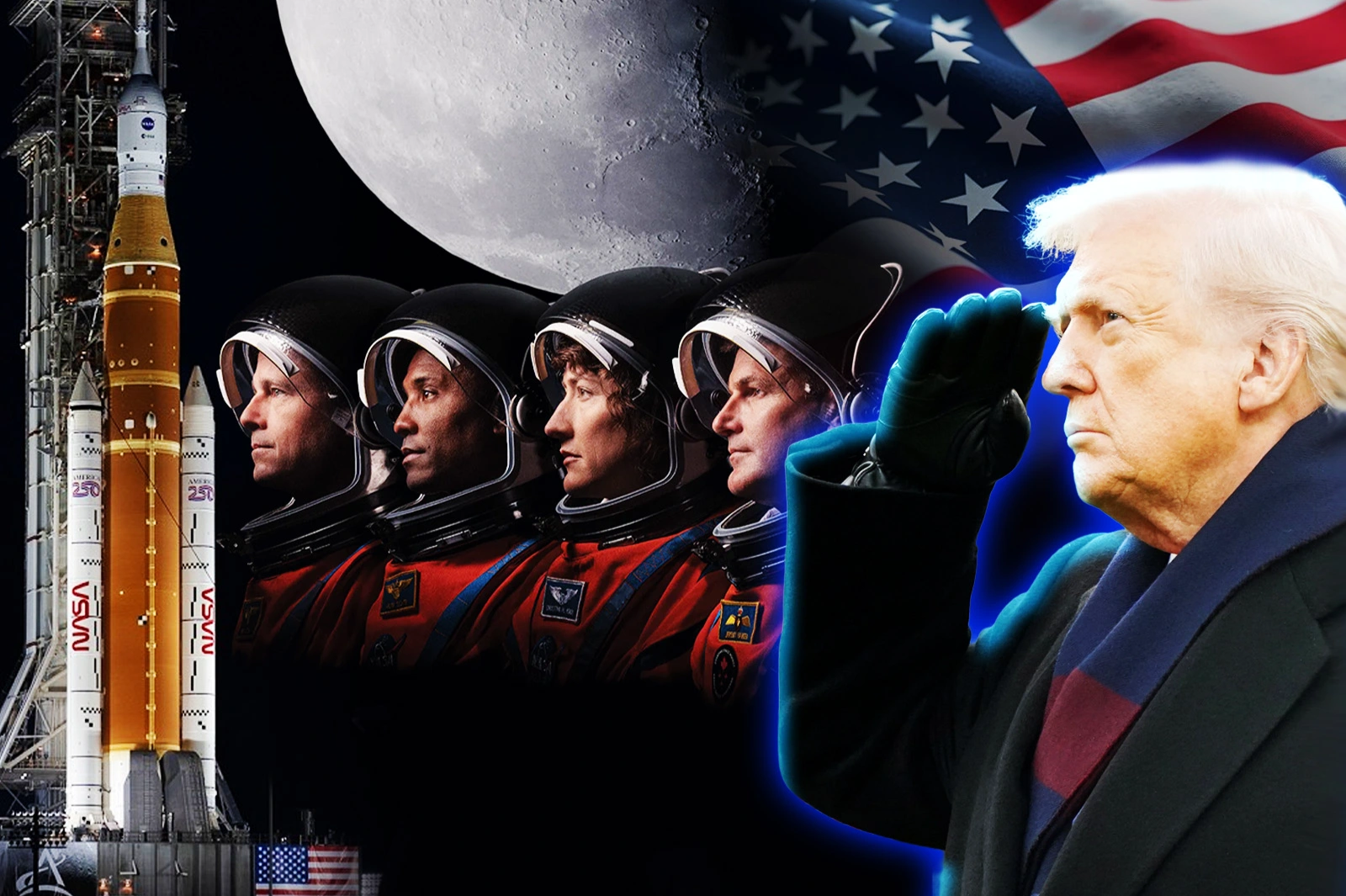
The president referred to the launch of Artemis II as a historic milestone and highlighted the country's leadership worldwide.
Compartir:
A few hours after the launch, the President of the United States, Donald Trump, celebrated the Artemis II mission and highlighted the country's return to lunar exploration manned after more than five decades, in a message where she linked the achievement to US global leadership
.
Through his account on Truth Social, Trump highlighted the historic nature of the event and the technological advance that the mission represents. “Tonight at 6:24 p.m. EST, for the first time in more than 50 years, the United States returns to the Moon!” , he said.
Along these lines, the president highlighted the rocket's capacity and the scope of the mission: “Artemis II, one of the most powerful rockets ever built, will launch our courageous astronauts farther into deep space than any human being has ever reached.”
President Donald Trump.
The message also included a strong political and strategic definition of the position of the United States on the international stage. “We are WINNING, in space, on Earth and everywhere: economically, militarily and now, BEYOND THE STARS,” he said.
In another stretch, Trump reinforced his vision of superiority over other countries: “No one comes close to us! The United States isn't just competing, it DOMINATES, and the whole world is watching.”
Finally, he closed with a message of institutional and patriotic support: “May God bless our incredible astronauts, may God bless NASA and may God bless the greatest nation that ever existed, the United States of America!”
. President Donald Trump's message. The launch of Artemis II marks a turning point in space exploration, as it is the first manned mission heading into lunar orbit since the Apollo program.
The operation is part of NASA's plan to resume human presence on the Moon and advance more far-reaching objectives
.
The mission does not contemplate a moon landing, but rather a flight around the natural satellite with the objective of testing key systems such as navigation, communications and life support in real deep space conditions. It is estimated that the trip will last approximately ten days.
The operation is being carried out from the Kennedy Space Center, in Florida, using the Space Launch System (SLS) rocket and the Orion spacecraft, two of the most advanced developments in aerospace technology.
In this context, the return of the United States to lunar orbit represents not only a scientific breakthrough, but also a sign of strategic positioning in an international scenario where space competition is once again taking center stage.