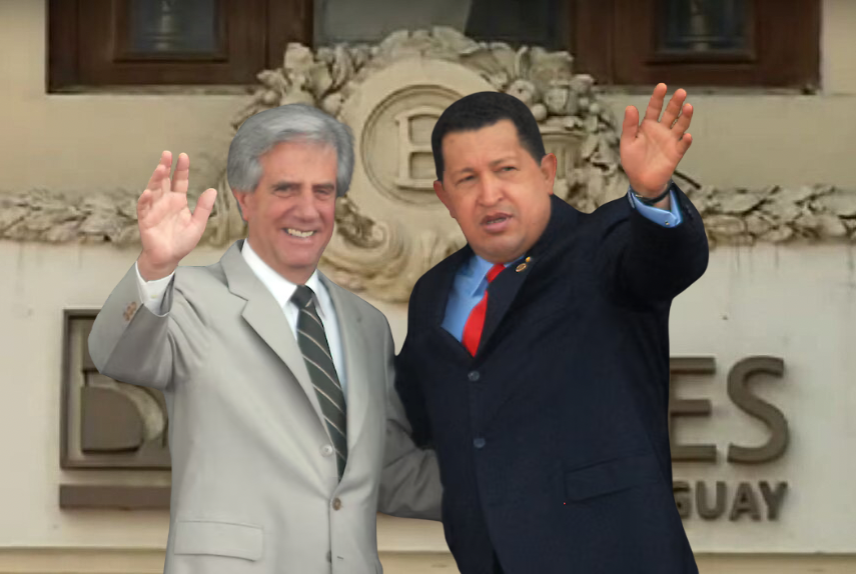

What began as a “development bank” created in 2005 during the first Tabaré Vázquez administration to seal the “brotherhood” with Hugo Chávez ended up becoming one of the most efficient cogs in the sanctions evasion machine of the Caracas-Tehran axis. Banco Bandes Uruguay S.A., a direct subsidiary of the Bank for Economic and Social Development of Venezuela (BANDES), was not just a channel for extracting foreign currency from the Caribbean country in the midst of a crisis: it formed an essential part of the opaque financial architecture that allowed Nicolás Maduro to divert nearly 7.8 billion dollars to Iran
between 2006 and 2024.Documents from the United States Attorney's Office and intelligence agencies, revealed by ABC and El Nacional in December 2025, are conclusive: Venezuela became a “covert financial and logistics platform” for Tehran. Diverted Chinese funds, FONDEN, the China-Venezuela Joint Fund and correspondent banks in third countries, including Uruguay, were the instruments. The route was clear: money came out of PDVSA or BANDES, passed through Bandes Uruguay or hubs like Panama, Dubai and Hong Kong, was “cleaned up” with fictitious “bilateral cooperation” contracts and ended up in Iranian companies or the Islamic Revolutionary Guard (IRGC). There is talk of 4,689 million in “joint projects” and 3,132 million in indirect transfers. While Iran evaded sanctions and armed drones and missiles, Venezuela was plunging into misery. And Bandes Uruguay was the most comfortable and discreet exit door
.The bank was founded in 2005 under Vázquez I, it operated unimpeded under Mujica (2010-2015) —even in 2013, 150 of its officials were absorbed into the official Uruguayan bank by law signed by Pepe himself—and when tough sanctions arrived in March 2019 during the second administration of Vázquez (OFAC marked it by the attempt to move more than US$ 1 billion from Caracas to Montevideo), no one touched it. The BCU monitored, customers experienced temporary lockdowns, but the license remained
in effect.And here comes the most unworthy thing: the government of Luis Lacalle Pou (2020-2025), which presented itself as the “democratic alternative” to left-wing populism, had five years to close that shame, to revoke the license, to intervene in the background, to send a clear message that Uruguay would no longer be the backyard of Chavism. He didn't. The Central Bank of Uruguay, under its administration, detected and documented serious irregularities in the prevention of money laundering and terrorist financing. Inspections from 2023 and 2024 revealed serious weaknesses in corporate governance, risk management and anti-money laundering controls. The BCU knew, the Ministry of Economy knew, Lacalle Pou knew. And they did absolutely nothing structural. The bank continued to receive Venezuelan capitalizations, it continued to lose millions (almost US$ 5 million in the first eight months of 2025, more than US$ 9 million in the year), it continued to operate in our financial center. That is not an omission: that is complicity by deliberate action of not acting. A government that boasted of “order and transparency” allowed an entity sanctioned by the United States for being a vehicle for evading sanctions and triangulation towards Iran to continue operating under its mandate. There's no excuse. It was a political decision: not to generate diplomatic noise with Maduro, not to confront the financial system they inherited, not to assume the cost of closing what the Broad Front had created. Passive accomplices, but accomplices