Uruguay takes pride in its "strong institutions." It is the mantra that is repeated in every official speech and in much of the journalism that relies on it. But institutions are not measured by the number of codes, declarations, or organizational charts. They are measured by the real incentives faced by those who hold power and those who try to oversee it. In that regard, the farce is evident.
Hans-Hermann Hoppe explained it clearly: democracy is not the government of the people, but the government of the coalitions that manage to capture the state apparatus. In that system, the time horizon shortens, the preference for the present prevails, and institutions become instruments of soft control. There is no need to prohibit. It is enough to raise the cost of bothering. The journalist who insists too much discovers that the atmosphere becomes tense: relationships cool, "restructurings" appear, or they become uncomfortable for the media owners, who depend on advertising, access, or simple good relations with the current power.
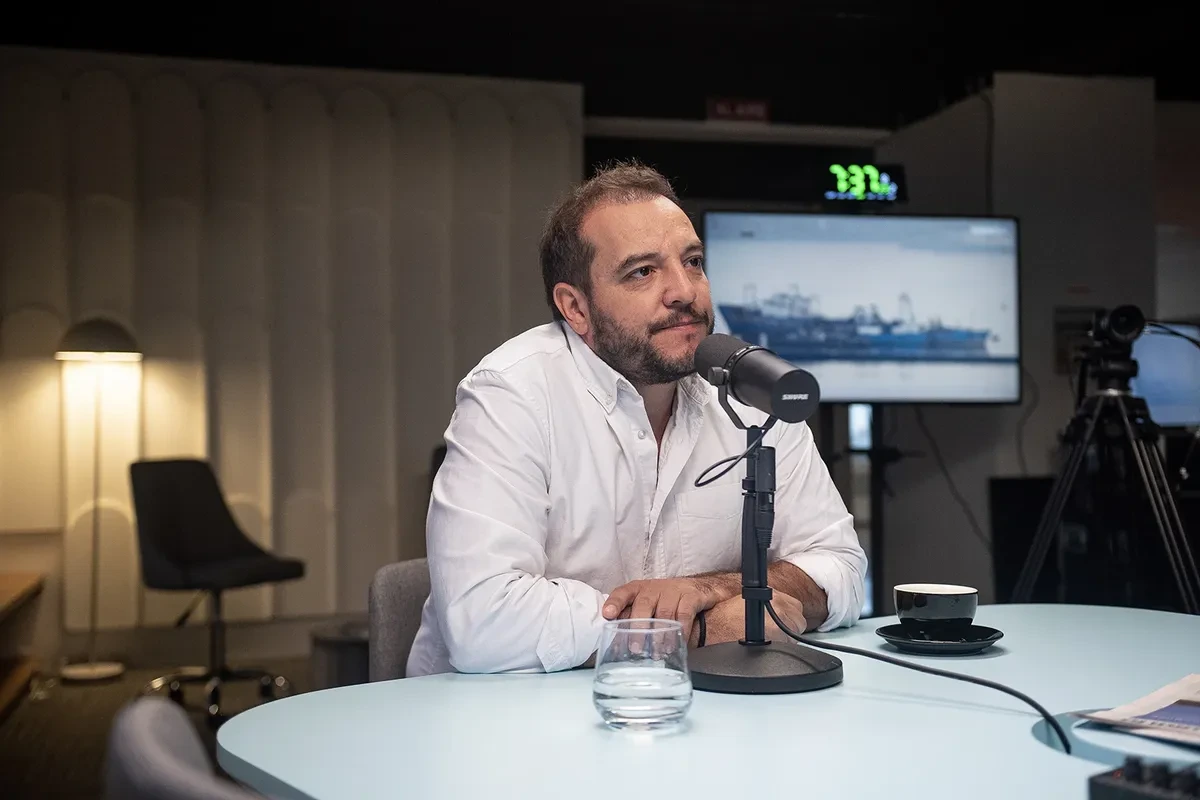
The recent clash between Leo Sarro and Minister of Economy Gabriel Oddone is a clear example. In a press conference, Sarro asked about the situation of those earning 25,000 pesos and having difficulties making ends meet. The journalist insisted and compared the current economic model with that of the previous administration. The minister's response was not a technical argument: it was a direct accusation. "What you just did is in bad faith," Oddone told him, demanding that he come closer to reaffirm it. A minister who feels legitimately questioned responds with data. A minister who feels uncomfortable responds by disqualifying the journalist. That is the symptom.
Leo Sarro is not an isolated case. He was dismissed from Radio Monte Carlo and Radio Cero in 2024 after 16 years. The official reason was a "restructuring." He himself has said that he has no proof of political motivations, but the pattern repeats: the journalist who becomes predictable in their discomfort ends up outside formal structures and takes refuge in social media, where today more real journalism is practiced than in many traditional newsrooms.
Ignacio Álvarez has followed a similar path of exits and tensions throughout his career. He has denounced attempts at censorship at different times, and his investigative style has generated concrete impacts, such as the resignation of officials after reports that exposed irregularities. His trajectory shows that the confrontational journalist ends up paying a cost in job stability within established media.
Nicolás González Keusseian recently announced his departure from Radio Carve through social media, described as a surprising resignation of a key journalist from the news program. Public details are limited, and he has not provided further explanations in the available messages. What is clear is the broader pattern: those who set the agenda with uncomfortable questions or investigations often experience greater job mobility or exits from high-exposure spaces.
This is not exclusive to one government. It is structural. In a mass democracy, power does not need to censor openly. It prefers cultural and economic capture. Private media are not islands of purity: they operate in an environment of relative dependence on the state. Official advertising, regulations, access to sources, or the simple calculation of not confronting too much with those who can facilitate or hinder business life. Hoppe would say this is predictable: when the state concentrates resources and legitimacy, "intermediate institutions" tend to align or be neutralized.
The institutional farce is also seen in the ritual reaction. Every time someone points out the pattern, the chorus appears that speaks of an "attack on democracy." As if democracy consisted of protecting journalists only when they annoy the right side. The true test of healthy institutionalism is not the existence of press associations that defend their own. It is the existence of real costs for those who try to disqualify or displace those who ask uncomfortable questions. In Uruguay, those costs remain low.
The result is increasingly cautious journalism in traditional spaces and more free —and precarious— in social media. As long as the cost of discomfort remains higher than the benefit of silence, institutionalism will continue to be, essentially, an elegant farce. And the journalists who expose it will continue to discover, time and again, that the system has very civilized ways of rearranging them.