The Southern Energy consortium, led by YPF, will export 2 million tons of LNG annually from Vaca Muerta to Europe for 8 years, in a key agreement to supply Germany's energy deficit.
In a global context marked by energy tensions and the urgent need for diversification of supply sources in Europe, Argentina, under the administration of Javier Milei is beginning to consolidate himself as a central player in the international gas market. The signing of the largest liquefied natural gas (LNG) export contract in the country's history marks a turning point in Argentina's energy integration in the world. The Southern Energy consortium, led by YPF and comprised of Pan American Energy (PAE), Pampa Energía, Harbour Energy and Golar LNG, signed an agreement in Berlin with the German company SEFE (Securing Energy for Europe) to export 2 million tons of LNG annually for eight years. The contract, which will begin to be executed towards the end of 2027, could generate revenues of more than USD 7 billion, depending on the evolution of international prices
.
The supply will come from the Vaca Muerta formation and will be processed through the “Hilli Episeyo” liquefaction vessel, which will be installed in the Golfo San Matías, in the province of Rio Negro. This unit will have a production capacity of 2.45 million tons per year, of which more than 80% are already committed to this agreement. In addition, the agreed volume represents more than 30% of the total projected capacity of the two liquefaction vessels that make up the development (6 million tons per year). The definitive contract continues the “Heads of Agreement” announced in December, which marked the beginning of negotiations for the sale of Argentine LNG to the European market, evidencing a rapid evolution towards a fully consolidated “Sales and Purchase Agreement” (SPA) in just over
three months. The president, Javier Milei.
Southern Energy highlighted that “the revenues derived from this contract will make it possible to monetize Vaca Muerta's vast gas resources and generate a genuine source of foreign exchange in the country's external account”, a key aspect for macroeconomic stability
driven by current management.
The president of Southern Energy, Rodolfo Freyre, stressed that “the contract with SEFE is relevant for two central reasons: on the one hand, it confirms Argentina's position as a new international and strategic supplier of LNG for the diversification of global supply sources; on the other hand, it constitutes a key contribution to strengthening energy security in Europe”.
For his part, the Chief Commercial Officer of SEFE, Frédéric Barnaud, highlighted the speed of the agreement: “Thanks to our shared determination and approach, we managed to move from a HoA to a fully consolidated SPA in just over three months. This rapid progress shows that SESA is the right partner to expand our portfolio in South America and, in this way, strengthen Europe's energy security.” Along the same lines, he added: “With deliveries starting as early as 2027, we will not only be the first German energy company to receive shipments from Argentina, but also the country's first long-term global LNG customer
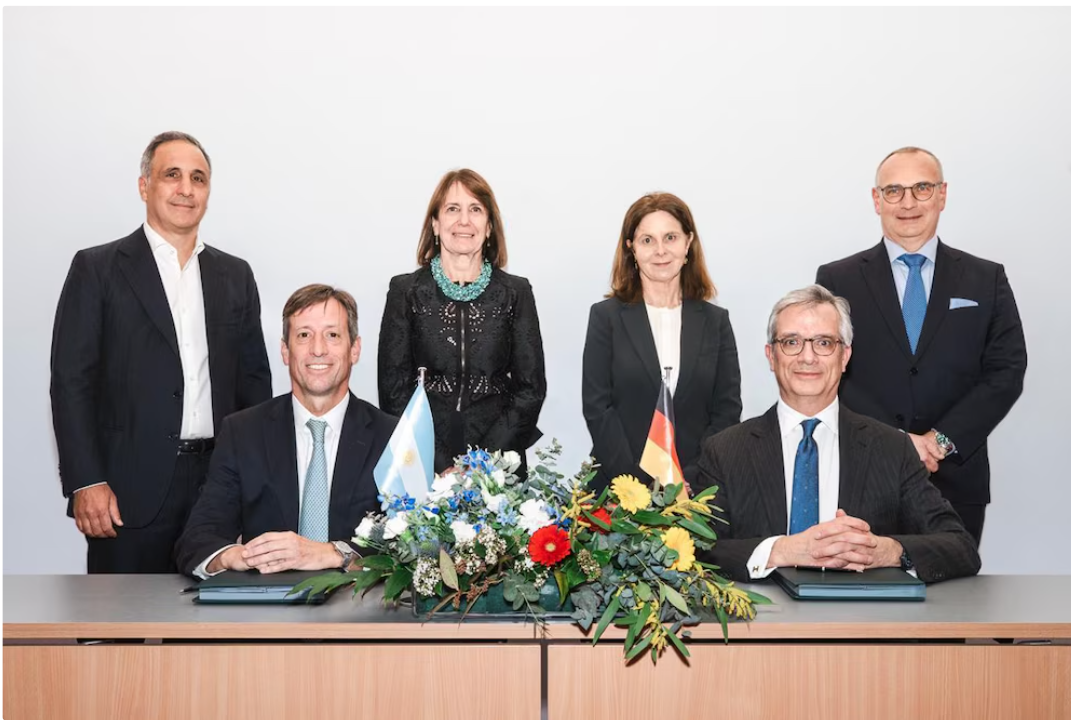
.” Marcos Bulgheroni, Rodolfo Freyre, Betina Pasquale de Fonseca, Doris Honold, Frédéric Barnaud and Dr. Egbert Laege The signing ceremony was attended by senior executives from both parties, including Rodolfo Freyre (President of SESA), Frédéric Barnaud (CCO ofSEFE), Marcos Bulgheroni (Group CEO of PAE), Martin Rueda (General Director of Harbour Energy Argentina and Chief Executive ofSESA), Patricio Da Ré (Project Integration Director of YPF and Chief Executive of SESA),
Karl Staubo(CEO of Golar LNG), Federico Petersen (CCO of Golar LNG and Chief Executive of SESA) and Matías Lacabanne (CCO of SESA). Also present was the Argentine ambassador to the Federal Republic of Germany, Betina Pasquale de
Fonseca.
On behalf of SEFE, its CEO, Dr. Egbert Laege; Doris Honold, member of the Supervisory Board; Jean-Manuel Conil-Lacoste, Executive Vice President ofLNG; and Sharif Islam, Vice President of LNG Origination - Atlantic, participated.
The project, led by PAE, envisages an investment of more than USD 15 billion over 20 years, consolidating a long-term strategy aimed at positioning Argentina as a global supplier of LNG in an increasingly competitive and geopolitically complex international scenario.
As part of the necessary infrastructure, a 480-kilometer gas pipeline is planned to transport gas to the port of San Antonio Oeste. In this context, the recent tender for the pipes generated tensions between the Government and the Techint group, after Southern Energy awarded the provision to the Indian company Welspun, leaving Tenaris out.
This agreement not only represents a quantitative leap in exports, but also a strong sign of the economic direction adopted by the government of Javier Milei: openness to the world, attraction of investments and efficient use ofstrategic resources to generate growth and genuine currencies.