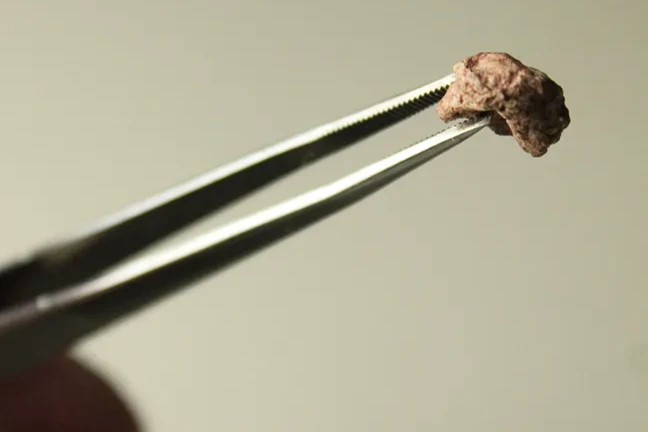

A fossilized skull measuring just 9.5 millimeters allowed for the identification of an unknown species that inhabited what is now Brazil approximately 240 million years ago. The animal, named Sauropia macrorhinus, belonged to an ancient group of reptiles and is the smallest tetrapod recorded so far in Middle Triassic deposits in South America.
The study was published on January 28, 2026, in the scientific journal Scientific Reports and was led by Rodrigo Temp Müller, a researcher at the Federal University of Santa Maria (UFSM). The discovery provides information about tiny animals that shared prehistoric ecosystems with much larger species.
Where the skull of less than one centimeter was found
The specimen was discovered at the Cortado site, located in the municipality of Novo Cabrais, in the Brazilian state of Rio Grande do Sul. It was located by paleontologist Lúcio Roberto da Silva during a field trip conducted with Pedro Lucas Porcela Aurélio.

The rock preserved an almost complete skull, with the jaw still associated. Its size forced specialists to carry out an extremely delicate preparation: they used fine needles and magnifying glasses to remove the adhered material without damaging the bones.
Subsequently, Leonardo Kerber examined the fossil using computed microtomography. The images allowed for the study of structures that are impossible to distinguish with the naked eye and complemented the digital reconstruction of its anatomy.
What Sauropia macrorhinus was like and what it fed on
Scientists estimate that the animal may have measured around five centimeters in length. Its appearance would have resembled that of a small lizard, although it was not a species of modern lizard, but a parareptile from the group of procolophonids.
Among its characteristics stand out proportionally large nasal openings, the broad shape of the skull, and a particular dentition, with circular-sectioned anterior teeth.
Due to these characteristics, researchers consider it likely that it consumed insects or other small invertebrates. No food remains were found to confirm an exact diet.