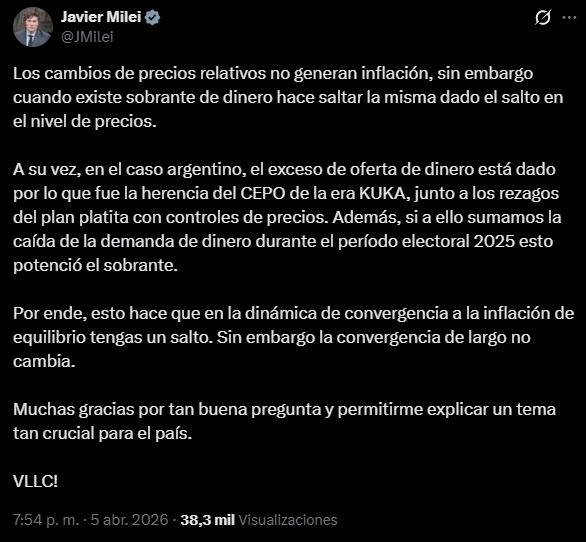
He explained that the monetary surplus in Argentina is a direct consequence of the exchange rate applied during the Kirchner governments, added to the lagging effects of policies such as the “silver plan” and price controls.The president explained a fundamental issue for Argentines.
Added to this, he indicated, was a drop in demand for money during the electoral process of 2025, which amplified the imbalance. In this context, the adjustment of relative prices may generate occasional jumps in inflation, but it does not alter its long-term trend
President Javier Milei went out to answer one of the most pressing questions in the current economic debate on social networks: whether the adjustment of tariffs can generate inflation. Far from avoiding the issue, the president explained precisely why, from his approach, it is a conceptual error
.
It all started with a query from a user in X, who asked if the increase in rates has a direct impact on inflation. Milei took the opportunity to develop a broader explanation of the functioning of the price system and the true origin of the inflationary phenomenon
. A Twitter user's query reached the president.
As he explained, changes in relative prices—as with tariffs—do not generate inflation by themselves. The President argued that the problem appears only when there is an excess of money in the economy, since that excess is the one that puts pressure on the general price level
.
In that sense, he linked the current situation with the economic inheritance received.
.
These movements are part of the process of convergence towards equilibrium inflation. In other words, they can generate transitory variations, but they do not change the general course if there is no monetary issue to
sustain them. Javier Milei with his Minister of Economy, Luis “Toto” Caputo.
This explanation aligns with what Milei has been consistently stating since the beginning of her administration. A few days ago, the President had already harshly questioned economists who argue that inflation can be functional to growth, describing these ideas as “nonsense” both theoretically and empirically
.
Along these lines, he also emphasized that inflation is, in essence, a strictly monetary phenomenon. For this reason, the axis of its economic program is to eliminate broadcasting as a mechanism for financing public spending, thus attacking the root of the problem