One of the most important points of the study is the electoral projection. Faced with the question “if the presidential elections of 2027 were held today, would you vote for the re-election of Milei, or against the re-election of Milei?
More than a year before the next presidential elections, a recent national survey shows an encouraging scenario for President Javier Milei, in the face of a possible second term in 2027.
The survey, carried out by the consultancy firm Isasi/Burdman between March 20 and 26 on a total of 2,190 cases across the country, reflects a favorable trend for the libertarian government.
The data indicate that Milei maintains solid levels both in image and management approval, which strengthens its position for the electoral future.
President Javier Milei.
In terms of public perception, the president achieves a positive image of 46%, above his negative image. Along the same lines, 47% of respondents approve of its management, while 43% disapprove of it
”, 46% of those consulted answered that they would favor re-election, while 39% said they were against it, a difference of seven points.
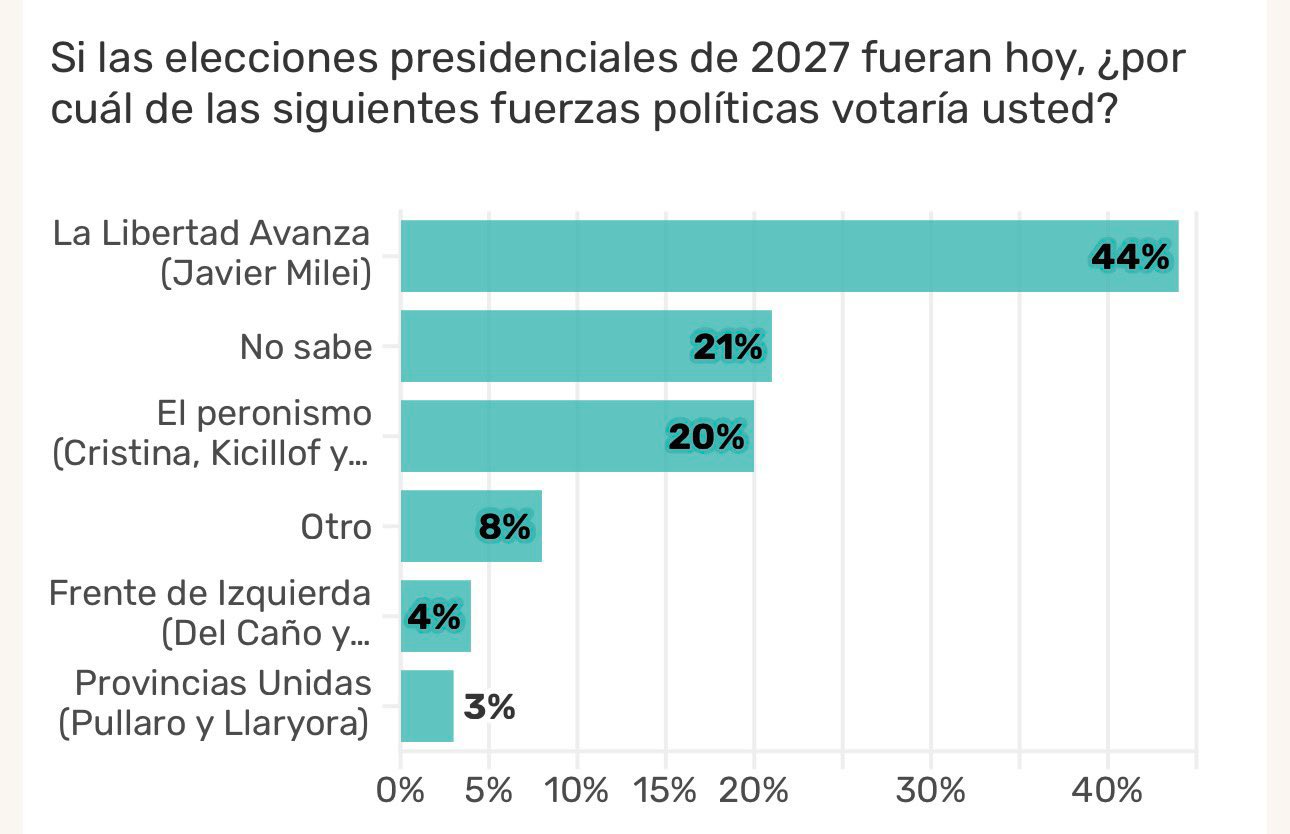
In addition, the survey delves into the intention to vote for political spaces. Faced with the consultation “if the presidential elections of 2027 were held today, which of the following political forces would you vote for? ”, La Libertad Avanza de Milei is clearly in the lead with a 44% intention to vote
. The survey. Peronism is far behind, with 20% even considering important figures such as Axel Kicillof, Cristina Fernández de Kirchner and Sergio Massa.
On the other hand, the Left Front accounts for 4%, and United Provinces for 3%.
A central fact is that the second most chosen option, after LLA, is "You don't know “, bringing together 21% and surpassing all the opposition parties.
The study also provides information on the main concerns of citizens. Corruption tops the list with 25%, consolidating itself as the problem most mentioned by Argentines. It is followed by unemployment (21%), inflation (12%), poverty (11%), insecurity (9%), public education (7%), health (2%) and drug trafficking (1%