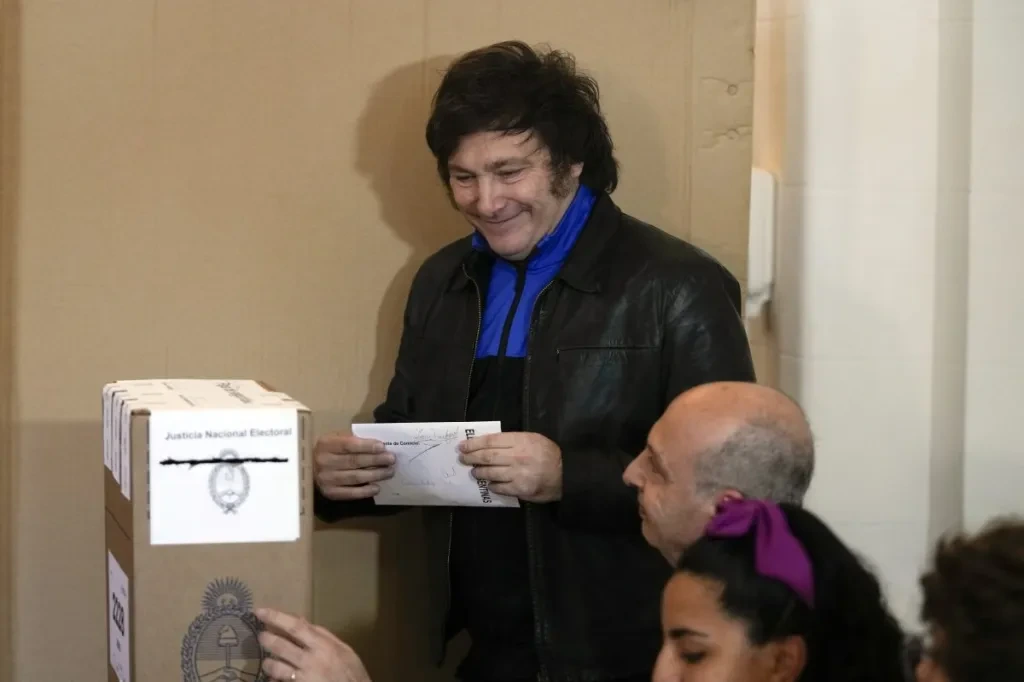
The project promotes an end to public funding of politics, promotes private contributions and seeks to exclude convicted leaders from office, in an offensive by the government of Javier Milei to reduce political spending and end impunity.
In that sense, a PRO legislator with a territorial presence in the province of Buenos Aires warned: “If we go to Buenos Aires together, we will have to resolve it this way or Karina (Milei) will come and want to impose on us the candidate. The truth is that our capillarity is greater than that of LLA and we can do better than them in a STEP to define the candidate.”
Beyond political tensions, the project also contemplates a reform in the design of the Single Paper Ballot (BUP), as well as new requirements for the constitution and funding of political parties. On this last point, the Government aims to eliminate public funding for electoral campaigns, replacing it with voluntary contributions, donations from human or legal persons and membership fees
.
From the official perspective, this measure seeks to end the use of state resources to sustain party structures, promoting a more transparent system based on real support from society. However, criticism suggests that this scheme could create opacity in the origin of the funds and make it difficult for smaller political parties that do not have sufficient funding to participate
.
In the Casa Rosada, they argue that the current context - since it is not an election year - offers a favorable opportunity to discuss substantive reform without suspicion of political speculation. In addition, they highlight that the ruling governments rarely use PASOs to define candidacies for President, which reinforces the argument that they are
unnecessary.
In this way, the Government of Javier Milei seeks to advance a profound reconfiguration of the Argentine electoral system, with the stated objective of reducing political spending, increasing transparency and putting an end to practices that, according to his diagnosis, have contributed to the country's institutional degradation.
In a new step in his structural reform agenda, President Javier Milei announced the sending to the National Congress of an ambitious reform project electoral that seeks to fundamentally modify the functioning of the Argentine political system. The initiative, which will be discussed during this legislative year, includes the elimination of PASOs, changes in the funding scheme of political parties and the implementation of the so-called “Clean Sheet”.
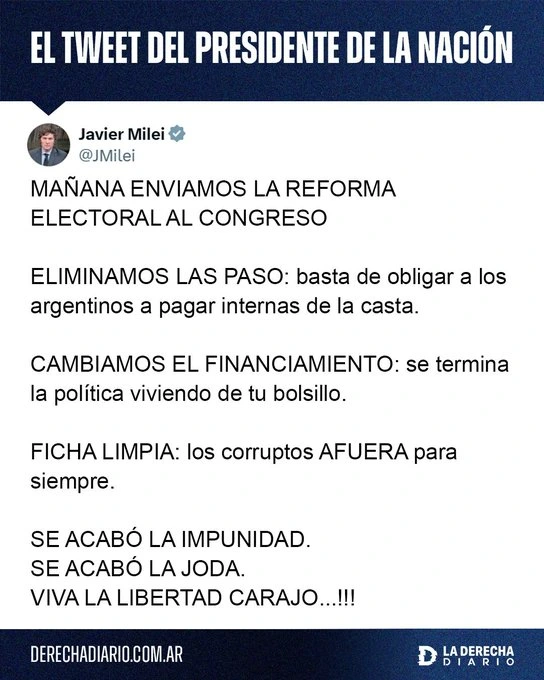
The president made the announcement through his social networks, with a direct and unnuanced message: “TOMORROW WE WILL SEND THE ELECTORAL REFORM TO CONGRESS. WE ELIMINATED THE STEPS: stop forcing Argentines to pay caste inmates. WE CHANGE FUNDING: Politics ends living out of your pocket. CLEAN SHEET: the corrupt OUT for ever”. Along the same lines, he reinforced the tone of his initiative with a slogan that summarizes the spirit of the project: “IMPUNITY IS OVER. THE FUCK IS OVER. LONG LIVE FUCKING FREEDOM...!!!”
. The president, Javier Milei in X
The project will enter through the Chamber of Deputies, where the ruling La Libertad Avanza block has a significant number of its own legislators and allies who could facilitate its initial treatment. However, the scenario becomes more complex in the Senate, where the balance of forces is tighter and the opposition could try to block or modify key points of the reform
.
One of the central axes of the initiative is the definitive elimination of the Open, Simultaneous and Mandatory Primaries (PASO), a mechanism that, according to the ruling party, involves unnecessary spending for the State and obliges citizens to finance internal party members. However, this measure faces resistance not only in the toughest opposition, but also in sectors of the Radical Civic Union and the PRO, who consider the primaries as a useful tool for establishing leadership and alliances.