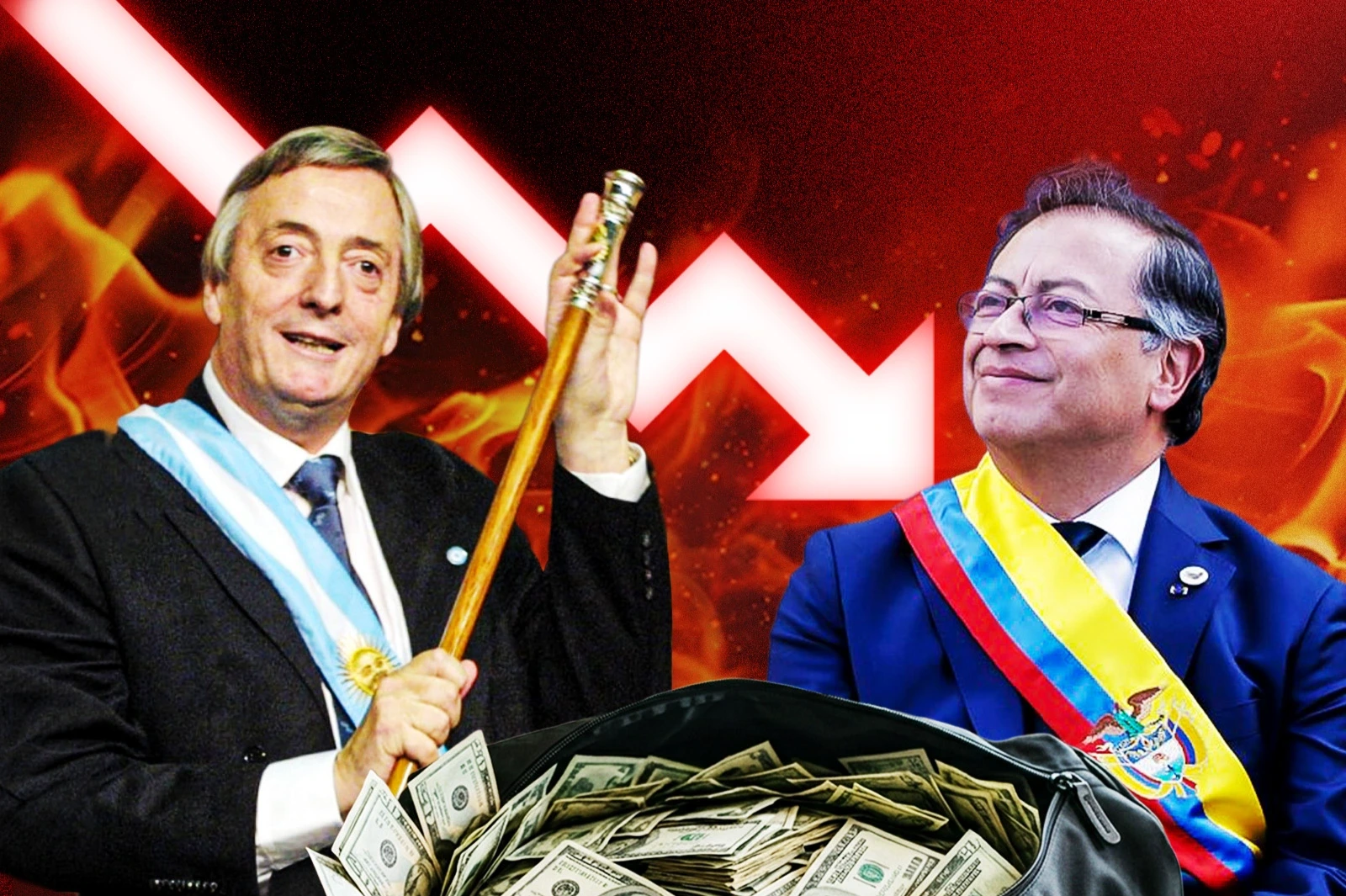
Petro repeats Néstor Kirchner's model: he pays debt with the IMF and replaces it with more expensive debt
Gustavo Petro celebrates the full payment to the IMF like Néstor Kirchner in 2005. They replace cheap debt with very expensive bonds. The same Kirchnerist deception.
Gustavo Petro celebrates the full payment to the IMF like Néstor Kirchner in 2005. They replace cheap debt with very expensive bonds. The same Kirchnerist deception.
The real result is not financial independence, but an increase in the cost of financing that ends up paying the taxpayer
.
The Argentine Background: Story, Expensive Debt and Impairment
In 2005, Néstor Kirchner used Central Bank reserves to cancel the debt with the IMF in one payment. The measure was presented as the end of “dependence” and an act of economic sovereignty.
But behind the story there was another reality: Argentina did not stop getting into debt. Changed creditor.
Bogotá and Buenos Aires are separated by thousands of kilometers, but today they share something much closer: the same economic deception disguised as a political epic. This week, Gustavo Petro celebrated the full payment of his debt to the IMF as if it were a historic milestone. The scene immediately goes back to 2005, when Néstor Kirchner did exactly
the same thing in Argentina.
Twenty years later, the story is repeated. And also its consequences.
The myth of the “liberation” of the IMF
Petro assured that Colombia leaves behind the Fund's “onerous conditions”. In other words: he sold the idea of financial liberation. It is the same discourse that Kirchnerism installed for years in Argentina, building an external enemy to justify
wrong internal decisions.
The problem is that the epic doesn't stand up to economic analysis.
Debt with the IMF is, in relative terms, cheap. This is multilateral financing with low rates — historically between 2% and 3.5% — and reasonable terms. Cancelling it doesn't eliminate debt: it simply replaces it
.
And that's exactly what happened.
Pay cheaply with expensive debt
Both in the Argentine case of 2005 and in Colombia's recent decision, the mechanism is the same: cancel cheap debt to issue new, more expensive debt in the markets
.
In the Colombian case, the Flexible Credit Line taken during the pandemic —for about 5.4 billion dollars— was settled using bond issues at significantly higher rates, around 5.5% to 6.5% or even higher, according to recent investments.
The equation is simple:
Cheap debt → canceled
Expensive
debt → issued
Report of sovereignty → amplified
After closing the door of the IMF —which offered relatively cheap financing—Kirchnerism turned to Venezuela as a source of financing. Between 2005 and 2008, the country issued bonds that were purchased by the government of Hugo Chávez at rates that ranged from 7.4% to 14.8%, well above the
cost of multilateral organizations.
There were even one-off issues with returns of more than 10% per year in dollars, making it one of the most expensive loans since the 2001 default. Colombia repeats the
formula
What is happening today in Colombia follows that same logic. The Petro government replaces cheap financing with more expensive debt, while building a political narrative of sovereignty
.
But the account doesn't disappear: it changes shape.
And in that process, the cost of indebtedness increases, reducing future fiscal margin and transferring the impact to the real economy.
A lesson that the region already knows
The parallelism between Petro and Kirchnerism is no accident. It responds to the same ideological matrix that privileges discourse over economic sustainability
.
Recent history shows that this path does not lead to sovereignty, but to more debt, higher financial cost and less predictability.
Argentina has already paid that price for years. Colombia is beginning to follow a similar path
.
And as is often the case, the narrative remains in the hands of governments. The bill, in the hands of society.