Ignacio Alonso, president of the Uruguayan Football Association, hinted at the possibility that the next qualifying process could adopt a different system and put a title at stake
The path to the 2030 World Cup could present a unique scenario for South American football. For the first time, three of its national teams would have their presence in the World Cup guaranteed without the need to compete in a qualifying tournament. In this context, Ignacio Alonso, president of the Uruguayan Football Association (AUF), announced that the upcoming qualifiers could have a different format, inspired by the European Nations League.
The possibility was raised by the official himself in a conversation with Carve Deportiva, before Uruguay's friendly match against the Dominican Republic. "This is a new era, with a renewal of hope, with a view that we have a qualifying tournament starting in a few months, which will be in a different format, a Nations League format, so we are going for a title," he stated.
His statements generated repercussions because, until now, the South American Football Confederation (CONMEBOL) has not officially communicated how the next qualifying process could unfold. Additionally, details about the competition system, the distribution of teams, the number of World Cup spots, or the possibility of establishing groups and a final stage to determine the champion are still unknown.
Ignacio Alonso announced that the South American qualifiers could adopt the style of the Nations League, with a title at stake
The uniqueness of this edition would be related to the organization of the World Cup. Argentina, Uruguay, and Paraguay will be hosts alongside Spain, Portugal, and Morocco, although most of the tournament will take place on European and African soil. The three South American countries will host opening matches to commemorate the 100th anniversary of the first edition, held in Uruguay in 1930, so their respective teams are already guaranteed qualification.
In light of this situation, the possibility of implementing a parallel competition with a title at stake would be an alternative to maintain the sporting interest of the qualifiers and prevent teams that already have their spot secured from playing matches without competitive objectives.
On the other hand, it is still unknown how many teams will participate in the 2030 World Cup. One possibility would be to maintain the 48-team format implemented in 2026, although there is also consideration of the exceptional alternative to expand it to 64 participants to commemorate the centenary of the World Cup. That decision would also be crucial in determining how many spots South America would have.
How does the Nations League work and what precedents does CONMEBOL have?
The model referenced by Alonso is the one used by UEFA so that its national teams have an official competition during FIFA dates that are not designated for the Euro or World Cup qualifiers. The European tournament features different divisions, establishes promotions and relegations, and has a final phase among the best teams to determine the champion.
Implementing a similar structure in South America would require adaptations, mainly because CONMEBOL has only ten associations, a considerably smaller number than Europe, although that would not be an impediment if we consider the first experience of this kind in the region.
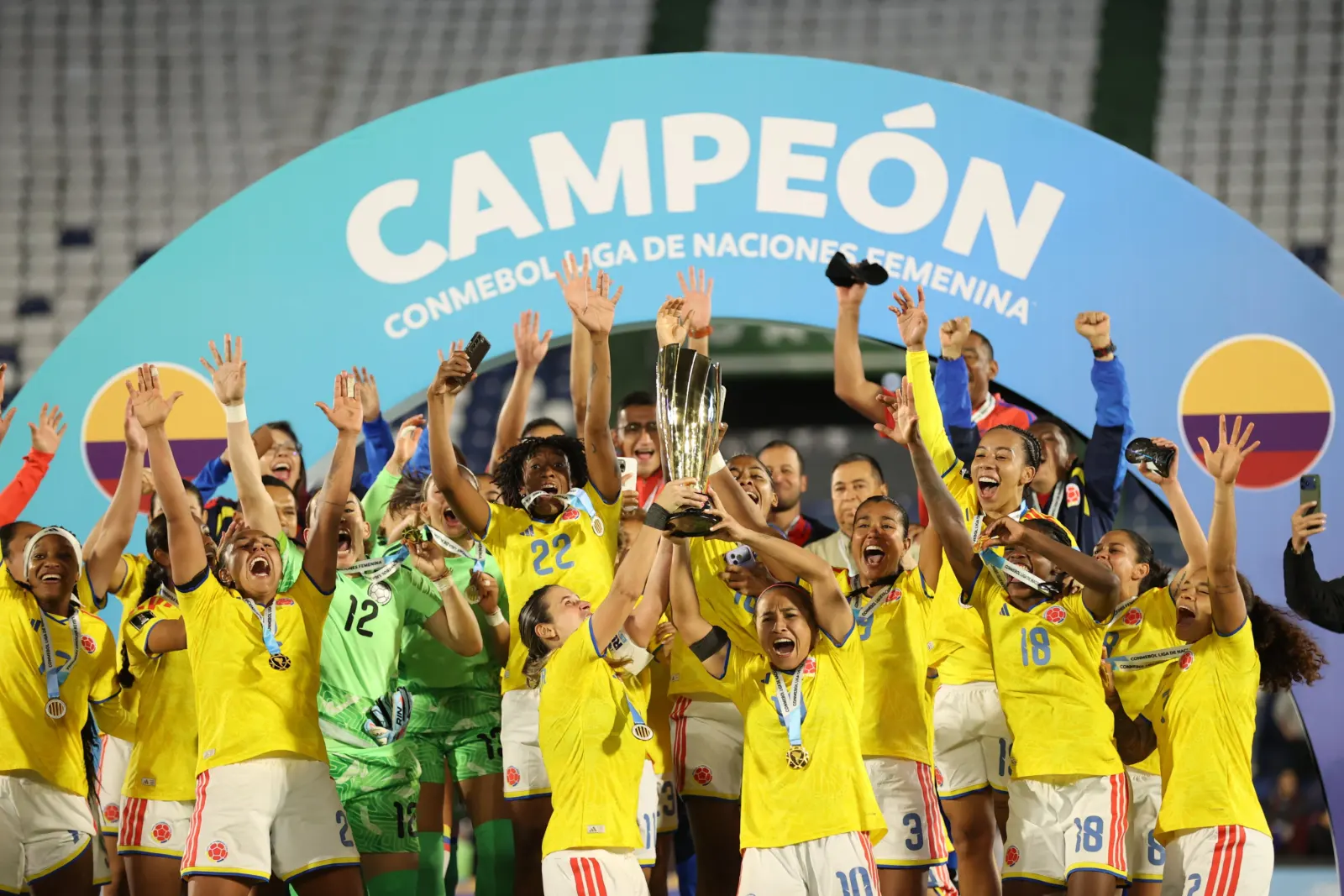
Recently, CONMEBOL organized a Nations League to determine the qualification for the 2027 Women's World Cup
Between October 2025 and June 2026, South American women's football already had its own Nations League as part of the qualifying process for the 2027 World Cup, which will be held in Brazil. In that competition, nine teams participated, as the host team already had its spot secured, with a round-robin system. Colombia finished at the top with 20 points and secured qualification alongside Argentina, which finished second with 18 points, followed by Venezuela (12) and Ecuador (11), who finished third and fourth respectively and obtained the right to compete in the International Playoff.