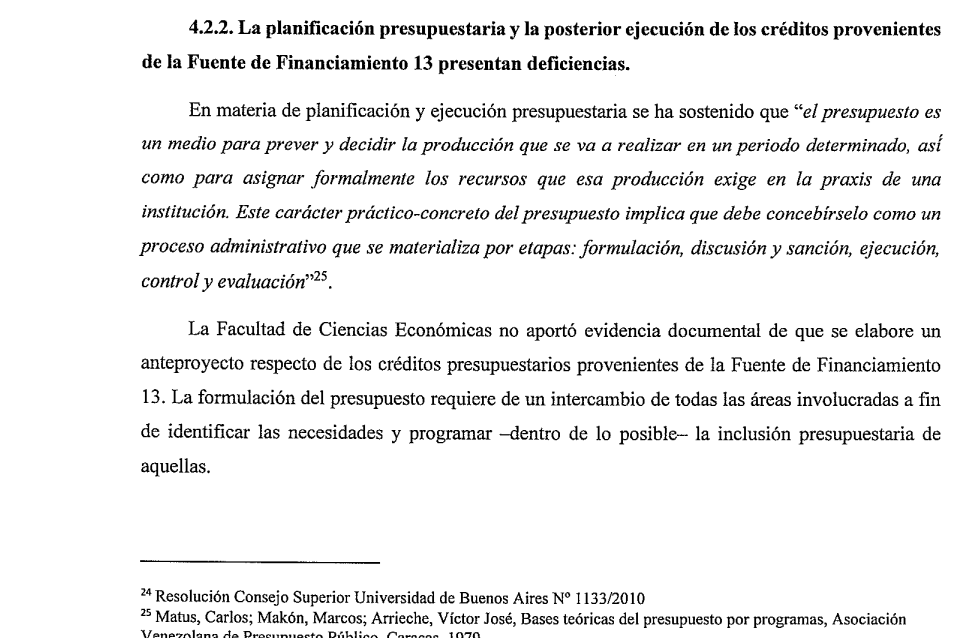

A report by the National Audit Office (AGN) revealed a series of structural deficiencies in the financial, administrative and organizational management of the Faculty of Economic Sciences of the University of Buenos Aires (UBA). The document, corresponding to the 2024 period, exposes problems ranging from lack of strategic planning to serious flaws in the purchasing and contracting processes
.The external control work analyzed in detail the formulation and execution of the budget, as well as the use of funds from the National Treasury and agreements with third parties. Among the main findings, the absence of clear mechanisms to guarantee transparency and efficiency in resource management stands
out.Lack of internal control and poor organizational structure
One of the strongest findings is that the organizational structure of the faculty was not approved through a single and comprehensive administrative act, which generates overlaps, disorder and
lack of clarity in responsibilities.In addition, the audit found that not all officials were formally appointed during the period under review, making it difficult to identify who is responsible for decision-making in key areas. This lack of traceability directly impacts accountability and institutional transparency
.
Non-existent planning and discretionary use of resources
The report also points out that the UBA lacks adequate strategic planning, with the absence of clear methodologies for defining
objectives and evaluating results.In budgetary terms, inconsistencies were evident in the programming and execution of funds, especially those derived from technical assistance agreements. According to the AGN, these resources do not have sufficient documentation or monitoring to verify their correct use
.Irregularities in purchases and contracts
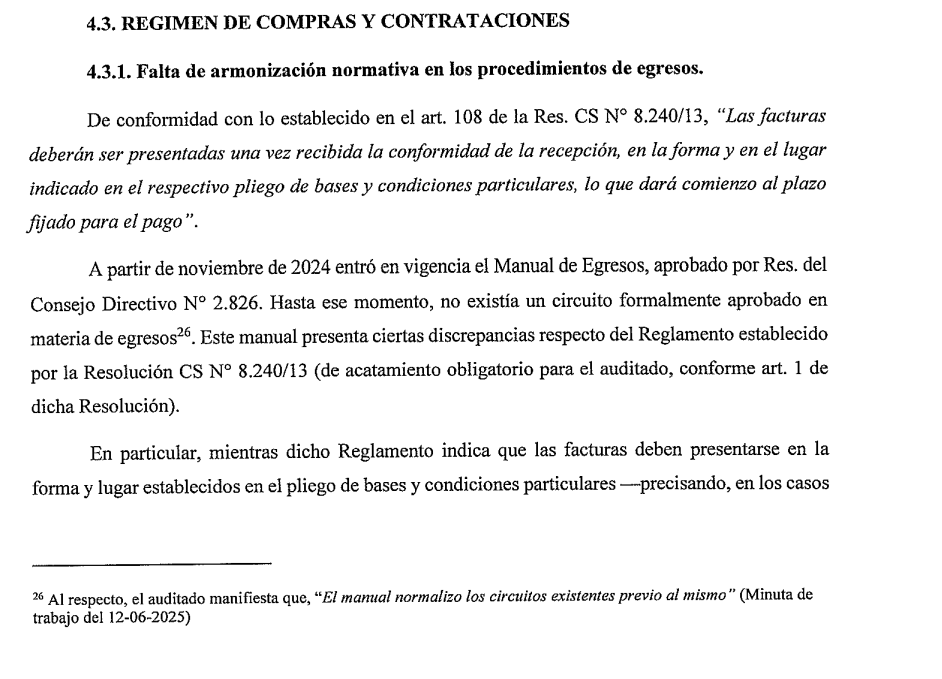
One of the most sensitive points in the report is related to the purchasing regime. The AGN found that the faculty does not have adequate procedure manuals or formal systems that order hiring.
Among the most significant irregularities are:
Lack of complete documentation in contracting files Absence of
information on the exchange rate in foreign currency transactions