This Monday, the Minister of Economy, Luis "Toto" Caputo, reported that Argentine agro-industrial exports reached a historic record during the first seven months of 2026.
The result reflects a strong growth both in the volume of products sent abroad and in the value generated by international sales, thanks to the reforms driven by the Government of Javier Milei.
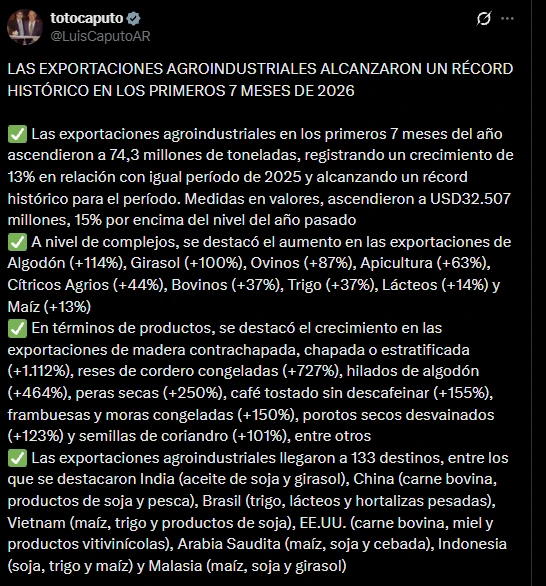
Through a message published on X, Caputo highlighted that between January and July, agro-industrial exports reached 74.3 million tons, representing an increase of 13% compared to the same period in 2025 and constituting a historic record for those first seven months of the year.
Javier Milei and Luis Caputo
The performance was also positive when measured in economic terms. Exports reached USD 32.507 billion, a 15% increase compared to the same period last year.
The growth extended to various productive complexes. Among the main increases were cotton, with a rise of 114%; sunflower, 100%; sheep, 87%; beekeeping, 63%; sour citrus, 44%; cattle and wheat, both with 37%; dairy, 14%; and corn, 13%.
The advance was also observed in specific products, with strong increases in various sectors of the agro-industry. Among them were plywood, veneered or laminated wood, whose exports grew 1,112%; frozen lamb carcasses, with an increase of 727%; and cotton yarns, which advanced 464%.
Significant increases were also recorded in the exports of dried pears, roasted coffee without decaffeination, frozen raspberries and blackberries, shelled dry beans, and coriander seeds, among other products.
The message from Luis Caputo
Export Destinations
The export record was also accompanied by a widespread international presence. According to data released by the Minister of Economy, Argentine agro-industrial exports reached 133 destinations during the first seven months of the year.
Among the main markets are India, where sales of soybean and sunflower oil stood out; China, with beef, soybean products, and fish; and Brazil, destination for wheat, dairy, and heavy vegetables.
Vietnam also stood out for its purchases of corn, wheat, and soybean products; the United States, with demand for beef, honey, and wine products; Saudi Arabia, with corn, soybeans, and barley; Indonesia, with soybeans, wheat, and corn; and Malaysia, with corn, soybeans, and sunflower.
The result thus shows the magnitude achieved by the Argentine agro-industrial complex during 2026, driven by the reforms of Milei's Government.
With more tons exported, higher revenues, and presence in 133 markets, the sector recorded a record level of exports during the first seven months of the year and consolidated a strong expansion compared to the same period in 2025.