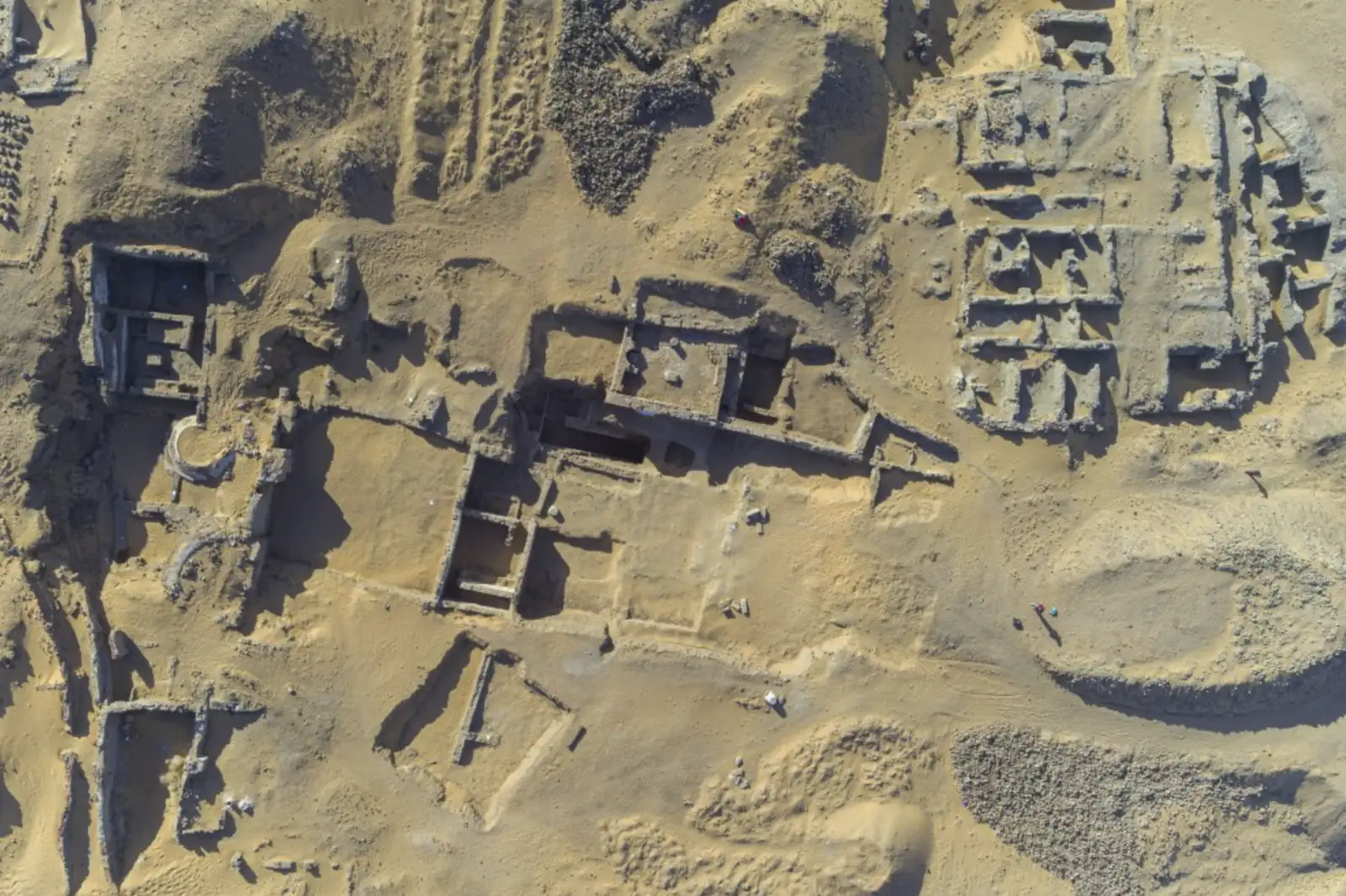
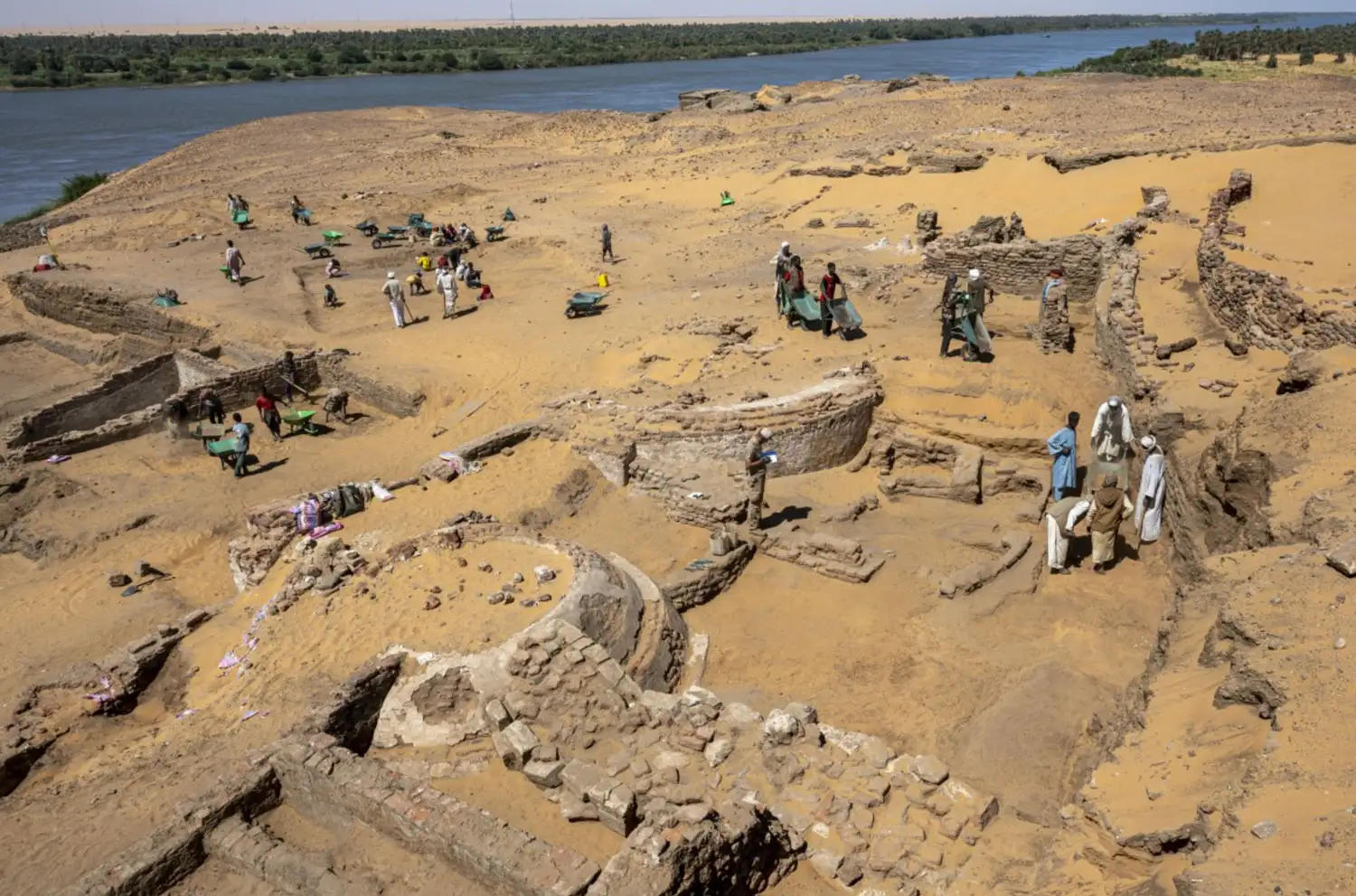
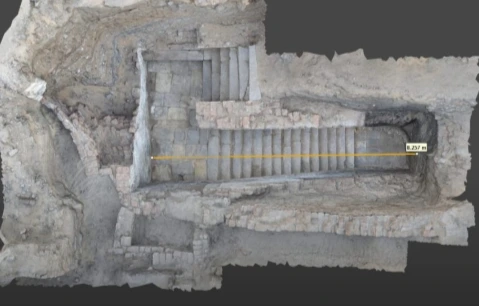
Excavations at Old Dongola, the former capital of the kingdom of Makuria, reveal the ground where the faithful walked and the base of an enormous staircase in the most monumental Christian temple in the region
They discovered another church with Greek paintings and inscriptions
The excavations allowed for the identification of a second religious building in a structure adjacent to the cathedral.
This church occupied an upper floor and preserved remnants of painted decorations, although its walls survived only to a height of approximately one meter.
The specialists recovered so many fragments of decorated cladding that they needed six large shelves to store them.
Among the materials were inscriptions in Greek containing fragments of biblical hymns.
The specialist Agata Deptuła identified texts corresponding to religious odes linked to the Psalter, including a passage from the prayer of Hannah, mother of the prophet Samuel.
These inscriptions provide information about the religious practices of the inhabitants of the ancient city.
The importance of the Christian kingdom of Makuria
Old Dongola was for centuries one of the main political and religious centers of Nubia. The kingdom of Makuria adopted Christianity in the 6th century and developed its own architectural and artistic tradition, linked to the Christian communities of the Nile valley.
The Great Church of Jesus would have occupied a prominent position within that religious organization.
For now, only a small part of the building has been excavated, so its definitive dimensions still need to be confirmed.
The researchers intend to expand the excavations during the upcoming campaigns, although the preservation of the structures requires special resources and procedures.
The protection of the site also poses a challenge: the floods of 2024 damaged several covers intended to preserve the archaeological remains.
The team will continue investigating the temple to determine its true extent, its internal organization, and the place it occupied within the history of medieval African Christianity.
A group of archaeologists discovered for the first time part of the original floor of the Great Church of Jesus, considered one of the largest religious constructions of medieval Nubia. The finding took place in Old Dongola, in northern Sudan, where more than a thousand years ago the capital of the powerful Christian kingdom of Makuria was located.
The excavations were carried out by the Polish Center of Mediterranean Archaeology at the University of Warsaw, in collaboration with the National Corporation of Antiquities and Museums of Sudan.
The discovery allows for progress in the reconstruction of a building that would have measured 57 meters long, 47 meters wide, and approximately 21 meters high.
The archaeologists found the original floor of a gigantic cathedral
During the work, the researchers discovered a monumental staircase leading to the interior of the temple and were able to reach the level of its original floor for the first time.
The floor appeared in the staircase area, which is so far the only space where the excavations reached that depth.
The structure was identified in 2021, but its systematic study advanced after the team secured funding from the National Science Center of Poland.
The archaeologists also discovered large buttresses that supported the apse, one of the main parts of traditional Christian churches.
Some walls preserve heights of up to eleven meters, a circumstance that requires particularly deep excavations.
A construction that could have marked the architecture of Africa
The director of the expedition, Artur Obłuski, explained that the importance of the building could far exceed the borders of the ancient kingdom of Makuria.
“In the history of architecture, certain buildings emerge that, to use a modern term, become trends. Hagia Sophia in Constantinople, present-day Istanbul, is undoubtedly one of those examples,” he stated.
He added: “The Great Church of Jesus seems to be a natural candidate for that role in Nubia, and even in this part of Africa”.
The comparison relates to the influence that certain constructions had on the design and techniques used in later temples.
The researchers also believe that the Great Church of Jesus may have functioned as the cathedral of Dongola, which would require a review of the function attributed to another church located outside the city walls.