Argentina reached a historic record in oil production in December, with Vaca Muerta contributing 70% of the total
Nuevo
Agregar La Derecha Diario en
Compartir:
Argentina's hydrocarbon industry closed 2025 with an unprecedented milestone. During December, national oil production reached an average of 860,255 barrels per day, the highest level recorded in the sector's historical series.
The performance of the year's last quarter showed a sustained growth curve that made it possible to surpass, in just two months, the ceiling that had been broken in October. In that month, production had reached 859,841 barrels per day, surpassing for the first time the record in force since 1998.
Comunicado oficial del Ministerio de Economía en conjunto con la Secretaría de Energía
After a slight stabilization in November, with 858,826 barrels per day, the sector accelerated again in December. This way, Argentina was consolidated above the barrier of 860 thousand barrels, a production zone that is unprecedented for the country.
The weight of Vaca Muerta
The central driver of this record was the development of Vaca Muerta, which accounted for about 70% of total crude production. The performance of the unconventional formation made it possible to offset the natural decline of conventional basins and to steadily push up the national total.
Vaca Muerta, Neuquén.
In the province of Neuquén, production reached 601,273 barrels per day in December, surpassing for the first time in its history the barrier of 600 thousand barrels. That volume represented 69.8% of the total extracted in the entire country.
The year-on-year comparison reflects the magnitude of the phenomenon: in December 2024, Neuquén produced 467,467 barrels per day. One year later, the jump was 28.6%, consolidating the Neuquén basin as the productive heart of Argentine oil.
A structural change in the production matrix
Thanks to the momentum of shale oil, Argentina today produces 54% more oil than it did five years ago. The improvement in technical efficiency, the operational learning curve, and the scaling up of unconventional projects managed to offset the maturity of traditional areas.
This structural change transformed the country's energy map. It made it possible to sustain continuous production growth, even in a context of decline in other regions.
Horario Marín, CEO de YPF.
The leap in natural gas
The end of the year also left solid figures in natural gas.In December, national production reached 130.9 million cubic meters per day, which implied an increase of 7.1% compared with November.
In Neuquén, gas production went from 82.2 million m³/day in December 2024 to 90.8 million m³/day in December 2025. This constitutes year-on-year growth of 10.4%.
Currently, the province accounts for 69.3% of the gas produced in Argentina, consolidating its strategic role in energy supply.
Infrastructure and outlook
The outlook for 2026 is positive thanks to the availability of transportation infrastructure. The Oleoductos del Valle system stands out in particular, whose expansions made it possible to ease the bottlenecks that had limited expansion in previous years.
However, the real leap in scale is projected for 2027, with the commissioning of Vaca Muerta Oil Sur (VMOS). This is a key project that will connect the Neuquén basin with the Atlantic Ocean and will enable a significant expansion of crude exports.
Impact on the macroeconomy
The production record had a direct impact on the macroeconomy. In 2025, crude exports grew 41% year-on-year, allowing the energy sector to account for almost 70% of the total trade surplus.
According to the Argentine Foreign Trade report published by INDEC, the energy surplus reached US$7.815 billion, the highest value recorded, out of a total trade surplus of US$11.286 billion.
Milei y Caputo.
Clear rules and consolidation of energy potential
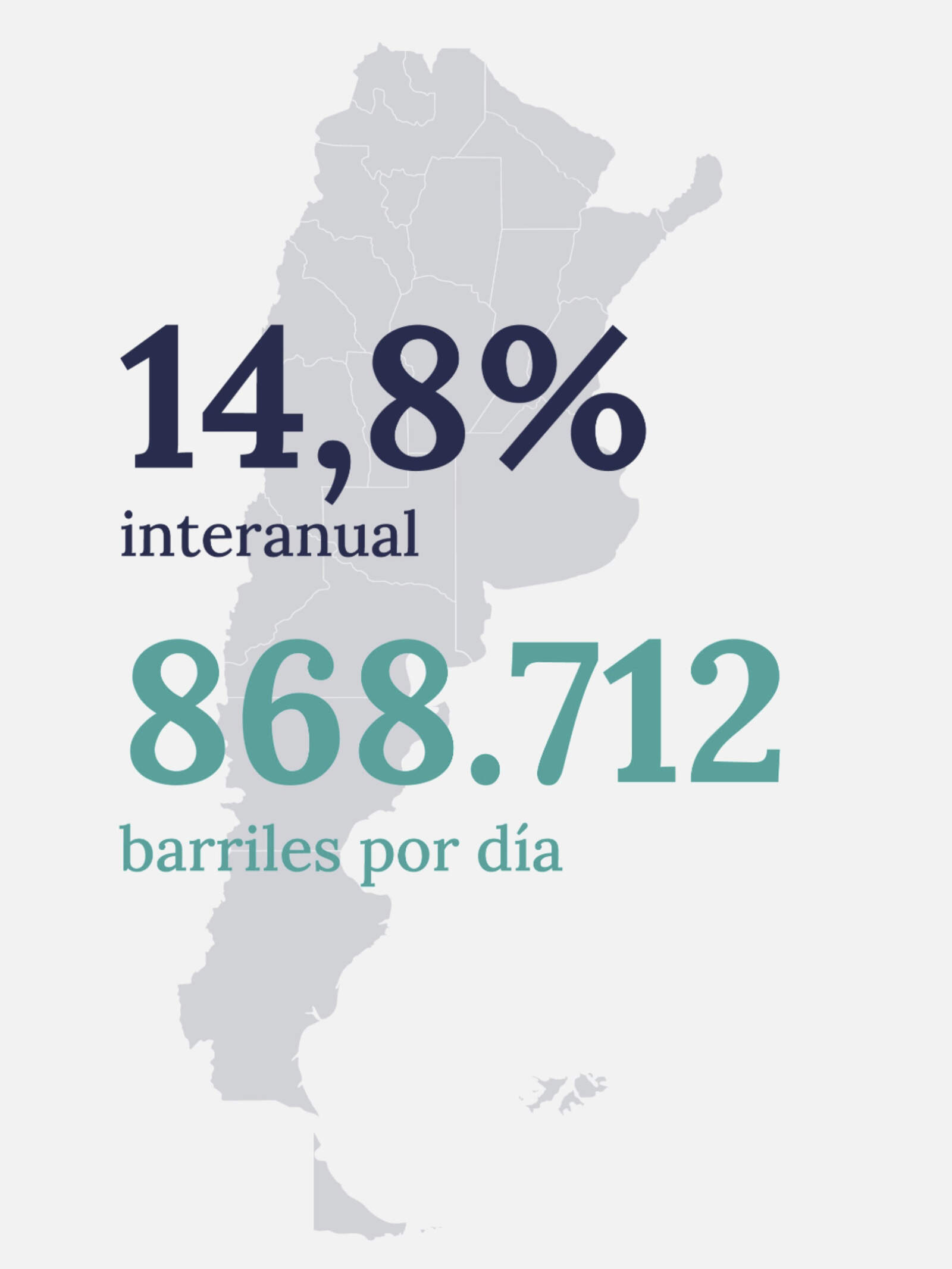
The record performance in December —with peaks that reached 868,712 barrels per day— showed that energy growth did not respond to cyclical factors, but to a change in conditions.
With clear rules, sustained private investment, and a limited state that set the framework and allowed production, Argentina consolidated its energy potential. This way, it began to transform natural resources into economic growth, employment, and a structural source of foreign currency for the country.