Even the United States, under a management that has lost fiscal direction, ranked among the countries with the highest price increases, with a variation close to 1.6 points. The eurozone as a whole, Spain, Turkey, Canada, and South Africa also suffered significant accelerations, evidencing that the developed world has no answers to the shock. In contrast, the management of the Minister of Economy, Luis Caputo, has made Argentina, along with Indonesia, one of the rare cases of resounding success in this context.
This Argentine miracle is supported by an efficient and realistic management strategy. National oil companies, led by YPF, implemented smart schemes so that the international rise in crude oil did not translate into sharp increases at the pump, prioritizing the stability of fuel prices to avoid punishing consumers.
The global economy is going through a moment of extreme fragility, trying to absorb the aftershocks of the war in the Middle East, as defined by the Managing Director of the International Monetary Fund (IMF), Kristalina Georgieva. In her recent academic and analytical article titled “The global economy withstands the impact of the war, for now”, the official detailed how this geopolitical conflict has driven up energy prices, strained financial markets, and overshadowed growth prospects in almost all regions.
Despite the fact that oil prices have been approximately 30% above pre-conflict levels, Georgieva highlighted that the “global economy has shown a greater capacity for adaptation than expected”, partly due to the fact that the increase in crude oil was lower than in other periods of historical crisis.
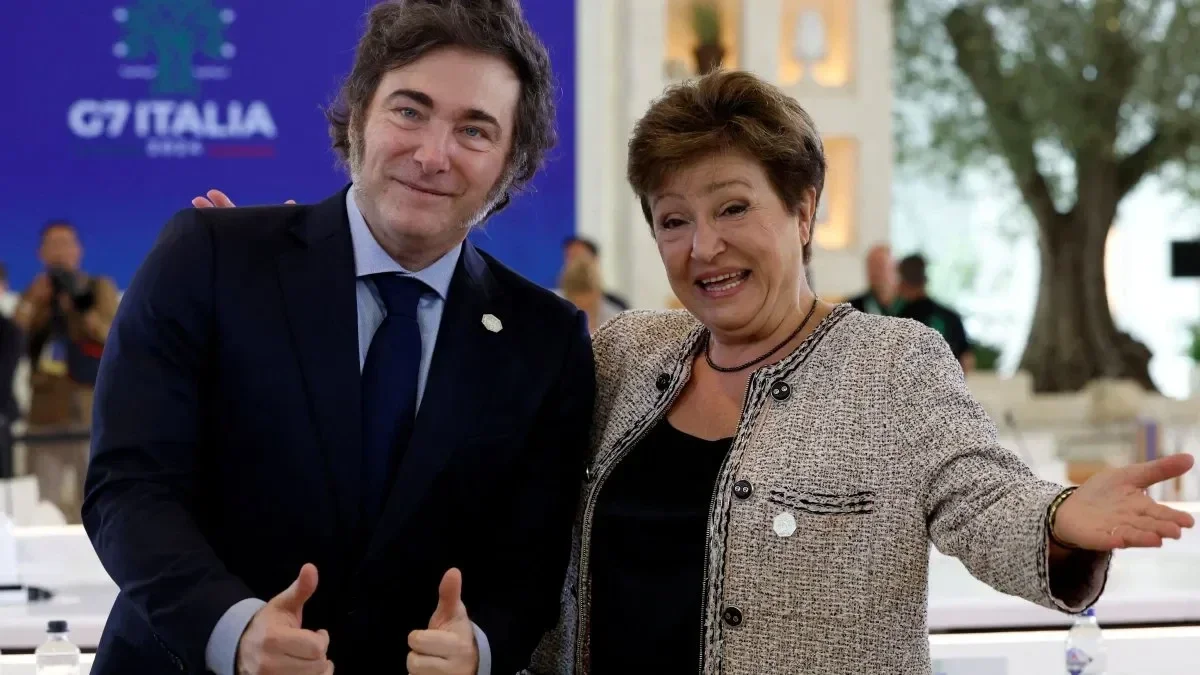
Javier Milei and Kristalina Georgieva
However, behind this supposed global resilience, the IMF revealed an uncomfortable truth for traditional powers: Argentina has become one of the very few and brightest exceptions to the widespread inflationary collapse.
An official chart from the organization, which analyzes the change in annual inflation since February 2026, places the country in a select group that managed to slow down prices amid the energy storm. While the vast majority of nations faced price escalations, Argentina under Javier Milei exhibited a negative variation close to 0.7 percentage points.
This achievement is crowned by the data from May, where local inflation plummeted to 2.1%, consolidating a path of stability that seemed impossible just months ago.
The statistical humiliation for nations that embrace interventionism is total. According to the data presented by the IMF, European powers such as France and Italy recorded concerning inflationary increases, close to 1.7 percentage points.
Meanwhile, in other regions such as the emerging economies of Asia, retail energy prices have skyrocketed by 40% since the start of the war, along with currency depreciations and capital flight that Argentina has managed to tame with its new financial architecture.
Donald Trump on Truth Social
The report by Kristalina Georgieva also highlighted that medium-term inflation expectations have remained stable globally thanks to the “confidence in central banks' commitment to price stability”, a premise that today is the non-negotiable mantra of the Libertad Avanza administration.
Furthermore, it was identified that investments in artificial intelligence and data centers are functioning as a growth engine that Argentina is already beginning to capitalize on to expand its productivity and not fall behind China or the United States.
In contrast, the IMF warned about the grim fate of those who ignore structural reforms. Oil exporters from the Gulf directly involved in the conflict are facing economic contractions, and in Africa, the lack of fiscal discipline is leading to food insecurity and unsustainable budget crises.
Therefore, the final recommendations from Georgieva sound like an absolute endorsement of the current economic plan in our country: the official was blunt in stating that “fiscal discipline” is fundamental and that “price controls, subsidies, and similar measures can generate significant costs for public accounts”, recommending instead focused and temporary responses. While the powers of the old world sink into statism, Argentina accelerates towards the future under the guidance of freedom.