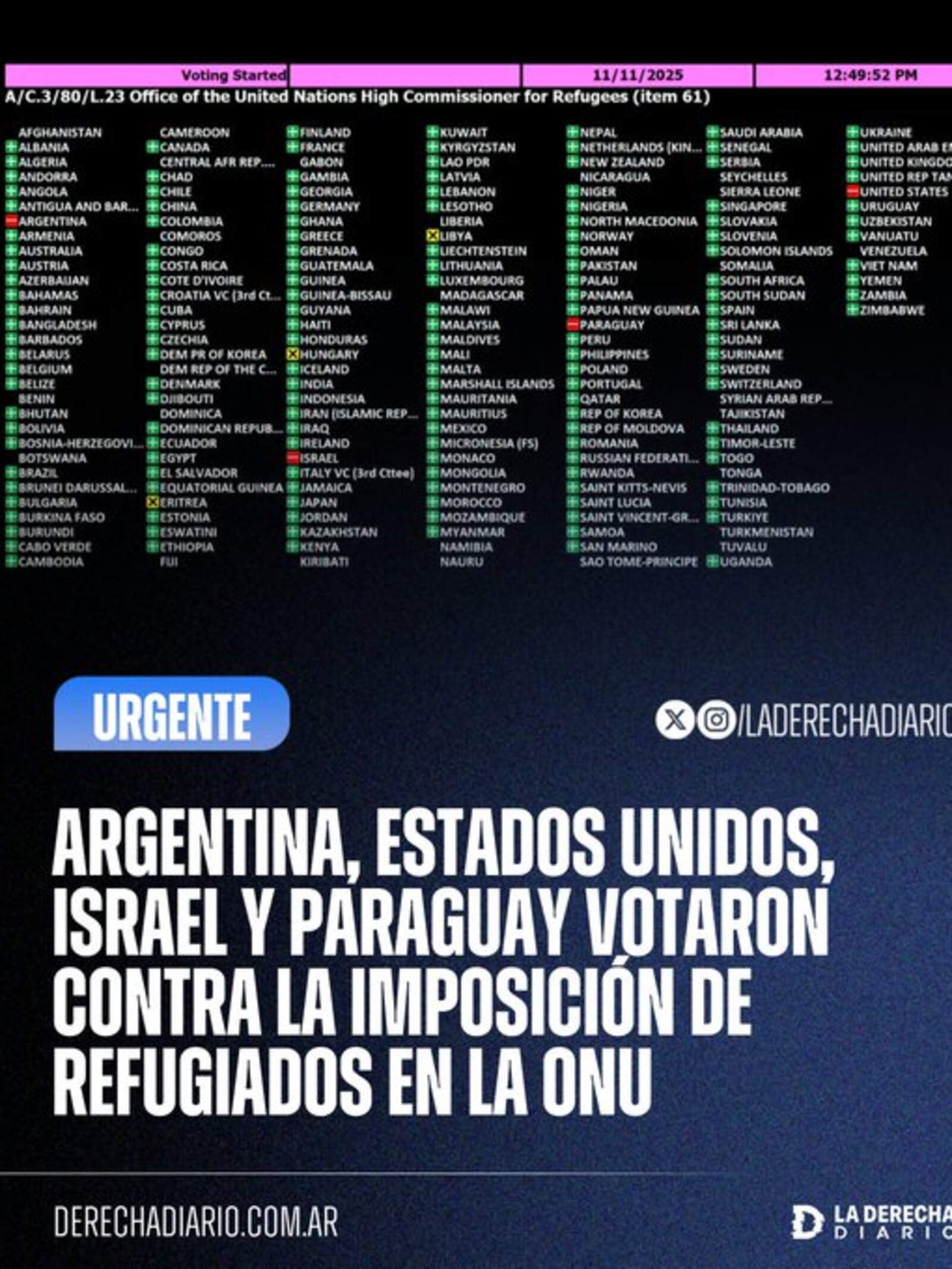
Argentina, United States, Israel, and Paraguay voted against a new leftist resolution promoted in the Third Committee of the UN (Social, Humanitarian, and Cultural Issues), corresponding to the 80th session.
The document, presented within the framework of the UNHCR mandate, sought to reinforce the obligation of States to accept refugees and comply with international provisions that dangerously encroach on the legislative autonomy and sovereign powers of each nation to regulate its migration policy.
The resolution, linked to agenda item 61, which addresses the functions and guidelines of the Office of the United Nations High Commissioner for Refugees, included a series of general points on humanitarian assistance, financing, and protection of "vulnerable groups."
La votación en la ONU.
Nevertheless, the text incorporated formulations that required countries to accept resettlements or impose uniform criteria for migration admission, regardless of the will or internal regulations of each nation.
The opposition bloc, made up of four countries with governments that openly defend national sovereignty, supported the need to have migration policies based on internal realities and not under multilateral dictates promoted by sectors seeking to impose far-left agendas on sovereign States.
The resolution rejected by Javier Milei's government sought to move toward open border policies, disguised under the humanitarian argument, representing a risk to the country's security and internal stability.
Javier Milei y Donald Trump
Argentina's negative vote, in particular, confirms the strategic shift the country has adopted in international organizations since the arrival of the libertarian administration to power. The current government seeks to put an end to the automatic alignment with progressive resolutions that, under the discourse of humanitarian assistance, often impose obligations that violate national legislation. This time, Buenos Aires made it clear that it will not allow external organizations to dictate how its borders should be managed.
In a global context marked by migration crises, regional conflicts, and ideological pressures from various international organizations, the four countries demonstrated that there are still governments willing to defend their borders, their laws, and their sovereignty in the face of international bureaucracy.