The Argentine delegation presented opportunities to attract private capital, increase the production of medical radioisotopes, and open new markets for national nuclear technology
During these meetings, Federico Ramos Napoli emphasized the vision of the Argentine economic project by stating: “Argentina has developed internationally recognized nuclear capabilities for over seven decades. Today we have a concrete opportunity to turn that knowledge into larger-scale projects, with private investment, exports, and skilled employment”.
In the context of an unprecedented geopolitical and economic alignment, the governments of President Javier Milei and U.S. President Donald Trump are consolidating a strategic nuclear cooperation agenda designed to attract private investments, promote uranium mining, accelerate the construction of small modular reactors (SMR), and exponentially expand Argentine technological exports to international markets. This policy of strong alignment with Western powers aims to capitalize on the global expansion of clean energy through market openings and full integration into global value chains.
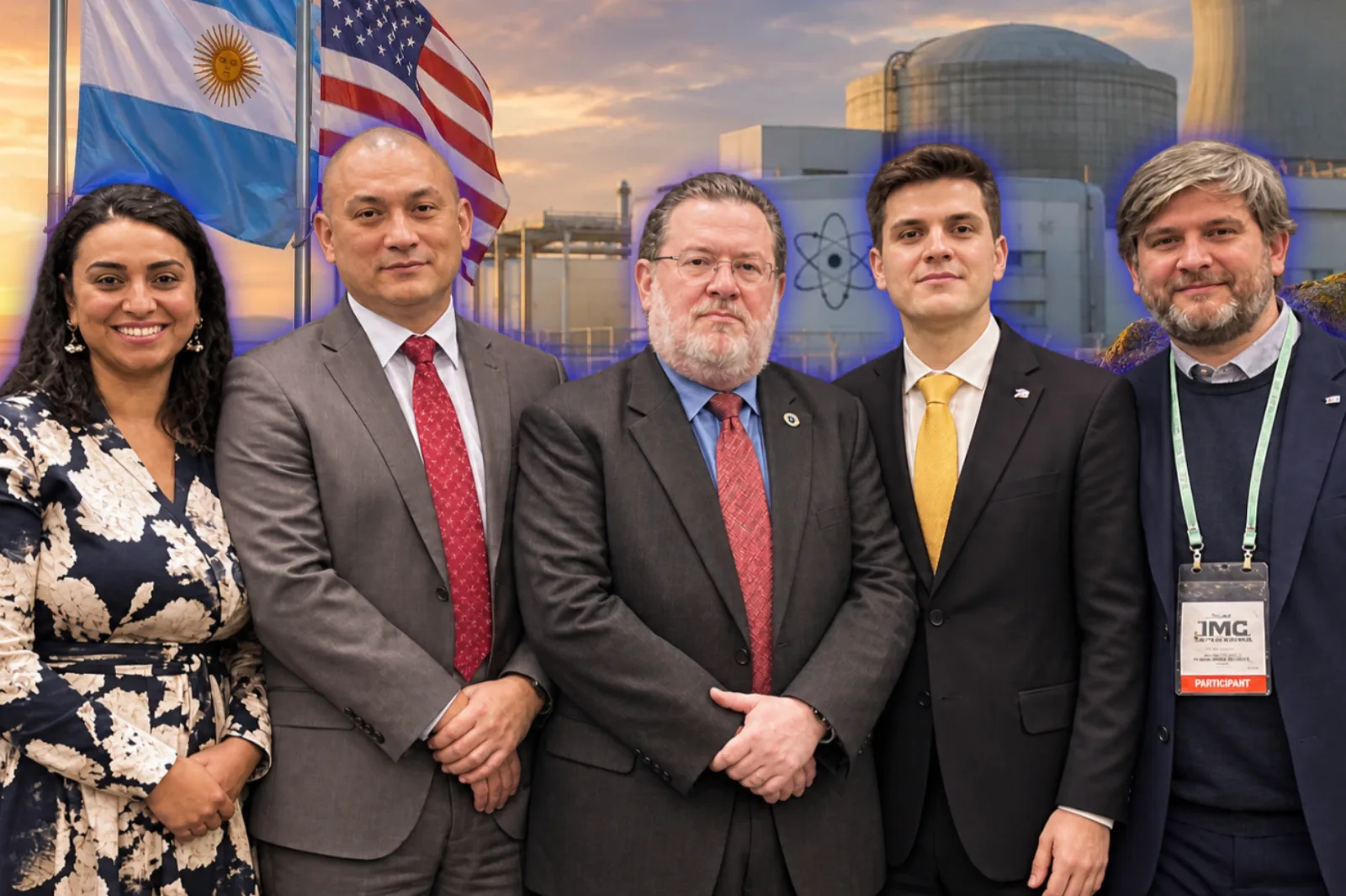
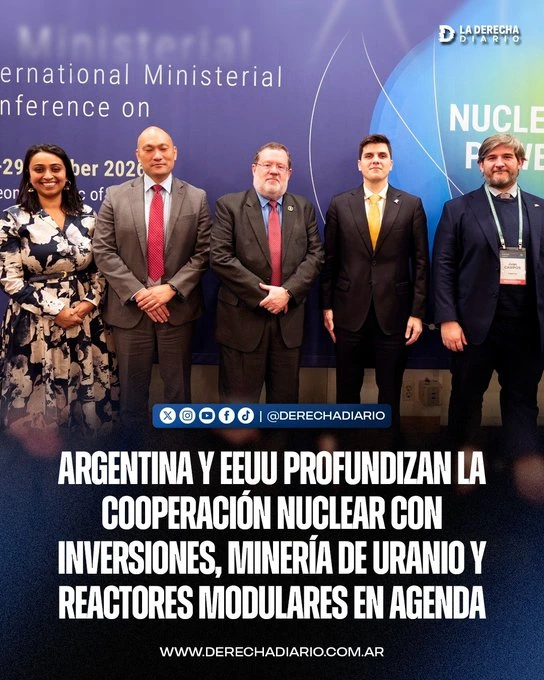
To achieve this diplomatic and industrial milestone, the official Argentine delegation landed at the Ministerial Conference on Nuclear Energy of the International Atomic Energy Agency (IAEA), a summit held from October 27 to 29 in the city of Incheon, Republic of Korea (South Korea). The national delegation was led by the Secretary of Nuclear Affairs of the Ministry of Economy, Federico Ramos Napoli, and the president of Nucleoeléctrica Argentina, Juan Martín Campos, who presented the new management model based on boosting the sector through market freedom and incentives for private capital.
Argentina and the United States deepen nuclear cooperation
In terms of bilateral negotiations, Argentine authorities held high-level strategic meetings with key representatives from the U.S. Government and the nuclear industry. Among the American interlocutors were officials from the State Department, a delegation from the Department of Energy led by Michael Goff, and the representative of the Nuclear Energy Institute (NEI), Carol Berrigan, an entity that groups the main private companies in the sector.
Turning to technical infrastructure projects, discussions prioritized the commercial development of the multipurpose reactor RA-10, which is expected to be operational by 2027. Through a scheme aimed at incorporating private capital, the Argentine Government seeks to enhance the economic performance of the facility, multiply the production of medical radioisotopes for high-complexity applications, and capture new export markets. In this regard, official sources confirmed that "The incorporation of private capital appears as a tool to develop new businesses based on the available infrastructure and knowledge in the country".
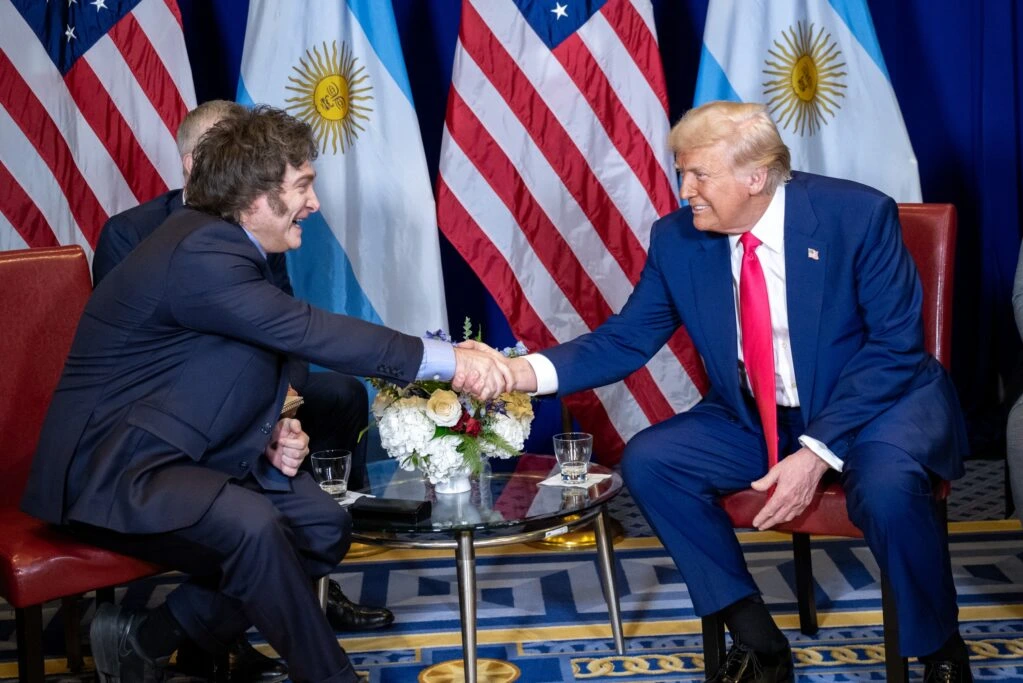
The presidents, Javier Milei and Donald Trump.
Finally, at the more detailed operational level, the bilateral agenda progressed in attracting investments for uranium mining, the various stages of the nuclear fuel cycle, and the implementation of small modular reactors (SMR). In this segment, both delegations agreed on the urgency of moving towards regulatory harmonization in Latin America that eliminates inefficient bureaucracy and reduces licensing costs, providing legal certainty for investments without neglecting nuclear safety standards.
In this sense, they reaffirmed that "The goal is to reduce the costs associated with licensing processes and offer greater predictability for investments, without compromising nuclear safety standards", ensuring the strengthening of industrial supply, the training of skilled talent, and the commercial consolidation of more than seven decades of Argentine scientific experience.