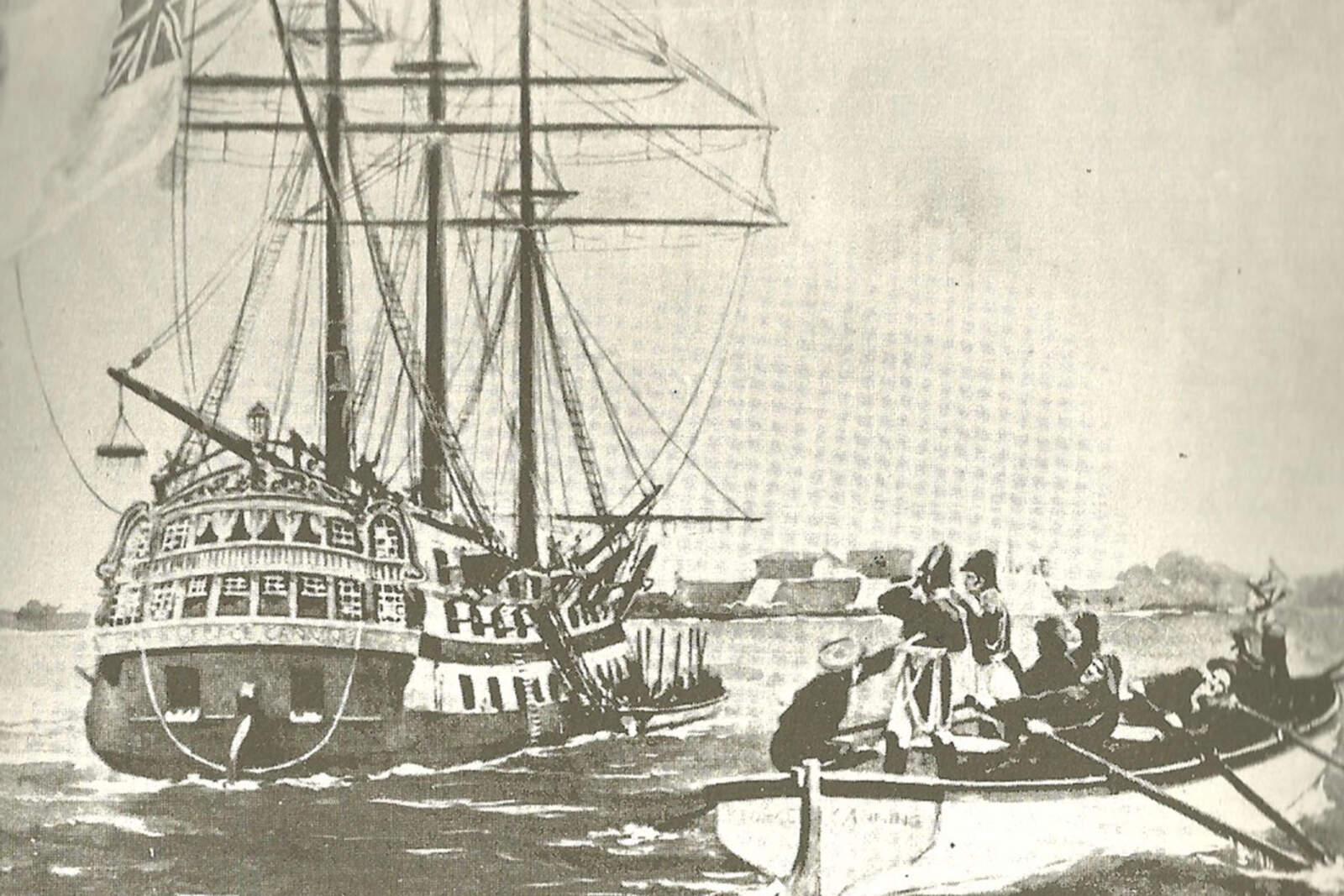

On Friday, March 13, 1812, the Gazeta de Buenos Ayres, the official newspaper of the Revolutionary Government, which Mariano Moreno had founded almost two years earlier, highlighted the following publication on its front page:
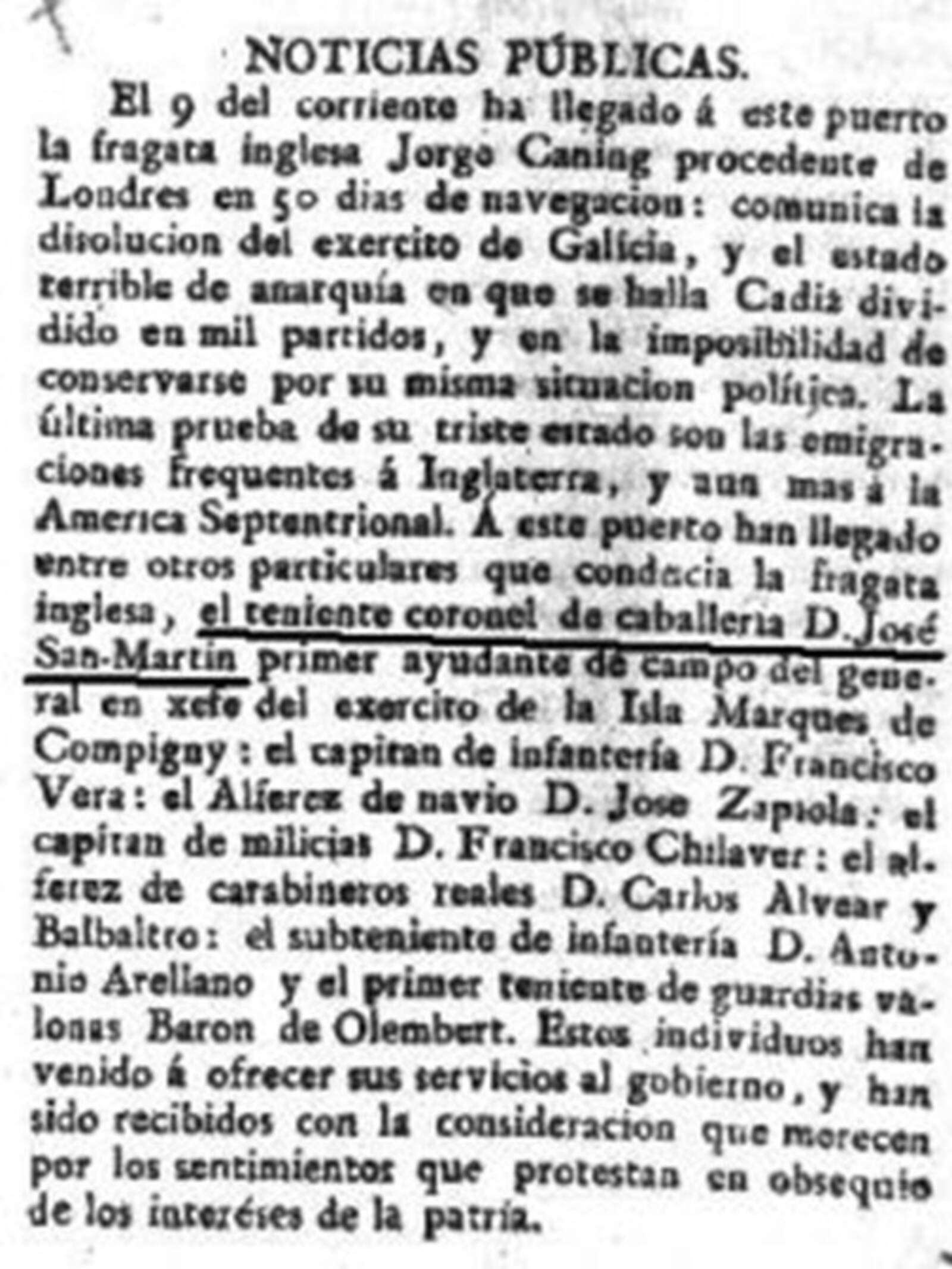
"On the 9th of the current month, the English frigate George Canning arrived at this port from London, after 50 days of navigation: it reports the dissolution of the army of Galicia and the terrible state of anarchy in which Cádiz is divided into a thousand factions, and the impossibility of maintaining itself due to its own political situation. The latest proof of its sad state is the frequent emigrations to England, and even more to North America. Among other individuals brought by the English frigate to this port are the cavalry lieutenant colonel Mr. José San Martín, first aide-de-camp to the general-in-chief of the army of the Island Marquis of Compigny; the infantry captain Mr. Francisco Vera; the ship's ensign Mr. José Zapiola: the militia captain Mr. Francisco Chilavert, the royal carabineers ensign Mr. Carlos Alvear y Balbastro; the infantry second lieutenant Mr. Antonio Arellano; and the first lieutenant of Walloon Guards Baron de Olembert. These individuals have come to offer their services to the government and have been received with the consideration they deserve, for the sentiments they profess in favor of the interests of the homeland."
Inaccuracies of the Publication
In reality, this publication had some errors and inaccuracies. Firstly, the name of the British frigate mentioned in the article was actually "George Canning" and not "Jorge Caning." Secondly, the exact date of the frigate's arrival at the Buenos Aires port was March 6 or 7, according to other documents of the time, which confirm this; thus, the Liberator would have arrived on our shores two or three days earlier than is commonly believed. Finally, there are some spelling errors in the names of the people mentioned in the publication. Namely, it should say "Marqués de Coupigny" and not "Marqués de Compigny" as stated; or "José de San Martín" and not "José San Martín," or finally: "Barón de Holmberg" and not "Barón de Olembert," as published. All this is understandable, given that these were not well-known personalities at the time in our land.
Now then, who were these newcomers who came to offer their services to the First Triumvirate? Leaving aside José de San Martín and Carlos de Alvear, the better-known members of the passage; we see that part of the newly arrived entourage included: the infantry captain Francisco Vera; the militia captain Francisco Chilavert, the ship's ensign Matías Zapiola; and the first lieutenant of Walloon Guards Baron de Holmberg.
The Infantry Captain Francisco José de Vera
Francisco José de Vera was an infantry captain, who was in Montevideo shortly after the May Revolution broke out. He was one of the few prominent officers in the Eastern Band who had adhered to the First Junta, along with the ship's ensign Matías Zapiola, the captain Cosme Ramírez de Arellano, and the lieutenant colonels Prudencio Murgiondo and Juan Balbín. Because of this, they were imprisoned and sent to Cádiz, to serve their sentences as conspirators, in the dungeons of that city.
The chaos in the capital of Cádiz in 1811 was such that a secret organization of American patriots took advantage of the prevailing disorder, as the Spaniards also had to deal with the French imperial army besieging Cádiz, practically at the city's gates, to secure the freedom of their captive comrades; resorting to bribing the sentinels, or directly to the escape of the prisoners from the dungeons. Carlos de Alvear, the wealthiest patriot of the group, was one of the main financiers of the escape operations that were organized.
Thus, Vera and his comrades were able to escape, and they joined the secret organization that had freed them. Together, then, they conspired and decided to return to their homeland to fight for their country's freedom.
The Militia Captain Francisco Chilavert
Francisco Chilavert was also arrested along with Vera and Zapiola, in Montevideo, on July 12, 1810, by the royalist authorities, due to his revolutionary sympathies; and sent to Cádiz. For some unknown reason, Chilavert was allowed to travel to the peninsula with his two young sons: José Vicente (later a great friend of General San Martín) and Martiniano (future artillery colonel in our civil wars).
Upon arriving in Cádiz, Vera, Zapiola, and Chilavert were subjected to a court-martial; from which the latter would be acquitted. All of them escaped; along with the other prisoners captured in Montevideo (Cosme Ramírez de Arellano, Prudencio Murgiondo, and Juan Balbín), they ended up joining the same secret organization that had facilitated their escape.