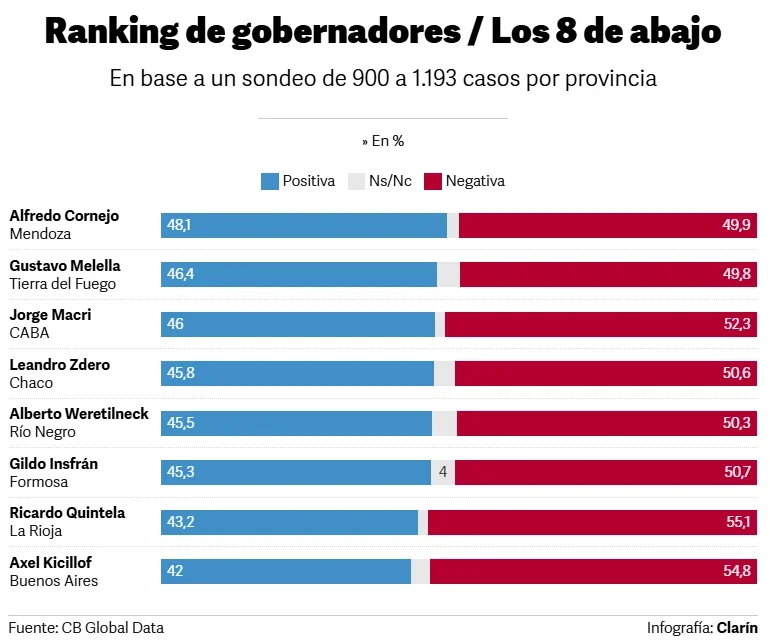
The survey was conducted on samples of between 900 and 1,193 cases in each of the 23 provinces and the City of Buenos Aires. Based on this data, CB Global Data ranked the governors according to the level of positive image they have among their own constituents.
Axel Kicillof has once again received a blow in the polls after the latest national ranking of governors prepared by CB Global Data placed the Buenos Aires governor in last place among the 24 provincial leaders and the City of Buenos Aires.
The monthly report from the consultancy, which measures the image of each governor within their own district, left Kicillof in 24th place, with only 42.0% positive image. The result comes at an awkward time for the Kirchnerist leader, who is trying to maintain prominence within Peronism while facing growing criticism for the dramatic situation in his province.
CB Consultora anticipated the results of the ranking
The ranking was led by the Salteño Gustavo Sáenz, who achieved a 54.6% positive image. Following him were Rolando Figueroa, governor of Neuquén, with 54.4%, and Osvaldo Jaldo, from Tucumán, with 54.0%. The table showed a clear difference between the best-rated governors and those who ended up at the bottom of the survey.
At the bottom appeared three leaders from Kirchnerist Peronism: Axel Kicillof, Ricardo Quintela, and Gildo Insfrán. The Buenos Aires governor came in last with 42.0%; the Riojan was second to last with 43.2%; and the Formosan completed the group of worst performers with 45.3% approval.
Despite governing the most important province for Peronism in the country, the leader ended up below all his peers and even behind leaders with significant accumulated wear, such as Quintela and Insfrán, demonstrating Kicillof's weakness in Buenos Aires territory.
Axel Kicillof is facing a social security crisis in the province.
For Kirchnerism, this data comes at a particularly sensitive moment. Kicillof is trying to project himself as one of the central figures of the opposition to Javier Milei, but the ranking shows that he cannot even garner popular approval within his own territory.
While the national government focuses on fiscal order, lowering inflation, and structural reforms, the Buenos Aires governor goes against the trend and finds himself trapped in a management marked by internal conflicts, insecurity, and the growing hospital crisis.