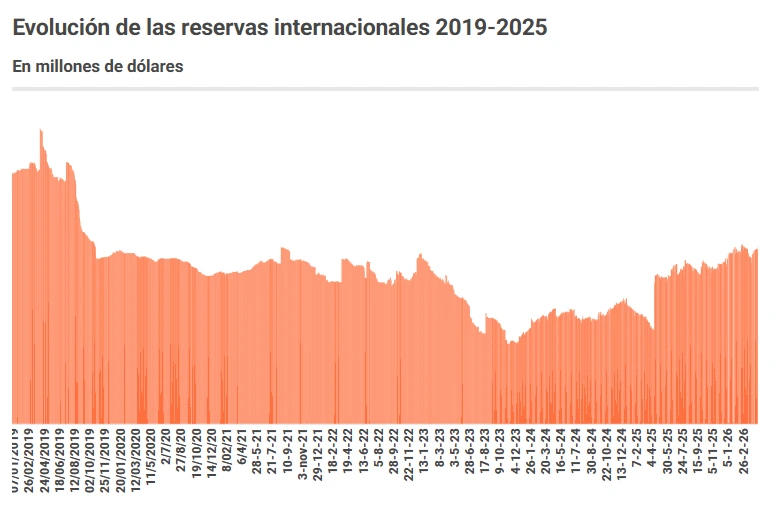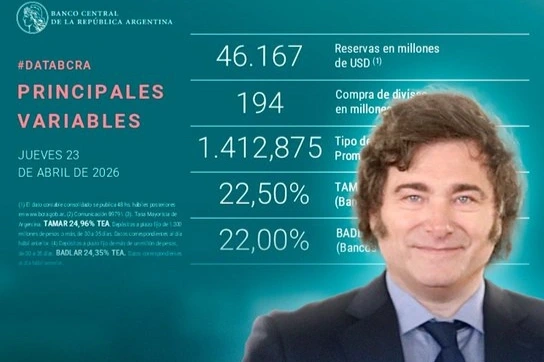

The Central Bank of the Argentine Republic once again positioned itself as a key actor in economic stabilization by maintaining a strong pace of foreign exchange buying, which allowed reserves international companies will once again exceed USD 46 billion. On Thursday, the monetary authority acquired USD 194 million, thus reaching 73 consecutive wheels with a positive balance in the
official market.So far in 2026, the agency has already accumulated purchases of more than USD 6.6 billion, while since the implementation of the new monetary scheme in January 2026, the total amounts to USD 6,685 million, a figure that represents more than half of the annual objective. During April alone, the pace intensified significantly, with acquisitions of USD 2,299 million
.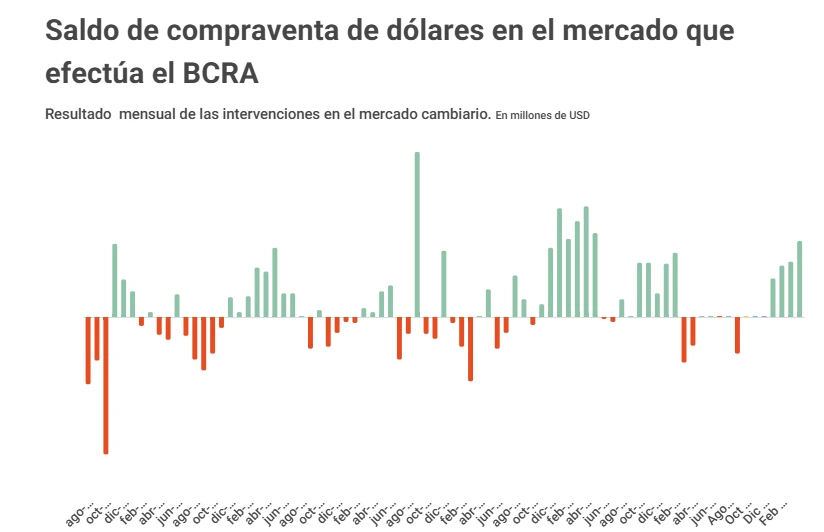
Currently, the BCRA has already reached 66% of the annual purchase target, in a context where debt payments made by the National Treasury —which obtained part of the currencies from the Central Bank itself—moderated the net growth of reserves. Even so, the official strategy managed to sustain the accumulation process
.To maintain this path, the bank expanded the issuance of pesos without direct sterilization, while the Treasury made progress in placing debt in local currency with the objective of absorbing excess liquidity. This combination seeks to avoid pressure on the exchange rate and contain inflation, two sensitive variables in the stabilization process
.Official projections estimate that the net balance of purchases could be between USD 10 billion and USD 17 billion in 2026, depending on the availability of foreign exchange and the demand for pesos. In this regard, the president of the Central Bank, Santiago Bausili, stressed that these variables will be decisive for the
final result.At the close of the last day, international reserves stood at USD 46,167 million, after registering a daily increase of USD 326 million. It should be remembered that in February they had reached USD 46,905 million, the highest level since 2018 and a record for the current administration. Recent fluctuations respond both to foreign currency debt payments and to changes in the valuation of assets—such as gold and bonds—in an