The project aims to replace emergency measures with stable rules, with rates closer to actual costs and subsidies concentrated on those who need them the most.
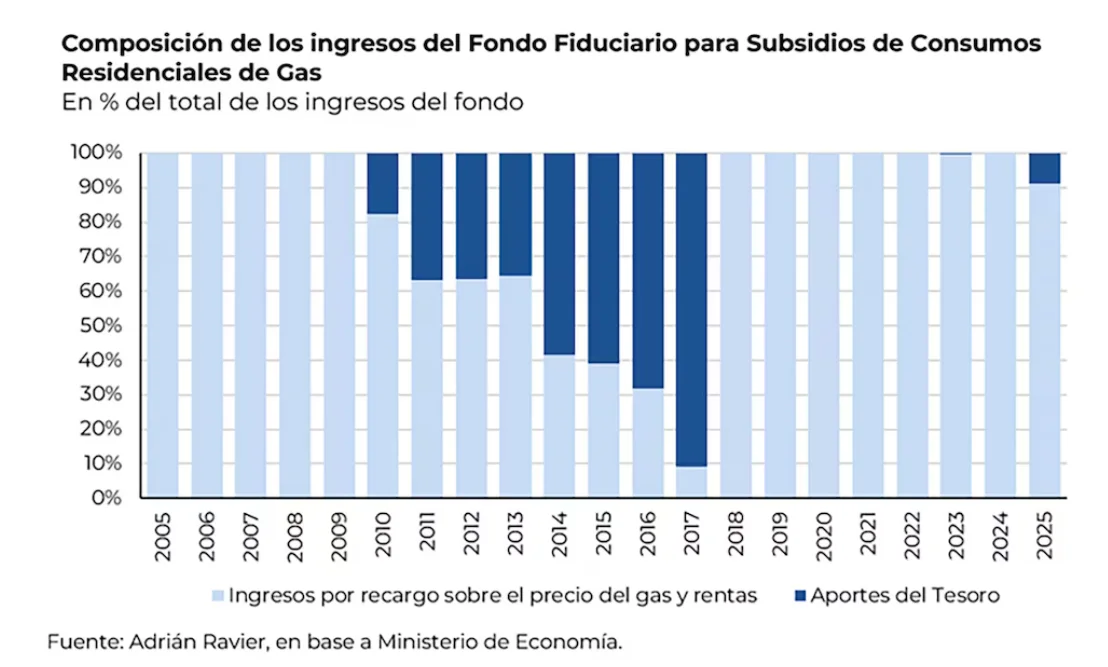
The Trust Fund for Residential Gas Consumption Subsidies is financed through a surcharge on the price of gas paid by all users in the country. Initially, that surcharge was set at $0.004 for each cubic meter of gas consumed through networks throughout the national territory. Shortly after, with Law 25.725 of 2003, it was modified to a percentage of up to 7.5% on the price of gas at the Entry Point to the Transport System for each cubic meter of 9,300 kilocalories, applied to all cubic meters consumed or marketed through networks or ducts in the country.
This percentage has increased over time. According to a report from the National Audit Office, in December 2017 the surcharge was 2.58%; in September 2018, it was 2.96%; in June 2019, it was 4.46%; and in August 2021, it reached 5.44%. With the tariff reviews of 2025, it climbed to 7.5%, the current legal cap. Nevertheless, the fund ended up with a deficit: the revenue collected was not enough to cover the entire subsidy, and the Treasury had to make additional contributions.
In April 2026, DNU 266/2026 authorized the Executive Power to raise it to 11.25%, that is, 50% above the current limit, a power that the bill under discussion seeks to incorporate by law.
With those resources, the State compensates distributors for the difference between the subsidized price they charge users and the real price of gas. The benefit is calculated on the full tariff: price of gas, transportation, and distribution. Additionally, it applies to both natural gas through networks and undiluted propane gas and, in the core zone, to cylinders and LPG tanks. For several years, with tariffs frozen at outdated levels, that percentage was sufficient to sustain the system.
With tariffs still intervened, the fiscal cost of the 2021 expansion seemed manageable. That situation changed when tariffs began to approach real costs: subsidizing 50% of a tariff frozen at 30% of the real cost does not have the same impact as subsidizing 50% of a tariff that starts to reflect its effective value.
The government of Javier Milei carried out the Five-Year Tariff Reviews during 2025, which brought the tariff tables closer to real costs.
The result was predictable. The fund collects through the surcharge paid by all users, transfers those resources to distributors to compensate them for selling gas at a subsidized price, and with those funds, the distributors pay the producers.
When the fund went into deficit and the Treasury did not cover the difference in a timely manner, the distributors stopped receiving compensation. Without those resources, they could not pay the producers. Thus, the payment chain broke, and the subsidy to the end user ended up generating debt upwards throughout the industry.
Second axis: debt of the electricity market and payment chain
The problem of the Argentine electricity system has a similar root. During years of economic emergency, electricity tariffs remained heavily intervened and lagged behind inflation and international prices. This difference accumulated imbalances that affected the payment chain of the sector.
The direct consequence was the progressive deterioration of finances. The distribution companies, responsible for delivering electricity to the end user, prioritized the minimum maintenance of the service over the full payment of the energy purchased from Cammesa, the Wholesale Electricity Market Administrator Company S.A. Thus, they accumulated a historical debt that deepened year after year.
Recent tariff adjustments brought price tables closer to the real distribution costs. However, that correction did not resolve the accumulated liability: the debt with Cammesa remains in effect, and if current revenues are allocated to settle it, there is not enough margin to make urgent investments in electrical infrastructure. The resources are sufficient for operation, but not to clean up and modernize the system at the same time.
The Government took measures to organize the payment chain: first, an emergency resolution in May 2024 for the oldest debts; then, DNU 186/2025, which established a broader regularization plan, with up to 72 installments.
To this financial strain is added a potential judicial front. Distributors have arguments to claim damages from the National State for breaches of their concession contracts during the tariff freeze period, which opens the possibility of million-dollar litigation. The result is a blocked wholesale electricity market: updated tariffs that cannot be fully allocated to improving the service, conditioned by an unresolved systemic debt and a scenario of high judicial conflict.
Third axis: incentives for hydrocarbons and change of context
The hydrocarbon sector has accumulated two incentive regimes that responded to a reality different from the current one. The first, Decree 929/13, enacted during the government of Cristina Fernández de Kirchner, aimed to promote investment and production in the sector under conditions that no longer apply today.
The Honorable Chamber of Deputies gave preliminary approval to a bill that reorganizes four central aspects of the Argentine energy system: the subsidy regime for gas in cold areas, the accumulated debt in the wholesale electricity market, incentives for the hydrocarbon sector, and the tax exemption aimed at renewable energies.
The proposal seeks to bring tariffs closer to real costs and to return the Cold Zone Regime to a more precise scheme: automatic continuity in areas historically recognized for extreme cold and targeting based on socioeconomic vulnerability in the rest of the territory. At the same time, it aims to regularize the debt with Cammesa, eliminate hydrocarbon incentives that have lost relevance in the current context, and extend tax benefits for renewables until 2045.
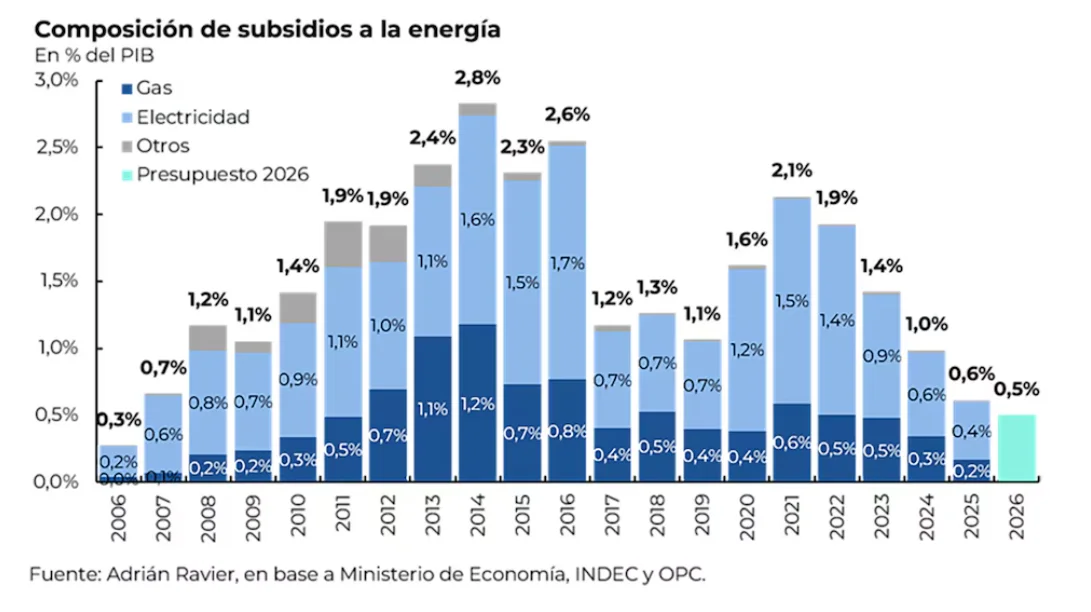
A basic rule of economics indicates that when a subsidy becomes universal, it ceases to fulfill a social function and ends up becoming a fiscal privilege that is difficult to sustain. The expansion of the Cold Zone Regime in 2021 is a clear example: it ended up subsidizing heating consumption for high-income households in temperate zones and deepened a fiscal deficit that is ultimately financed by all Argentines. The comprehensive reorganization project of the energy system raises an uncomfortable but essential issue.
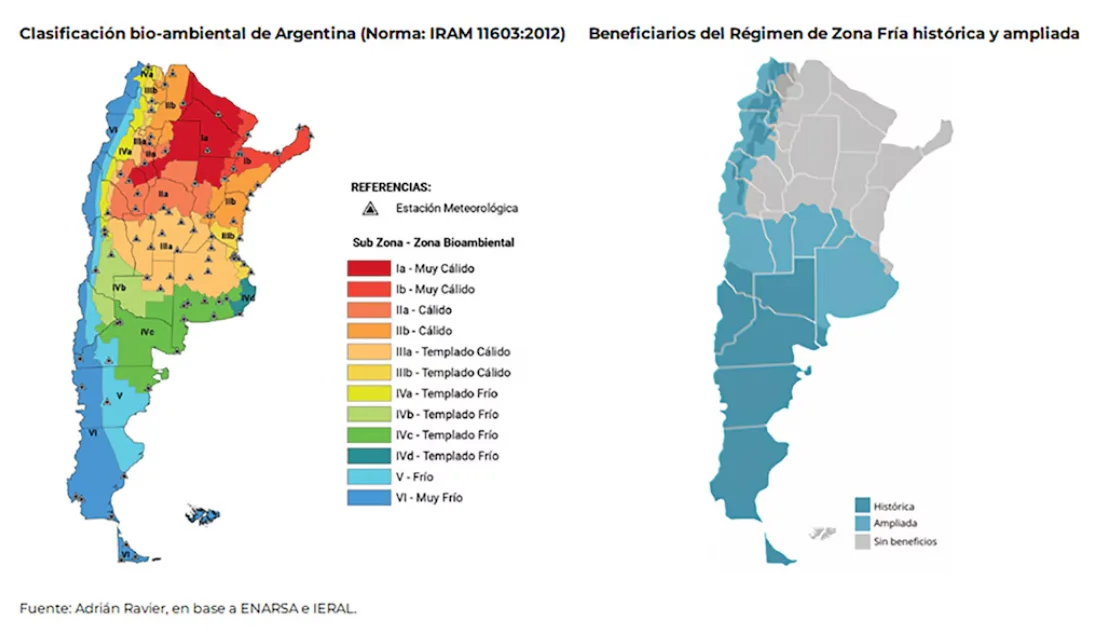
By proposing tariffs linked to real costs and redesigning the Cold Zone with a dual criterion—strict geography for the south and socioeconomic vulnerability for the rest—the law aims for the State to spend less and allocate resources better. The new regulation maintains the subsidy in historically cold areas, such as Patagonia, Malargüe, and the Puna, and applies a more stringent vulnerability filter in other regions of the country.
Together with the cleaning up of the debts of distributors with Cammesa and clearer signals for investment and renewable energies, the regulatory text aims to resolve a deficiency that the energy sector has been dragging for years: clear rules, predictability until 2045, and stable criteria for the allocation of subsidies.
The Executive Power sent a bill to Congress to modify the current subsidy and energy regulation scheme, organized around four axes: the readjustment of the subsidy regime for gas consumption in cold areas, the regularization of the historical debt of the Wholesale Electricity Market, the extension of the tax exemption for renewable energies, and the repeal of two incentive regimes for the hydrocarbon sector.
The four points respond to the same logic: to replace tools designed for emergency situations with rules capable of functioning under normal conditions.
First axis: subsidy for gas consumption and Cold Zone
Currently, around 4.3 million gas users in the country receive some type of subsidy on their consumption. Of that total, about 900,000 households belong to the area historically considered to be of extreme cold: the Patagonian Region, the Malargüe department in Mendoza, and the Puna region. There, the benefit is granted automatically, regardless of income level.
The more than 3 million remaining users were incorporated in 2021 through Law 27.637, which expanded coverage to regions with less severe climatic conditions. In those areas, the subsidy currently reaches households that prove incomes below three Total Basic Baskets for a typical family, through the registration of the Focused Energy Subsidy, among other requirements.
The regime has its origins in the period when Gas del Estado provided the distribution service. At that time, the State set differential tariffs for the coldest regions of the country and financed them directly with Treasury resources. After the privatization of the service in the 1990s, and with the State out of the role of provider, that mechanism became outdated.
In 2002, under the Public Emergency Law, the pesification and the tariff freeze, Article 75 of Law 25.565 created the Trust Fund for Residential Gas Consumption Subsidies, known as the Patagonian Fund. This scheme replaced direct Treasury financing with a surcharge on the price of gas paid by all users in the country, regardless of geographical location or income level. At that time, the subsidy still had a concrete climatic and territorial justification.
In 2021, Law 27.637, enacted during Alberto Fernández's presidency, extended the benefit to regions that did not have climatic conditions equivalent to those of the original core zone. What until then was a regime limited to Patagonia, Malargüe, and the Puna automatically expanded to include sub-environmental zones defined by the IRAM 11603 standard and adopted by Enargas as a zoning criterion: subzones IIIa, IVa, IVb, IVc, IVd, V, and VI. The new map incorporated sectors of southern Buenos Aires, areas in the center of the country, and other regions that, while colder than the northern areas excluded from the benefit, do not face the extreme conditions that justified the original regime.
In addition to setting a 50% discount for the core zone, the law established a general discount of 30% for all users in the incorporated regions automatically, and 50% for those qualifying as vulnerable according to the income criteria set forth in the regulation. Thus, the universe of beneficiary households increased from just over 800,000 to more than 4 million, including high-income users without socioeconomic filtering, with automatic access based on geographical location and no obligation to register in any registry.
Decree 943/2025 created in January 2026 the Focused Energy Subsidies regime, which unified subsidies for electricity, natural gas, undiluted propane gas through networks, and liquefied petroleum gas under a single criterion. Households whose combined net income is less than three Total Basic Baskets for a typical household 2 according to Indec, as well as those with at least one member with a Housing Certificate from ReNaBaP, Lifetime Pension for Veterans of the South Atlantic War, or Unique Disability Certificate, qualify for the benefit. The SEF replaced the previous segmentation into three levels—N1, N2, and N3—with a simpler, more verifiable binary scheme.