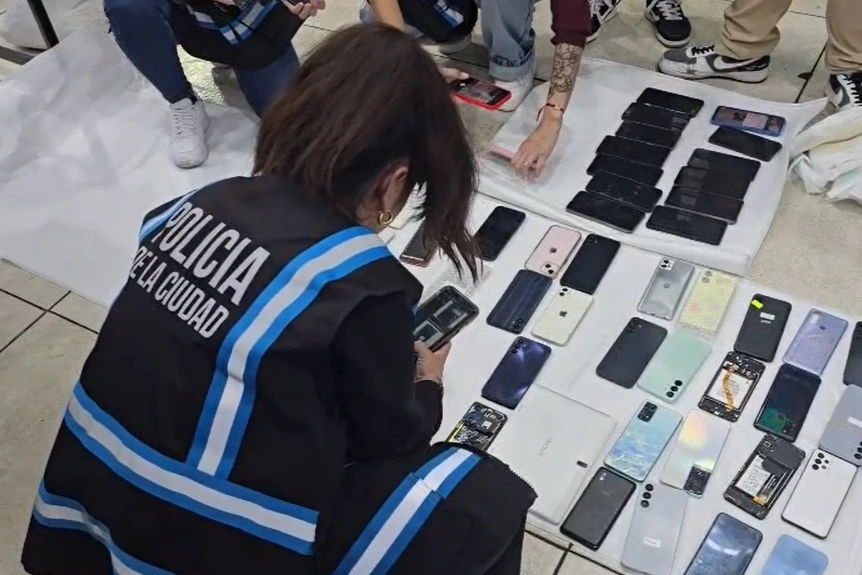
The Government of the City of Buenos Aires closed 112 establishments linked to the buying and repairing of cell phones since the head of Government, Jorge Macri, ordered a reinforcement of controls over the activity just fifteen days ago.
The operations are part of a strategy to dismantle the circuit for the commercialization of stolen cell phones, which are subsequently resold or disassembled to sell their parts as if they were legally sourced merchandise.
In addition to the closures, the procedures carried out by local agencies and the City Police allowed for the arrest of five people and the seizure of phones, spare parts, and tools used for repairs and disassemblies.
“Work like decent people and stop selling stolen cell phones. The free-for-all is over in this City,” said Jorge Macri referring to the operation against businesses that cannot justify the origin of the devices.
Once, one of the main focuses of the operations
One of the points where the first procedures were concentrated was Once, an area with a significant number of businesses dedicated to the repair and sale of used phones.
In various operations, inspectors from the Government Control Agency (AGC) and officers from the City Police raided establishments located on Corrientes Avenue at 2100, Junín at 3003, and various commercial galleries in the area.
Among the inspected establishments were Galería La Juanita, located on Pueyrredón Avenue at 9; Galería La Internacional, at Corrientes 2330; and the commercial gallery La Recova, at the corner of Azcuénaga and Pueyrredón.
In the latter, store 47 was closed, where agents seized 22 cell phones, 79 modules, and welding tools used for technical service work.
The devices found included equipment from brands such as iPhone, Motorola, and Samsung. According to information released by the local government, some had active theft reports with the National Communications Entity (ENACOM), while in other cases, the merchants could not prove their origin.
Emergency and stricter controls
The reinforcement of controls began after Jorge Macri declared the temporary emergency of the buying and repairing of used cell phones.
Among the measures implemented is the creation of a specific registry for those engaged in these activities, along with an increase in inspection tasks.
Additionally, licenses in sectors considered critical due to the concentration of businesses linked to the activity were suspended. These include Retiro-Microcentro, Balvanera-Once, Liniers-Western Limit, and Chacarita-Villa Crespo.
The goal is to prevent stolen phones from quickly returning to the commercial circuit through businesses that buy them to resell them whole or to disassemble them and sell their components.
“Anyone who buys a stolen phone is part of a mafia network”
Jorge Macri hardened the message against those participating in this circuit and specifically targeted merchants who acquire phones of illicit origin to sell their parts.
“Anyone who buys a stolen phone to disassemble it and sell it for parts is not a merchant; they are a criminal who is part of a mafia network. We declared an emergency to come down on them with the full weight of the law,” stated the head of Government.
From the local administration, they maintain that the controls are part of a broader security policy, aimed at attacking both those who commit the thefts and the structures that allow stolen goods to return to the market.
More controls and recovery of usurped properties
The local government also highlighted that the operation against the illegal cell phone market is part of other measures implemented since December 2023 to reinforce security in the City.
According to the administration of Jorge Macri, during this period more than 940 usurped properties were recovered and returned to their rightful owners, with an estimated value of around 500 million dollars.
This is in addition to controls against illegal constructions in various neighborhoods and villas, as well as police deployments aimed at reinforcing the boundaries of the City and making it difficult for criminals to enter and escape to the province of Buenos Aires.
For the local Executive, the offensive against the so-called “caves” of cell phones seeks to close one of the main channels through which stolen phones can return to the commercial circuit and generate a business around crime.