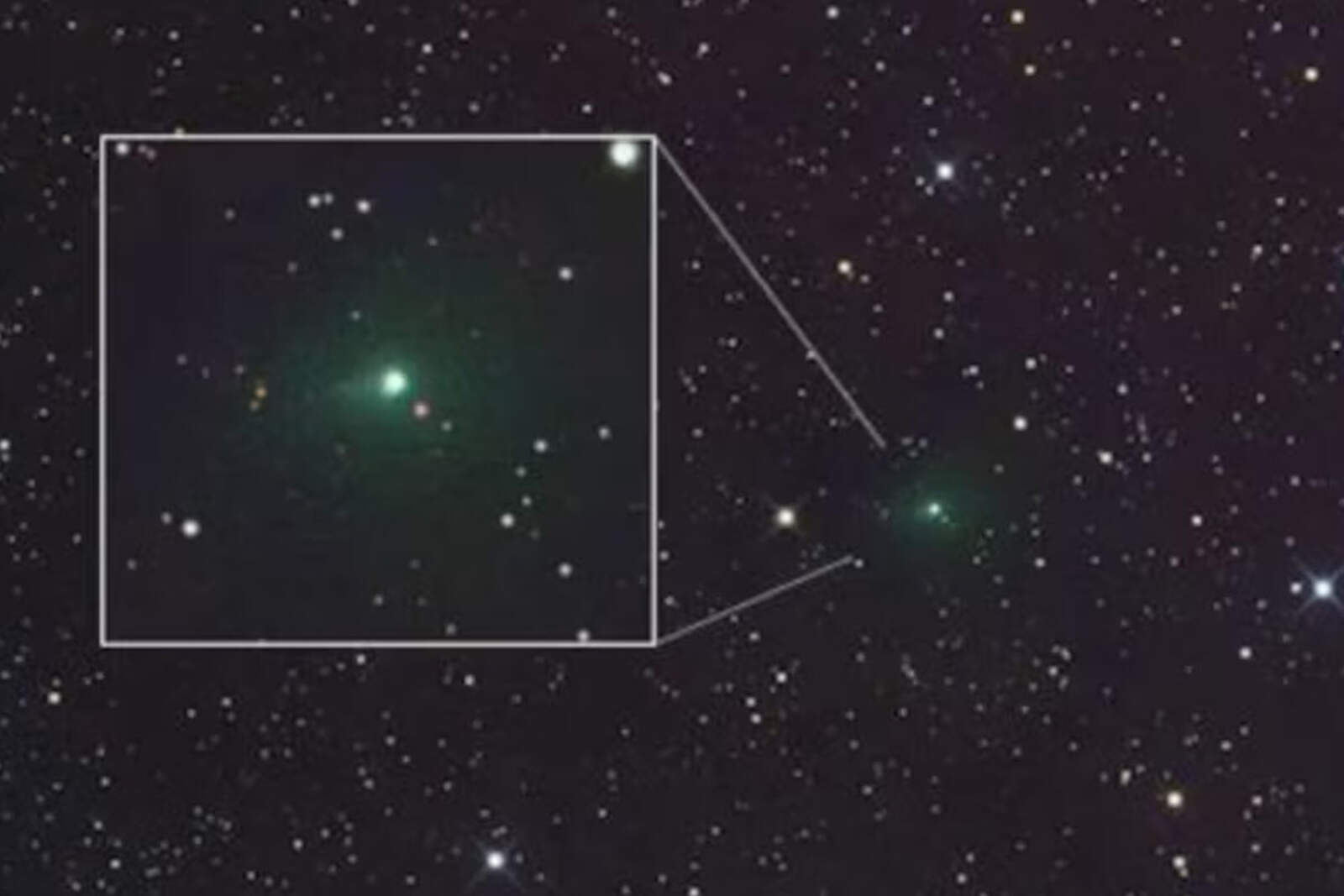
The 3I/ATLAS comet became visible again from Earth and puzzled astronomers with an unexpected change. Its classic green hue turned into a faint blue, a phenomenon never before recorded. The discovery reignited interest in this rare interstellar visitor that, according to experts, could be more than 7 billion years old.
The discovery was published by the Lowell Observatory. Scientists are now seeking to understand what process could have caused the color change. Su clásica tonalidad verde se transformó en un azul tenue
A visitor from another stellar system
3I/ATLAS is the third interstellar object detected in our Solar System, after "Oumuamua" and 2I/Borisov. Traveling at more than 210,000 km/h (130,488 mph), it follows a hyperbolic trajectory, which means it won't be trapped by the Sun's gravity. It arrived from another stellar system and, after passing by, will continue into deep space, never to return.
Astronomers estimate that its nucleus measures about 20 kilometers (12.4 miles) in diameter and has a mass greater than 33 billion tons. This makes it the largest interstellar object clearly observed to date. Its closest approach to the Sun was between October 29 and 30, when it reached a distance of 1.36 astronomical units.
The mystery of the blue color
In its first observations, the comet showed a reddish tone, then turned green, and finally reappeared with an unexpected blue. Scientists suspect that this coloration is due to the release of carbon monoxide or ammonia, which reflect sunlight differently.
However, the phenomenon puzzles specialists, since the comet's temperatures and mass don't match the conditions necessary for that color change. "The object's color is blue, bluer than the Sun, and that's very unusual", explained Professor Avi Loeb of Harvard University to Scientific American.
Theories and scientific caution
Some astronomers have speculated with more extravagant theories, even suggesting that the object could have an artificial origin, due to the presence of an "anti-tail" of dust oriented toward the Sun. Nevertheless, the scientific community remains cautious. "Extraordinary claims require extraordinary evidence," recalled astronomer Laura Nicole Driessen, quoting Carl Sagan.
Current analyses have revealed an unusual chemical composition, with high levels of carbon dioxide and nickel, but little iron. This suggests that the comet formed under conditions different from those of the Solar System, possibly in an older region of the Milky Way.