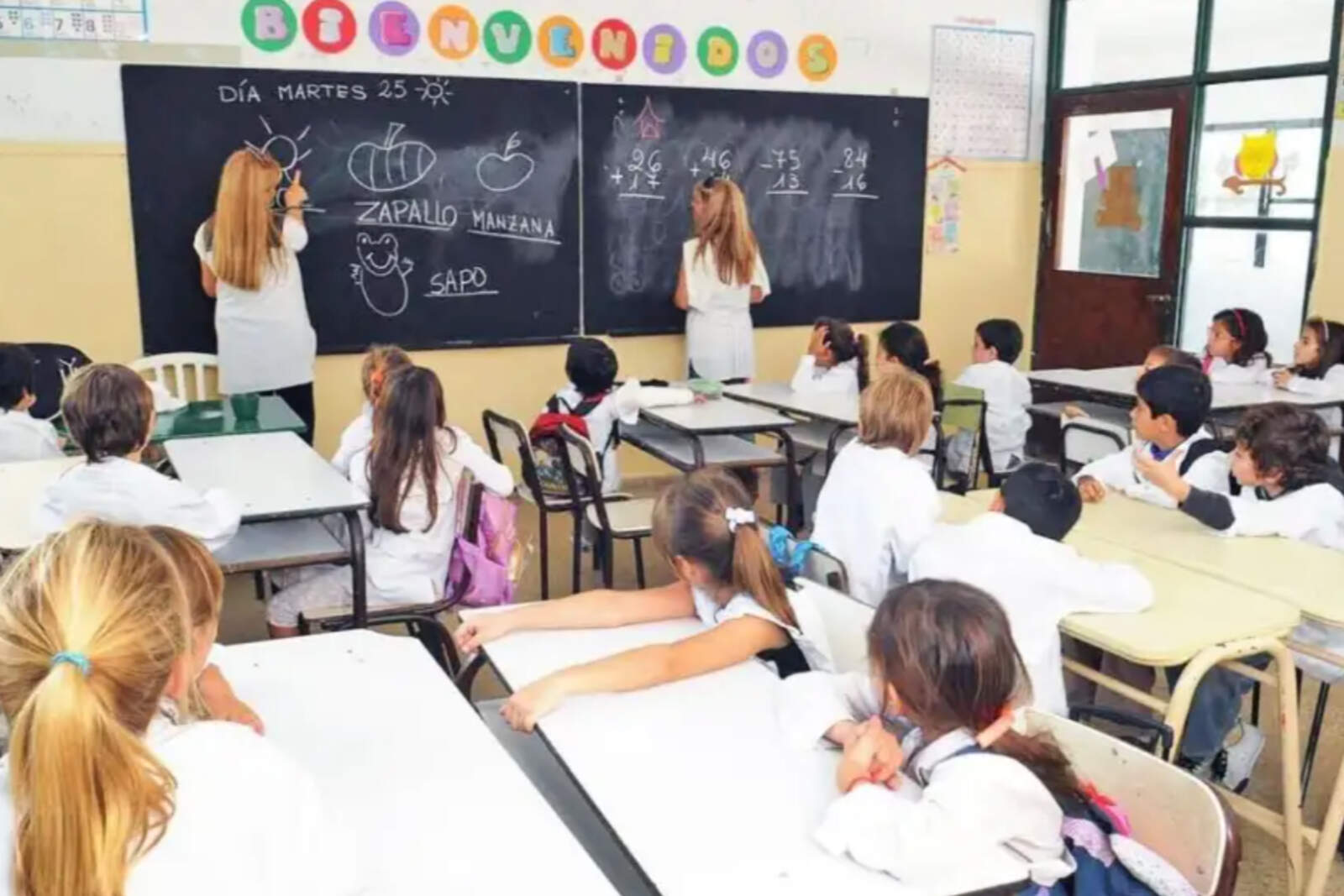
The Province will launch an educational transformation that will encompass all primary schools starting in 2026, incorporating new guidelines that cover institutional organization, content, and school schedules. The decision stems from an official government resolution that establishes a structural change in the way teaching is planned and daily pedagogical work is managed. The measure will apply to both public and private institutions, which will need to prepare for a general adaptation process throughout the next school year.
The Government presented this reform as part of a program aimed at modernizing teaching and strengthening skills considered essential for school performance in the different cycles. The initiative incorporates guidelines that seek to improve educational quality through the updating of the proposal and the expanded use of various learning tools. The central criterion of the redesign aims to integrate knowledge and promote skills that will enable students to function in increasingly complex environments.
The new framework includes four central components that reorganize everything from institutional projects to the distribution of pedagogical time in each school. Institutions will need to review their annual planning, redefine improvement projects, and update the mechanisms that coordinate content and practices. Meanwhile, the curriculum design will be renewed to prioritize reading, writing, speaking, problem-solving, digital citizenship, computational thinking, and social-emotional skills.
El Ministerio de Educación dispondrá un plan de apoyo con acompañamiento pedagógico con capacitación docente continua
Tutoring and complementary activities
Starting in 2026, each grade will have a Learning Support Tutoring session, conceived as a weekly space to reinforce priority content. These tutoring sessions will allow for addressing specific difficulties in small groups and offering more personalized opportunities, integrating into the new pedagogical structure. Institutional activities will also be promoted for students and families, including science, technology, art, and movement fairs to showcase learning processes.
The regulations promote a deep renewal of the system and organize the changes based on a comprehensive transformation built on four central pillars. The first is mandatory institutional updating, which requires reviewing the PEI and redefining the PMI 2026 to adapt them to the new curricular requirements. The second is a new curriculum design focused on essential skills, reorganizing learning to prioritize reading, writing, speaking, problem-solving, and digital competencies.
The third establishes more pedagogical time and a new schedule distribution, setting between 25 and 30 clock hours per week and strengthening the subjects Language, Mathematics, Science, and tutoring. The fourth is the strengthening of the Single School Day (JUE), which incorporates 50-minute modules, integrated projects, fairs, and STEAM experiences. Each pillar structures progressive changes that reorganize spaces, increase the hourly load, and promote more comprehensive institutional practices.
The Province indicated that each institution may decide until June 30, 2026, whether it wishes to apply as a Pioneer School within this new implementation process. To support the transition, the Ministry of Education will provide a support plan with pedagogical guidance, ongoing teacher training, technical assistance, connectivity, and academic resources. According to the educational authority, these measures seek to consolidate a "deep renewal of the educational system, with more school time, updated content, systematic tutoring, more technology in classrooms, and interdisciplinary projects."