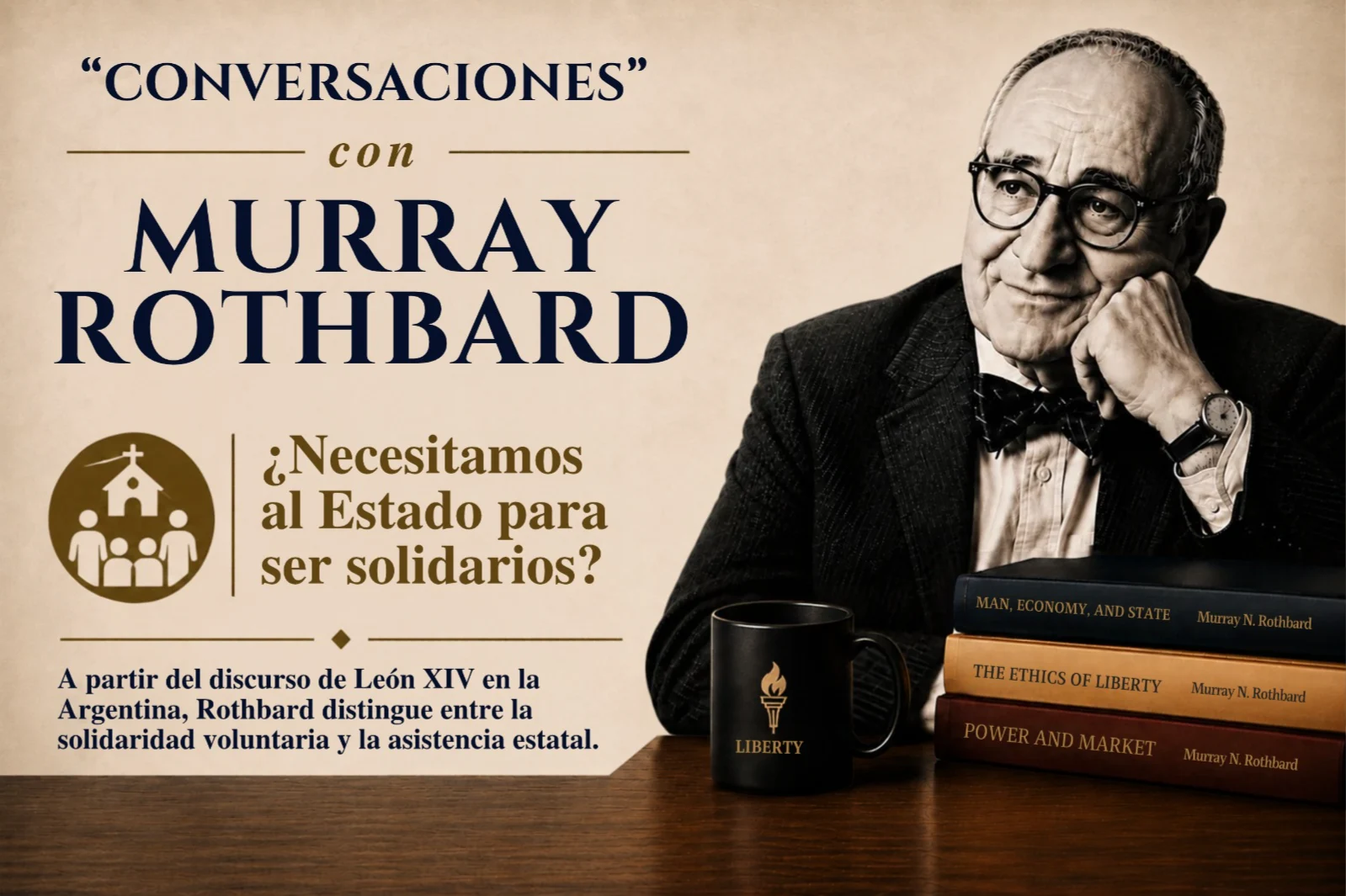

In the midst of a papal visit that has all of Argentina talking about Leo XIV, a part of his speech on Saturday at the Palacio Libertad deserves attention. The Pope defined the family as the “basic cell of society,” where we learn to care for the weak, share, and stand by those in need. He also recalled that for centuries the Church educated, cared for the sick, and accompanied the poor. He even stated that there are goods necessary for a society that no public policy can produce on its own.
This was the topic I returned to “discuss” with Murray Rothbard. Because those words allow us to separate two concepts that we often treat as synonyms: solidarity and state assistance.
—Professor Rothbard, the Pope just emphasized that in the family we learn to care for the weak and help those in need. Don’t we then need a supportive society?
—Naturally. The question is not whether people should help others. The question is what happens when we transform that moral responsibility into an obligation imposed by force.
—But if a poor person receives food, what does it matter if it came from a donation or a state program?
—For the person receiving the food, there is a similar material outcome. But the mechanism is completely different. In one case, someone decided to give their own resources; in the other, the State previously obtained resources through taxation and decided how to distribute them.
—So you reject help for the poor?
—On the contrary. In “Economic Controversies,” I defended replacing coercive public welfare with private charity. My objection is not against helping. It is against identifying help with coercion.
—Leo XIV also recalled that for centuries the Church educated, cared for the sick, and stood by the poor.
—And that demonstrates something important: recognizing a social need does not prove that the State must satisfy it. Between the isolated individual and the government, there is an enormous human capacity to associate, cooperate, and help voluntarily.
—But your critics might respond that voluntary charity may not be enough. What happens to someone whom no one wants to help?