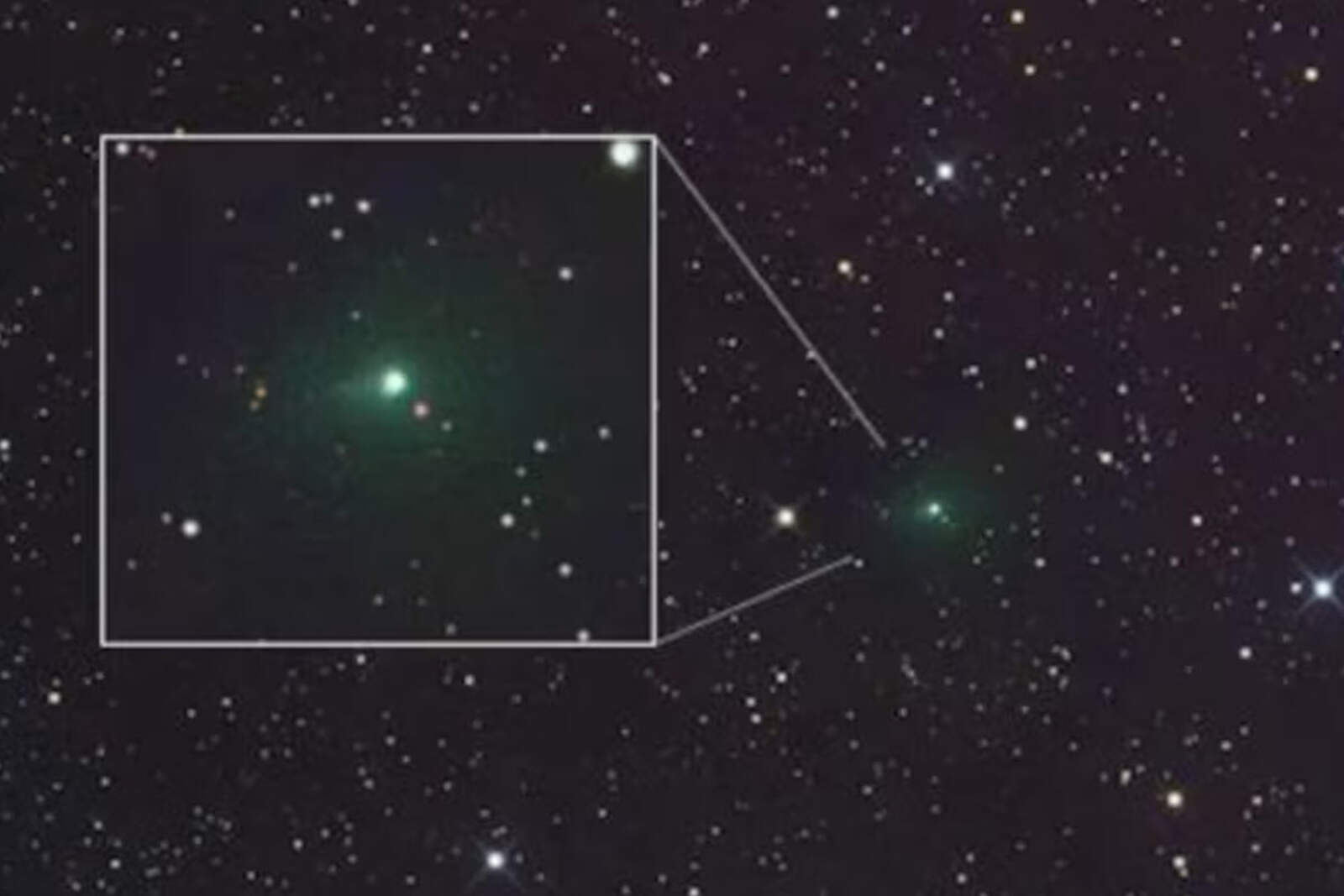
Comet 3I/ATLAS displays a pulse of light every 16 hours and is approaching its key moment on December 19
Nuevo
Agregar La Derecha Diario en
Compartir:
The 3I/ATLAS comet has once again surprised the scientific community with a phenomenon that has sparked as much curiosity as debate. A periodic signalin its brightness, described by specialists as a "cosmic heartbeat". The luminous pulse, recorded with a precision of 16.16 hours, was documented in a study published in Astronomy & Astrophysics.
The discovery comes at a crucial moment, as the interstellar object will reach its closest approach to Earth on December 19. On that day, it will pass at about 273 million kilometers (169.6 million miles), which will allow it to be observed in greater detail.
Su clásica tonalidad verde se transformó en un azul tenue
An interstellar comet with familiar behavior
Although 3I/ATLAS comes from outside the Solar System, its characteristics make it similar to weak comets from our own planetary region. This resemblance led researchers to rule out extravagant theories and propose a more plausible explanation for its repetitive pulse.
The key to the "heartbeat": the rotating nucleus
According to the study, the light pattern would be linked to the rotation of the nucleus. Harvard astronomer Avi Loeb explained that the comet may have a surface ice pocket that is cyclically exposed to the Sun.
When that area faces solar radiation, the ice sublimates and generates a jet of gas and dust. That material illuminates the coma, the cloud that surrounds the nucleus, producing the increase in brightness that repeats every 16.16 hours.
Avi Loeb acusó a la NASA de ocultar detalles del cometa 3I/ATLAS
The role of ejections and the questions raised by Loeb
Although NASA has confirmed that it is a natural comet, Loeb insists on continuing to analyze the trajectory of the jets. He suggests that if there were a non-natural origin, the ejections might not be oriented toward the Sun.
For now, all observations point to behavior consistent with an ordinary comet, although its interstellar origin makes it especially interesting for monitoring.