The bond Global 29 (GD29) rose 1.9%.
The Global 30 (GD30) advanced 2.2%.


The Country Risk fell to 446 points and S&P raised Argentina's sovereign rating to B-, supporting the fiscal and financial improvement of the country, managed by Milei
The bond Global 29 (GD29) rose 1.9%.
The Global 30 (GD30) advanced 2.2%.






The Global 35 (GD35) and Global 38 (GD38) bonds showed identical increases of 3.5%.
The big winner of the day was the Global 41 (GD41), with an improvement of 4.1%, followed by the Global 46 (GD46) which climbed 3.1%.

This financial shielding is supported by an impeccable management architecture that has allowed for expanding funding sources to cover debt maturities in 2026 and 2027. The Government has ensured stability through issuances of dollar bonds in the local market, agreements with international banks, and guarantees from multilateral organizations.
Looking ahead, projections under the libertarian model are of rational optimism. The economy is expected to grow 2.7% in 2026 and stabilize at a solid 3% annually thereafter. The pillar of this renaissance will be the energy sector, with Vaca Muerta at the forefront, projecting a trade surplus of USD 10 billion in 2026, a figure that leaves behind the meager USD 5.9 billion from the last year of the previous administration.
As for the scourge of prices, inflation is expected to fall from the 42% projected for 2025 to 32% this year, with the non-negotiable goal of reaching single-digit levels by the end of the decade. As analyst Camilo Tiscornia pointed out, fiscal policy and the overall macroeconomic improvement are what today allow Argentina to finally be seen as a serious country in the eyes of the world.
In a historic turn that marks a before and after for national finances, the Republic of Argentina has managed to break the chains of international distrust. Under the leadership of President Javier Milei, the libertarian administration has achieved macroeconomic milestones that the global community is now rewarding with a substantial improvement in sovereign solvency.
The agency S&P Global Ratings decided this Wednesday to raise the country's sovereign rating, moving from a humiliating CCC+ to a hopeful B- with a stable outlook. This decision, which places the nation outside the category of imminent default risk, is the direct result of the consolidation of fiscal balance and the accumulation of reserves being carried out by Minister "Toto" Caputo.
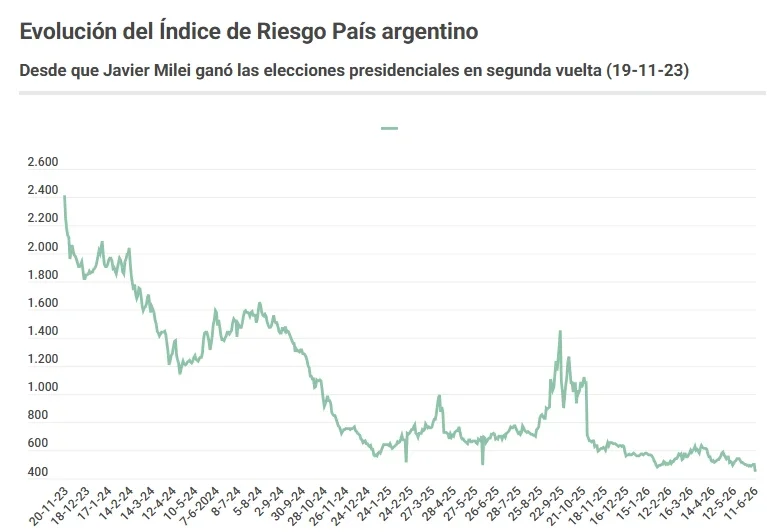
The financial market has reacted with euphoria to this validation of the freedom model. The Country Risk, a key indicator developed by JP Morgan, suffered a collapse of 11% (or 10.54% according to the most recent records), breaking the floor of 450 units to settle at just 446 basis points.
This record represents the lowest level in the last eight years, far surpassing the previous minimum of 481 points reached under Milei in January, and returning the country to figures from May 2018.
The strength of the adjustment and cleanup policies has even convinced the most skeptical analysts. According to the S&P report, the upgrade in the rating is based on the reduction of macroeconomic imbalances and the deceleration of inflation.
The agency was unequivocal in stating: “The accumulation of international reserves and continued fiscal surpluses strengthened the Government's liquidity profile”. For his part, economist Fernando Marull highlighted that this improvement, which adds to the one already granted by Fitch Ratings in May, will give a new "boost" to local assets.
In the meticulous detail of financial operations, dollar-denominated sovereign bonds began an unstoppable climb on Wall Street. The performance of the securities was as follows:



