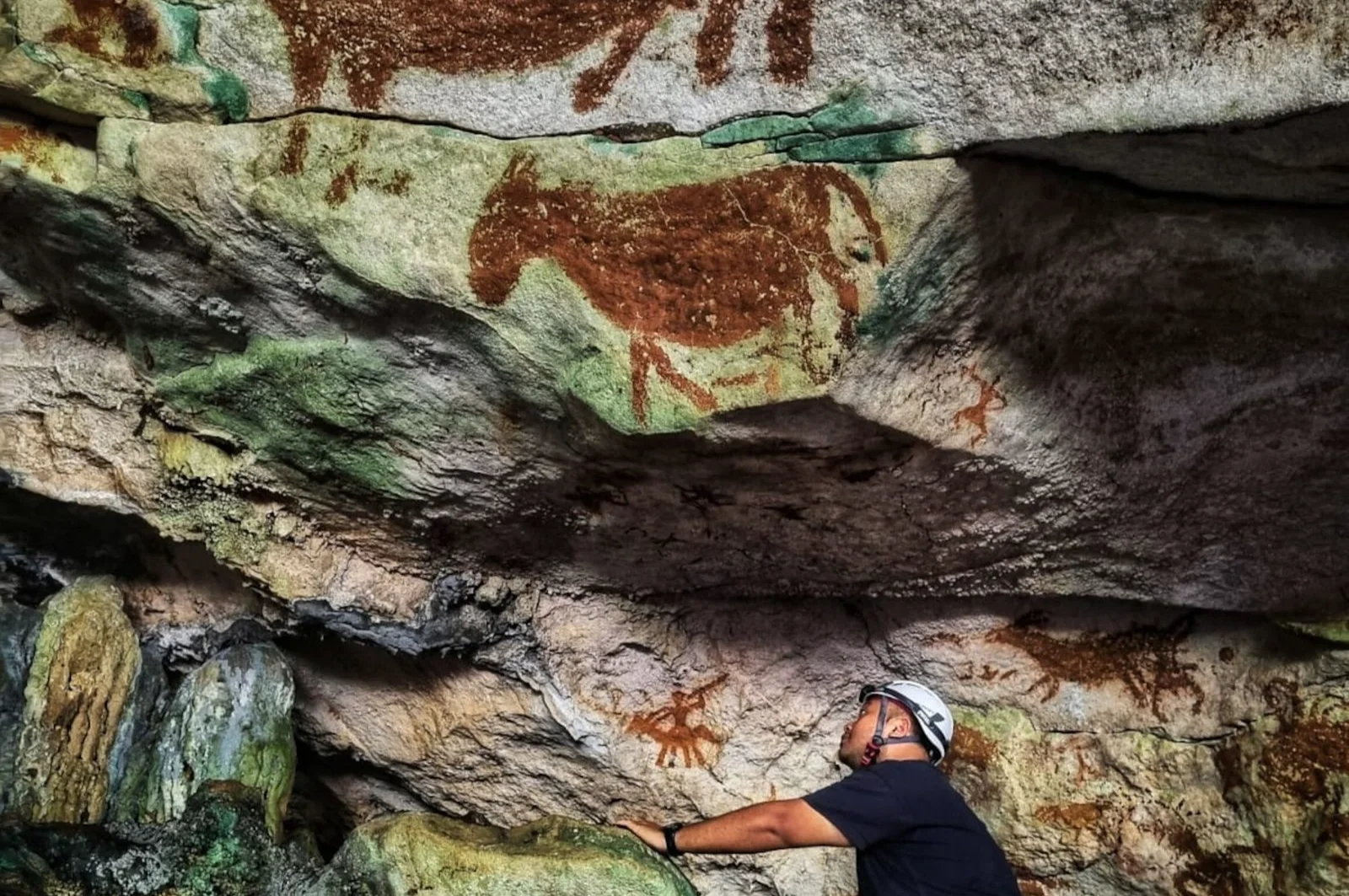
Archaeologists found in a cave on the Indonesian island of Muna the oldest rock art attributed to modern humans. It is a hand stencil that appears transformed into a claw, dated to at least 67,800 years ago.
The discovery, published in the journal Nature, was made in the Liang Metanduno cave. There, researchers like Adhi Agus Oktaviana and Maxime Aubert used an advanced laser dating technique to confirm its age.
This work is older than previous findings in caves in Sulawesi and is also older than the Neanderthal hand stencils found in Spain. It represents a key advancement in understanding human cognitive evolution.
Experts highlight that the modification of the finger to give it a claw-like appearance is not accidental. It suggests that prehistoric artists had the ability to imagine and create something that did not exist in reality.

A sophisticated mind in the Pleistocene
According to Oktaviana, this antiquity demonstrates that the first modern humans in Nusantara, the Indonesian archipelago, already possessed sophisticated cognition. They could transform a simple handprint into an artistic and symbolic expression.
Adam Brumm, co-author of the study, emphasized that this is the strongest evidence of human presence in the region during the late Pleistocene and of their creative capacity. The inhabitants continued practicing rock art for tens of thousands of years.
The researchers also dated other stencils in nearby caves, with ages ranging from 44,500 to 20,400 years. This indicates a prolonged artistic tradition that extended until the last glacial maximum.
The finding provides important data about migratory routes. Humans who inhabited these islands likely had the cognitive and technological skills necessary to navigate and jump between islands to Sahul, the continent that included Australia.
Implications for human history
This type of art challenges old Eurocentric views that placed modern cognitive development primarily in Europe. New dating techniques now allow for a better understanding of art made with ochre, common in Asia.
In 2019, the same researchers found narrative scenes in Sulawesi dating back 51,200 years with hybrid figures hunting animals. The new finding in Muna reinforces the idea that these groups had advanced symbolic thinking.
Some local specialists link the hand stencils to rituals to ward off bad luck, a practice that persists in certain indigenous groups in the region. However, the authors of the study prefer to focus on the evidence of mental complexity.
The use of the laser ablation technique allowed for the analysis of carbonate deposits over the pigment without damaging the paintings. This opens new possibilities for dating rock art in other parts of the world where ochre was used.
In summary, the art of Liang Metanduno not only sets a new record for antiquity but also sheds light on the creative and adaptive capacity of our ancestors who populated Southeast Asia and then Australia about 65,000 years ago.