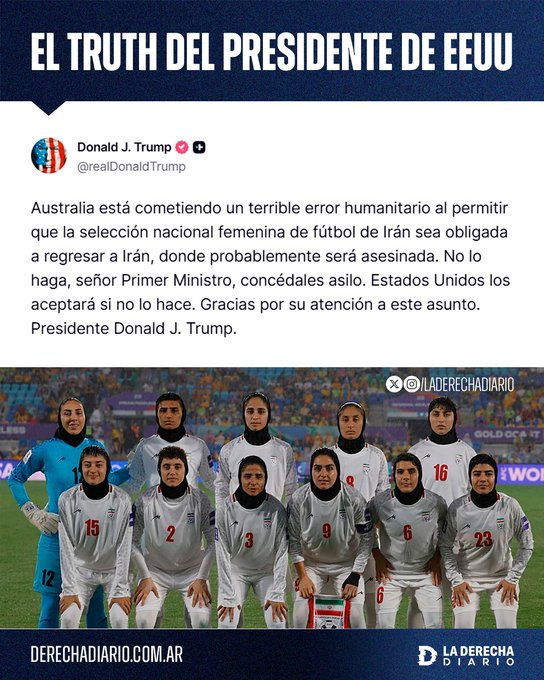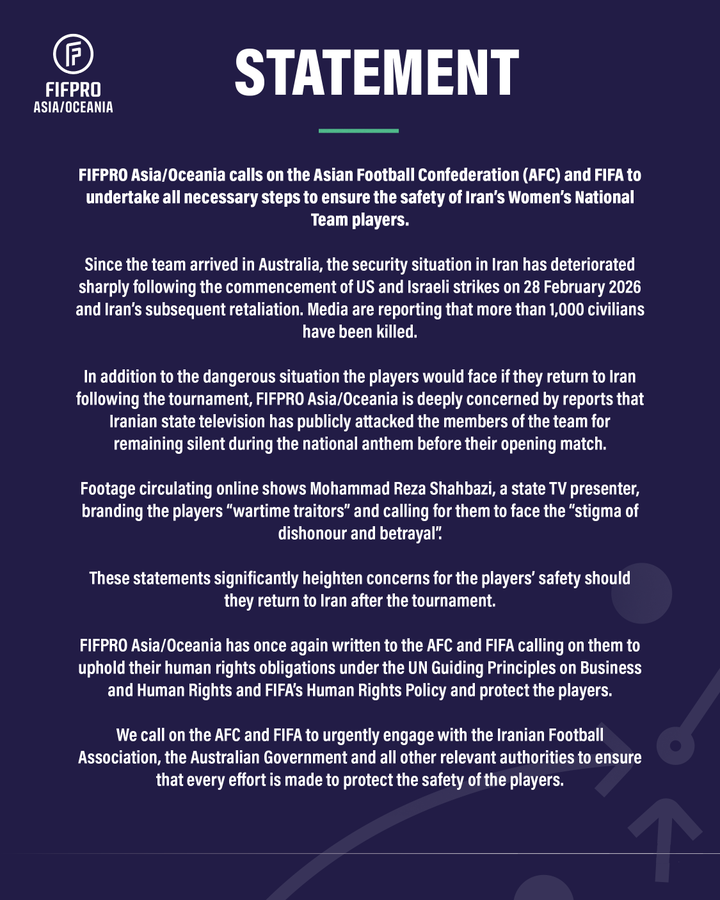

A request promoted by the Australian Iranian Council for the Canberra government to grant political asylum recalled that, after the match against South Korea, Iranian state media “publicly condemned the players harshly, calling their conduct treasonable in times of war and demanding that they be treated as traitors”.
A commentator on an official channel even described them as “the height of dishonor”. The petition addressed to Minister Burke collected more than 50,000 signatures in a few hours, after the last game played against the Philippines. Meanwhile, the position within the team itself generated confusion. In the opening match, the coaching staff also refused to sing the anthem, but in the subsequent meetings of the group stage, the entire delegation ended up singing it while giving the usual military salute, which sparked speculation about
direct pressure from Tehran.The official Australian agency AAP also quoted statements attributed to coach Marziyeh Jafari, who reportedly said that the team “wants to return to Iran as soon as possible”. “I want to be with my country and my home... We can't wait to return,” he said. From Iran, local media also quoted statements by Farideh Shojaei, vice-president of women's affairs of the Iranian Football Federation, who said that the return of the delegation was delayed due to air traffic disorders due to the
situation in the Middle East.Shojaei also said that the delegation “spoke to the families of these five players”, a detail that fueled suspicions about indirect pressure.
The case of female soccer players is not an isolated episode in Iranian sports. One of the best-known examples is that of climber Elnaz Rekabi, who competed in the Seoul World Cup without her hijab a month after the death of Mahsa Amini, the young woman whose death in 2022 in the custody of the moral police sparked massive protests. After that gesture, Rekabi would have spent two and a half years under house arrest,
according to various versions.She finally left Iran in March 2025, after being appointed ambassador for the Dakar 2026 Youth Olympic Games. Another even more dramatic case was that of the national karate champion Mohammad Mehdi, executed in January 2023 for his participation in protests against the compulsory use of the hijab and the actions of the moral police. The magnitude of the persecution was also reflected in the Paris 2024 Olympic Games, where 14 of the 36 members of the Refugee Olympic Team were Iranians, a figure that tripled the number of athletes from Syria or Afghanistan, two countries mired
in armed conflicts.