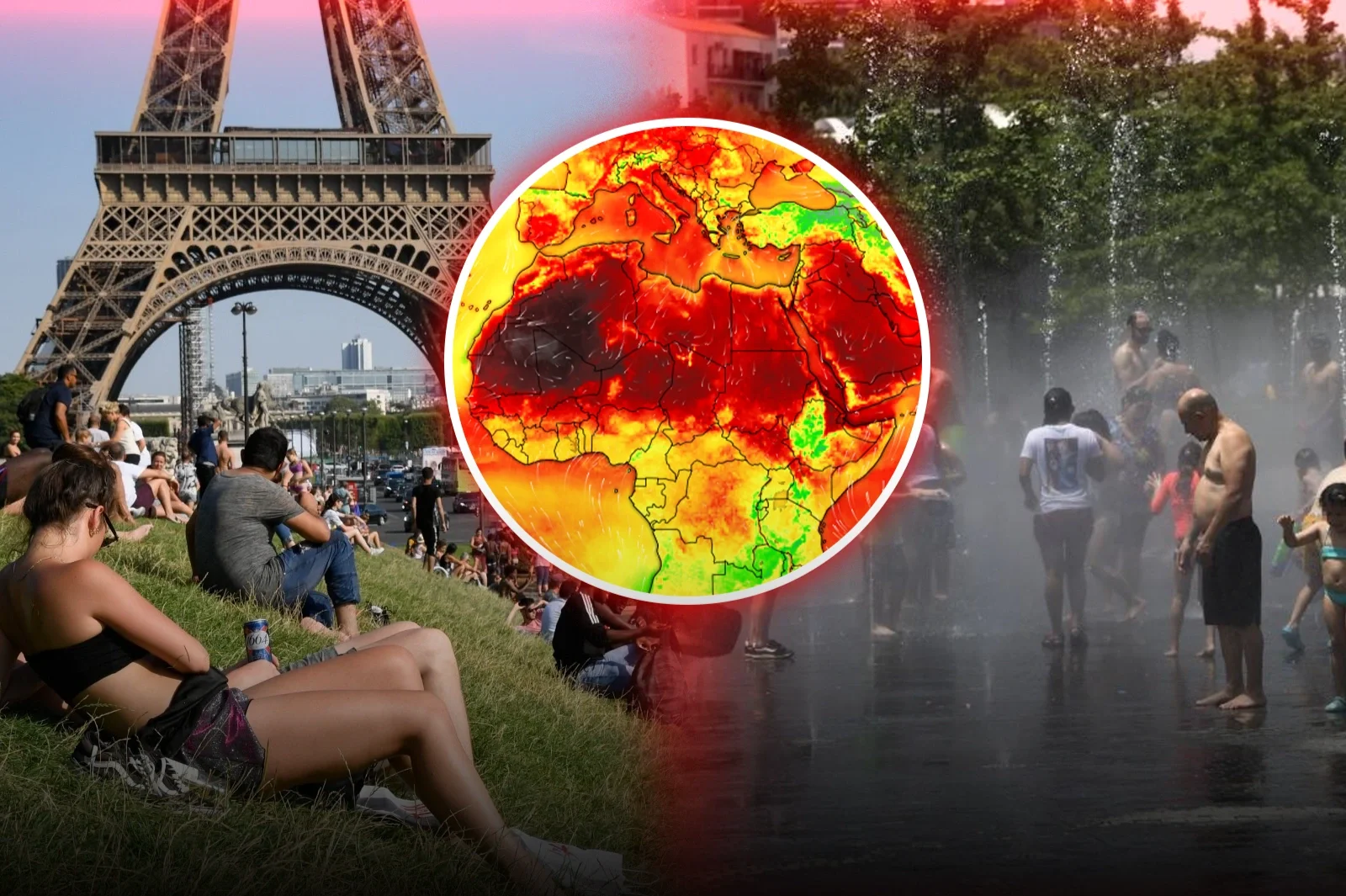
The WHO reported more than 1,300 deaths linked to extreme heat since June 21, while 191 million people endure temperatures above 35 °C and 22 countries remain on alert
Europe is experiencing one of the most extreme and devastating heat waves in its recent history, a phenomenon that has put at least twenty-two countries on red alert and threatens the health of millions of citizens. According to official data from the World Health Organization (WHO), since June 21, there have been more than 1,300 additional deaths on the continent directly linked to the heat surge.
The director-general of the organization, Tedros Adhanom Ghebreyesus, was blunt in warning that “150 million people are living under extreme heat, hundreds have died, schools are closed, and power grids are collapsing”. The latest projections raise the number of people enduring temperatures above 35 °C to 191 million.
Image of the heat wave in Paris
The magnitude of the disaster has led political leaders to compare the situation to the darkest moments of recent history. The Belgian Minister of Health and Environment, Yves Coppieters, stated that we are facing a “health crisis similar to what we experienced with Covid-19”.
The official denounced that, after just five days of intense heat, “the main structural pillars of society are crumbling”, affecting everything from public transport to the operation of nursing homes and the education system.
In meteorological terms, this earthly hell is caused by a phenomenon known as “Omega blocking”, which traps a mass of hot air over the region and prevents the entry of cool fronts, raising temperatures between 16 and 18 °C above normal. This configuration has shattered historical records in multiple nations:
Germany: Recorded a maximum peak of 41.7 °C in Coschen and 41.5 °C in Möckern-Drewitz.
Spain: Reached 42.7 °C in Bilbao, while in Andalusia, temperatures exceeded 45 °C.
Czech Republic: Marked a historic high of 41.1 °C in Doksany.
Poland: Reported a record of 40.5 °C.
Switzerland: Basel recorded 39 °C, breaking records for three consecutive days.
Denmark: Reached 37 °C in Aarhus, its highest temperature since 1874.
The impact on public health, defined by the World Meteorological Organization (WMO) as the “silent killer”, manifests through heat stress.
Image of the heatwave in Italy
This occurs when the body absorbs more heat than it can release, a critical situation when nighttime temperatures do not allow for physical recovery. Lachlan McIver, an advisor to the WHO, explained that “prolonged exposure... means that the body starts each day already stressed”.
In France, the situation is particularly alarming, with nearly 1,000 additional deaths recorded during this crisis.
European infrastructure has proven inadequate to meet the challenge. In Germany, the A7 highway suffered asphalt fractures, and the operator Deutsche Bahn had to cancel trips due to damage to the tracks.
In Austria, the deformation of the railway tracks also caused massive disruptions, while emergency services in Vienna saw a 15% increase in their calls.
Even in Paris, serious incidents were reported, such as a bus driver fainting at the wheel, in vehicles where the temperature reached 46 °C according to union reports.
Amid the chaos, solar energy has emerged as an essential relief. In the United Kingdom, the 1.9 million households equipped with solar panels have been able to power air conditioning systems for up to five hours a day at no additional cost.
However, this individual relief reopens the debate on environmental sustainability and the urban heat island effect, as the heat expelled by household appliances can raise nighttime temperatures in urban centers by up to 4 °C above rural areas.
While the European Union plans to eliminate harmful refrigerant gases by 2032, the current reality is a race for survival where, according to researcher Yuli Shan, “defending ourselves from extreme heat exacerbates the problem even further”.