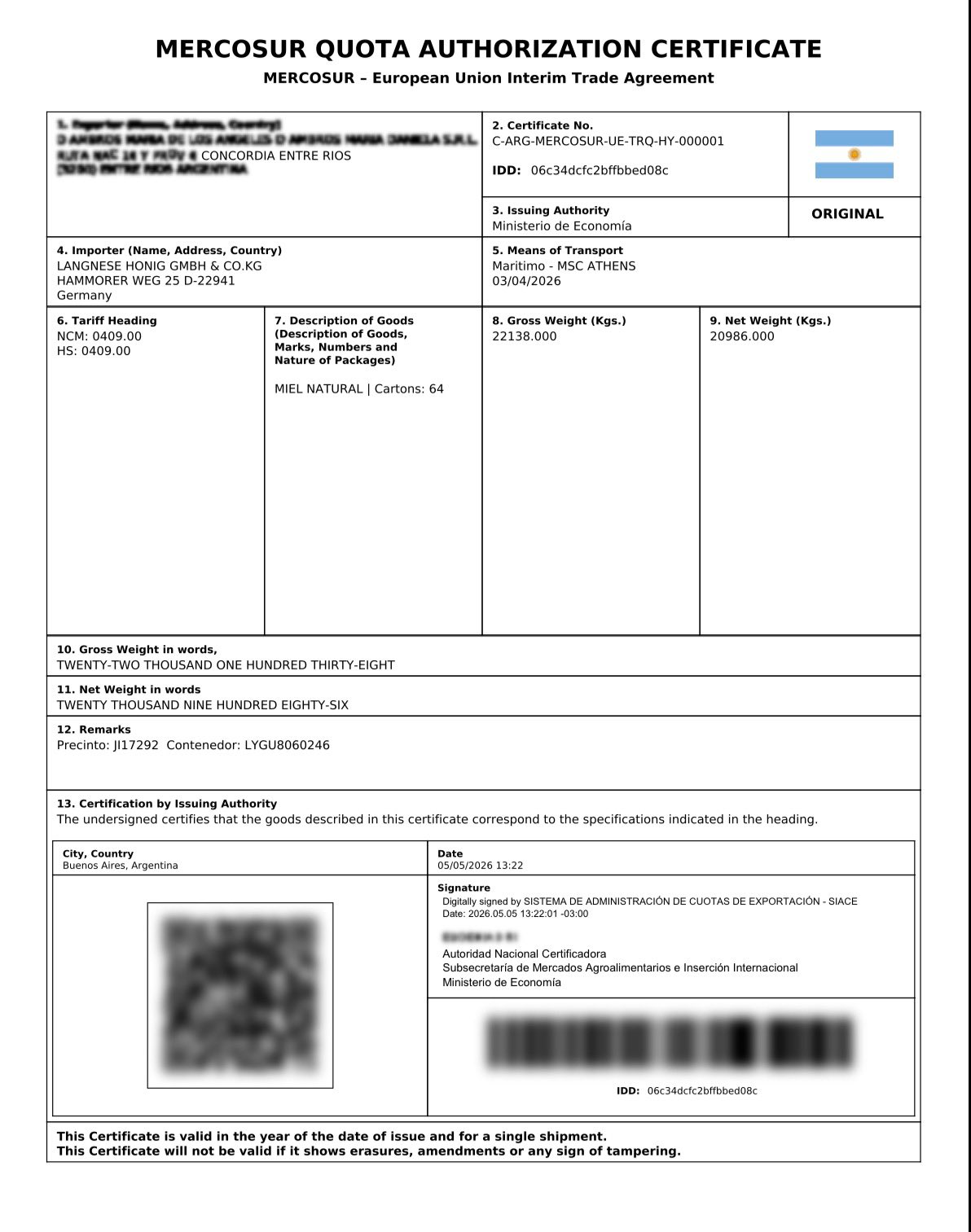
Argentina took a concrete step in implementing the agreement between Mercosur and the European Union: the Government issued the first certificate that enables the use of quotas granted by the European bloc, with an export of honey from Concordia, Entre Ríos, to Europe.
The news was confirmed by the Secretary of Finance, Pablo Quirno, who is on his way to the United States with President Javier Milei and the Minister of Economy, Luis Caputo, to participate in the Global Conference of the Milken Institute. In this context, the official highlighted the issuance of the first certificate as a concrete sign that the new business scheme has already started to work.
The certificate issued by the Ministry of Economy.
According to Quirno, the first certification corresponds to an export of natural honey produced in Concordia, Entre Ríos. Until April 30, this product entered the European market with a tariff of 17.3%. Based on this new mechanism, the operation will start for Europe with a 0% tariff, which directly improves the competitiveness of the Argentine product
.
The certificate presented by the official corresponds to the Interim Trade Agreement between Mercosur and the European Union. The document shows an export of natural honey to Europe, under the system of managed quotas, with the intervention of the Ministry of Economy as the issuing authority
.
The advance represents an important signal for regional economies, especially for productive provinces such as Entre Ríos, where the opening of markets and the reduction of trade barriers can translate into more production, more exports and more private employment.
Lowering from a tariff of 17.3% to 0% implies an immediate improvement for Argentine exporters, who can now compete on better terms against other international suppliers. In tight margin sectors, this type of relief can define whether a transaction is completed or is left out of the market
. Javier Milei together with Ursula von der Leyen, President of the European Commission.
Quirno summarized the impact of the agreement with a political and economic definition: more exports, more production and more employment for the provinces. The phrase marks the approach that the Government seeks to impart to its foreign and commercial policy: opening markets, lowering costs and turning international integration into a tool
for real growth.
The case of honey from Entre Ríos also works as a concrete example of productive federalism. This is not just an agreement signed at diplomatic offices, but an operation that was born in an Argentine province and reaches the European market with better access conditions