
The fall of the Kirchnerist wall and the arrival of mortgage loans

The fall of the Kirchnerist wall and the arrival of mortgage loans
Imagen de Editorial Team
porEditorial Team
Argentina

Financial opening and dollar credit could unlock new productive investments and expand access to financing for companies and developers

Add La Derecha Diario on
Share:

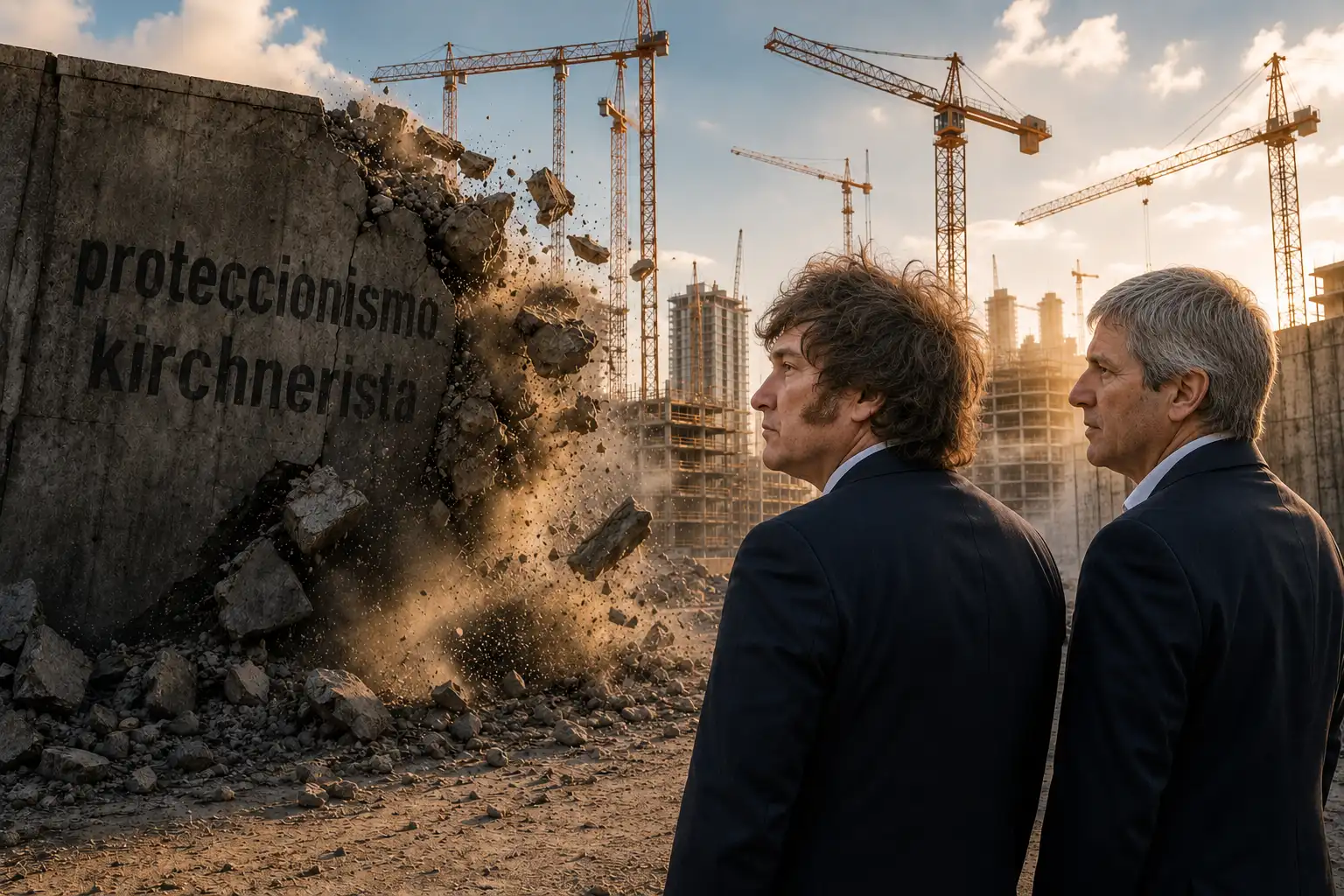
The triumph of Javier Milei in 2023 will be studied for many years in the books of Argentine History, not only as an unprecedented process of cultural change and the establishment of a new economic model in Argentina, but also as the closure of a statist phase of very low effectiveness, which manifested as a sectarian movement within Peronism known as Kirchnerism. This movement locked Argentines behind a wall for almost twenty years, isolating us from the world in a bubble of inequities and arbitrariness, and it ended with the advent of a new way of navigating politics and direct communication with the people embodied by La Libertad Avanza.

The process bears some similarities to the fall of the Berlin Wall in the '90s and the countries under the orbit of the old Soviet Union, as well as with the dynamics observed thereafter in the economies of those countries.

Embracing market policies implies: clarifying economic variables; drastically reducing inflation, preventing the proliferation of varied exchange rates, the coexistence of giant gaps with the official dollar, and the systematic shortage of key inputs due to the much-questioned "administration" of foreign trade, both for exports and imports.

Kirchnerism evolved into a kind of light chavismo that was maturing enough in terms of the exhaustion of the model to quickly mutate into the chaos we have already seen installed for decades in beloved and suffering Venezuela.

Argentines (at least 57% of us) realized, fortunately not too late, that Milei could lead us to a place that avoids that abyss, that returns us to the ranks of normal countries, and that allows us to dream again of a great Argentina.

 But what does a great Argentina look like? Did we get there without warning?

The legitimacy of the president's origin is both substantive and formal. He told us from day one the extent of the adjustment he intended to implement, even exemplifying it with a chainsaw that became emblematic of his proposal.

As for the forms, no one can claim a change in discourse or tone because there was no media outlet during his campaign that did not expose in all its dimensions the immensity of his anger and the intensity with which he had to overact his positions to carry out a huge cultural change entrenched in almost all institutions and corporations that resisted (and continue to resist) complying with the mandate of the ballot boxes regarding what the people wanted as the fate of the caste.

What are the classic economic stages in these radical transformation processes like that of the USSR and the local one?

In the first stage, when economic variables are clarified and public spending is adjusted in a significant way as occurred from the beginning of 2024, a period of economic depression and social uncertainty is visualized. Some sectors do not quickly find a floor from which they can project themselves while others begin to grow rapidly in an environment that facilitates the explosion of their competitive advantages.

Sectors that had grown for decades under state protection, whether through "inefficient" public spending, unsustainable tax advantages, or through the closure of imports that guaranteed them a captive market, begin to see their activity reduced and resized to their real comparative advantages. Sometimes, the lack of management capable of operating in a competitive environment makes it even harder for them to find a way to reinvent themselves.

There are other sectors that quickly find the way to grow and develop. In our country, this is the case for oil, gas, mining, lithium, agriculture, livestock, and knowledge sciences. The very dynamics of an orderly country allow them to find and unleash their potential desired by the world.

At this point, it is worth remembering that we are not a country of 200 or 500 million inhabitants with a robust internal market that allows us to operate some sectors at a competitive scale like Brazil, the USA, India, or China. In this aspect, our economy resembles Canada or Australia much more, with a huge amount of natural resources capable of being industrialized and adding value for a global market of 7 billion people and not for an internal one of 45 million.

Other activities enter a resizing dynamic according to what they have invested in technological innovation, production, and product design. Those who invested more suffer less from this process.

Meanwhile, those who enjoyed the benefits of protectionism for decades thinking it would be eternal suffer more. This is the case for industries that do not start from any differentiation in their production process, brand, or product. The most affected are linked to the textile sector, computers and cell phones, as well as household appliances and some car models. It is difficult to compete in these areas with global giants from countries that also have lower taxes and much lower wages than ours.

Argentina showed them the worst face of reality after many years of masks: we were a closed country that is now beginning to timidly open up to the world. But we also have a gigantic state that needs an expensive tax structure to sustain it.

The new model of Javier Milei leaves a pending debt for his second term in this regard: a deep tax reform and of the State in general that values a new rule of co-participation. And a system of pressure and tax burden that does not suffocate the private productive sector and returns the competitiveness that was stolen from it for decades through extremely high taxes, which were illusorily compensated with recurrent nominal devaluations.

In this dynamic of transformation processes of this magnitude, inevitably winner sectors emerge faster than the reconversion of those that prima facie appear as losers. And in that transition time, doubts, sadness, and uncertainty about the sustainability of the model arise. YOU ARE HERE TODAY.


The sectors that have not realized they are on the winning list

There are intermediate sectors that still do not realize they are part of the winning list because those advantages are not so obvious: construction, real estate development, and services in general. And now we will explain why.

In this difficult transition, the model shows cruel sides: very high interest rates, currency appreciation, and stagnant real wages. This is the way the national "organism" finds to adapt and function in a state of latency until the virtuous accelerators begin to work.

What are those accelerators and what can be expected in the short term regarding this?

The main accelerator is investment. The other is the improvement of real wages and lastly, but no less important, exports. Although there are more than 130 billion dollars presented under the RIGI framework, the number of approved projects and those that are already beginning to show concrete execution are still scarce.

Surely by 2027 we will see more movement of the committed investments, but undoubtedly the risk of continuity or change tied to the 2027 elections is an important hinge that the system of economic gears finds for the machine to reach an optimal rhythm.

Surveys towards the end of the year that show a popular will more inclined to support a second term would facilitate the flow of resources necessary to oil the engine and avoid friction.

 Is the government taking the initiative on some of these issues to give signals to the market of the right incentives?

On one hand, the government seems less intrusive in the homologation of collective bargaining agreements. Some of that is already reflected in a gradual improvement and sawtooth of real wages, but we must be pragmatic and accept that this process will be heterogeneous depending on the productivity of each sector.

On the other hand, this week Minister Luis Caputo announced the boldest measure since the exit from the currency controls. He decided to relax the macro-prudential rule from 2001 by which banks could not lend dollars to individuals and/or companies that did not have income in that currency.

Today the banking system has almost 40 billion dollars in bank deposits from savers who (at least) are now encouraged not to leave them under the mattress. However, they were still sleeping the sleep of the just in monetary and productive terms since banks could only lend them to the export sector, but now they will be able to turn to all SMEs.

A collateral benefit of the measure is that companies that take out a loan in dollars will have to liquidate them in the exchange market, thus eliminating the risk of multiplying secondary currency that is not legal tender and generating as an advantage a greater influx of dollar supply to the market which is always welcome to provide fluidity and predictability.

With the aim of beginning to monetize those savings and put them at the service of production, companies (for now individuals are excluded) will benefit from credit instruments with rates of 7-8% per year. They clearly enable many more projects than those we currently know in pesos at rates of 50-60%, still very high in real terms compared to inflation.

And how does this flexibility of dollar loans reach the people?

Perhaps the most noble and tangible example can be seen with the real estate project developers who will now be able to access dollar loans at very low rates to build buildings, ventures, houses, or renovations.

But isn't there a need to connect the other end? The one for the individual who needs to secure a long-term mortgage for their first home as happens in all countries of the world? Yes, that is missing. But I believe it is on the way. The next bold measure from Minister Toto Caputo will be the conversion of a part of the FGS of Anses into long-term UVA fixed terms that will be auctioned to private banks.

This will allow Anses to move away from more volatile assets like stocks to a fixed and secure income instrument that initially maintains purchasing power and achieves an attractive interest on top of that.

But above all, it will provide banks with the long-term funding they currently lack to convert it into UVA mortgage loans + 7-8% interest, an instrument suitable for young people to access their first home with a debt that is updated at the same rate as their salaries.

From now until the end of the year, we will see several of these. And at the pace of their execution, we will also see the reflection of confidence in the government in the electoral surveys. In the credible ones, of course.

More time is needed to see the fruits of a transformation. But it is worth seeing how the economies that emerged with the fall of the wall are doing today


La Derecha Diario logo
TwitterInstagramYouTubeTikTokFacebook
Derecha Diario TV

Nosotros

  • Quienes Somos
  • Autores
  • Donar

Privacidad

  • Protección de datos
  • Canales
  • Sitemap
  • RSS

Contacto

  • info@derechadiario.com.ar
PUBLICIDAD

Related news

Abelardo ordered a minister on Twitter to fire all the leftists from her ministry

Abelardo ordered a minister on Twitter to fire all the leftists from her ministry

The Third Wave of "cultural socialism" in universities

The Third Wave of "cultural socialism" in universities

The Civil Guard confirmed 15 rapes in Ceuta following the invasion of illegal Moroccan immigrants

The Civil Guard confirmed 15 rapes in Ceuta following the invasion of illegal Moroccan immigrants

The court upheld the power of U.S. troops to make arrests in border areas

The court upheld the power of U.S. troops to make arrests in border areas

Brake on Madness: Greg Abbott banned the installation of foot washing stations for Muslims in airports

Brake on Madness: Greg Abbott banned the installation of foot washing stations for Muslims in airports

The Trump administration warned the European Union about its regulations on American companies

The Trump administration warned the European Union about its regulations on American companies

La Derecha Diario logoLa Derecha Diario logo
ESX logoInstagram logoYouTube logoTikTok logoFacebook
ARGENTINAUNITED STATESECUADORISRAELMEXICODERECHA DIARIO TV
  • ES
    XInstagramYouTubeTikTokFacebook
  • DERECHA DIARIO TV
  • Sections
  • ARGENTINA
  • UNITED STATES
  • ECUADOR
  • ISRAEL
  • MEXICO
  • URUGUAY
  • Countries
  • La Derecha Diario logoLA DERECHA DIARIO
  • La Derecha Diario México logoLA DERECHA DIARIO MÉXICO
  • La Derecha Diario Uruguay logoLA DERECHA DIARIO URUGUAY
  • La Derecha Diario Ecuador logoLA DERECHA DIARIO ECUADOR
  • La Derecha Diario Israel logoLA DERECHA DIARIO ISRAEL
  • La Derecha Diario Estados Unidos logoLA DERECHA DIARIO ESTADOS UNIDOS
  • Topics
  • GUERRA EN IRÁN
  • The Newspaper
  • QUIENES SOMOS
  • AUTORES
  • PUBLICIDAD
  • DONAR