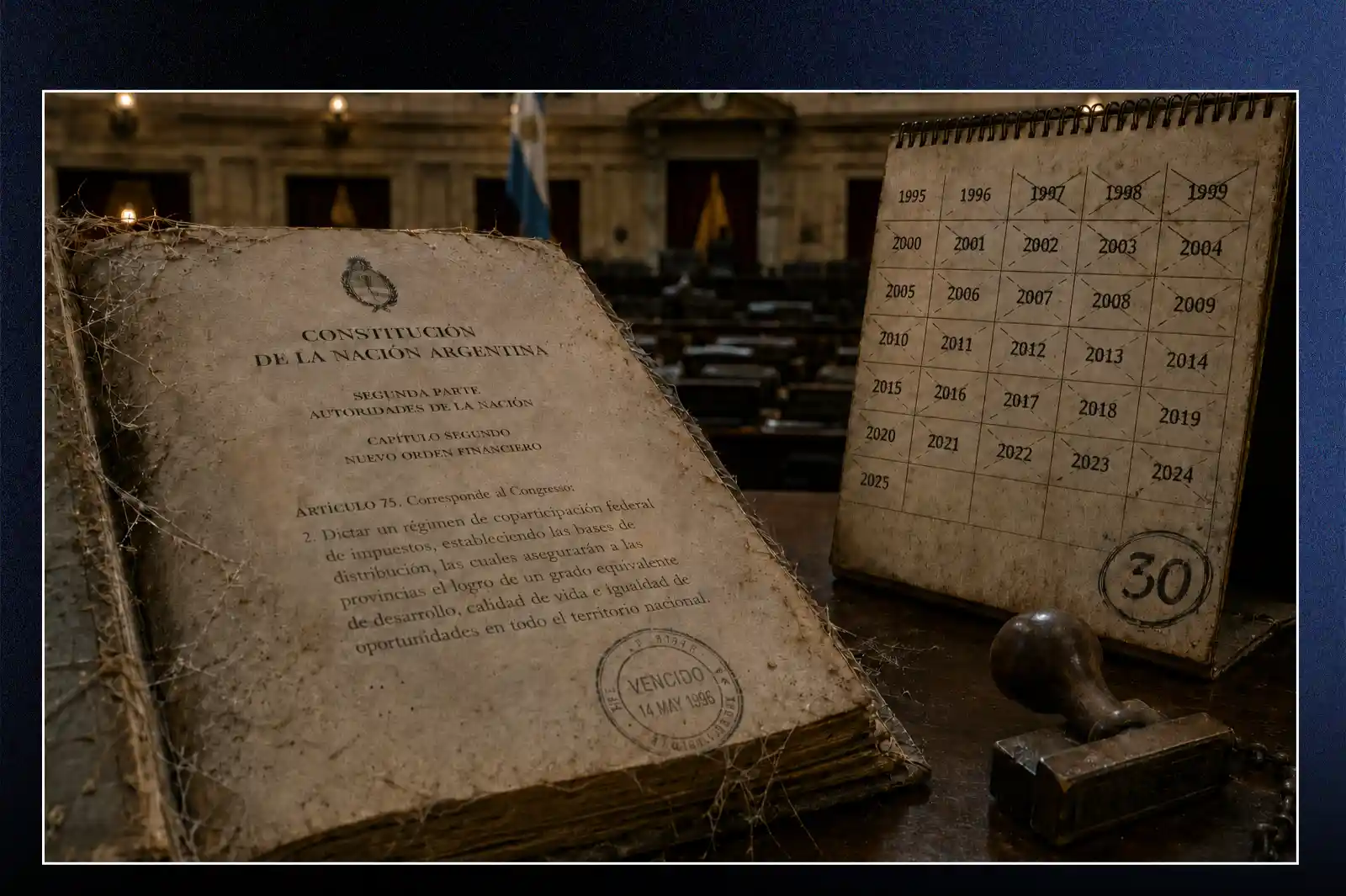
In 1994, we Argentines reformed our National Constitution. Among other major issues, the constituent assembly incorporated that year, through article 75, section 2, parameters for a new federal tax sharing regime, which was to be established before the end of 1996 through a law agreed upon between the Nation and the Provinces.
It has been exactly thirty years since this mandate has gone unfulfilled. This is a clear indication that the purpose of the constituent assembly in this matter is impossible to achieve. This is not only for substantial reasons, related to the sensitive issues at stake (the short blanket), but also for procedural reasons: the mechanism for modifying the federal tax sharing stipulated in article 75 section 2 requires not only special majorities in Congress but also the unanimous agreement of all the provinces.
The issue of federal tax sharing is a crucial matter in the design of our fiscal federalism, which has been addressed by infraconstitutional norms since the late 19th century.
In 1994, there was an attempt to constitutionalize the system, but in practice, we never managed to move beyond the last tax sharing law enacted before that reform. Only patches were made, through the so-called fiscal pacts, and the so-called “labyrinth of tax sharing” became increasingly intricate. This, in turn, implies that it became progressively less agile, heavier for the taxpayer, less friendly for the design of fiscal policies, for the national government but perhaps mainly for the provinces.
Whoever resolves that labyrinth will be the great liberator of the productive and economic forces of Argentina.
Tax sharing is the great Gordian knot of our political, economic, and institutional development. Do we persist resignedly before the knot, as we have so far, or do we cut it in one stroke? The way to cut it is to call for a constitutional reform to re-discuss not tax sharing, but our fiscal federalism in an integral manner.
Tax Sharing is Not Synonymous with Federalism
It is a mistake to identify tax sharing with fiscal federalism. Federal tax sharing is not necessarily federalism, and it can even be the opposite.
The federalism proclaimed by our Constitution has a sense, a cause, a material one. Argentina is a huge and very geographically diverse country. Federalism is a practical option. In a country with these characteristics, it is advisable to leave a wide margin of autonomy to the Provinces so that they can implement the economic policy options that best suit the resources they have.
Our 19th-century constituents were clear about this. The preservation of true autonomy in the Provinces was essential for the nation-building project dreamed of in 1853 to be realized. Based on the idea—closely related to liberalism—that self-interest would lead each jurisdiction to exploit its own resources in the most convenient way, the political program of 1853 stipulated that all necessary tools for pursuing their material progress should remain in the hands of the provinces. The progress of the provinces would derive the progress of the Nation. The Nation did assume the commitment to subsidize provinces whose revenues did not cover their ordinary expenses (current art. 75 section 9), which largely obeyed the fact that the Constitution definitively closed a disastrous source of provincial income, but one that existed at that time, which was that of internal customs.
Our country has not yet been given the opportunity to develop in this way. Since the late 19th century, it has been replaced by a completely different method, with an increasingly firm trend to centralize the most important decisions and regulations in fiscal matters. Gradually, the very important practical and natural reasons that made the system devised by the constituents preferable were forgotten. The provinces have peripheral fiscal powers to the national tax system, which makes it difficult for them to foster, promote activities, attract investments, and compete with their neighbors.
True federalism, to bear fruit, needs the Provinces to have real fiscal policy powers.
Decision and Courage, but with Responsibility and Justice
Since the last years of the 19th century, political decisions have been made in this centralizing sense.
Evidently, they must have had their reasons. The truth is that the result seems to be what a legislator who was not provincial but from Buenos Aires saw at the end of the 19th century.
In 1894, the debate over the first extension of the internal tax law took place. There, the false argument that had been put forward in 1890 (that internal taxes were direct contributions, and that as such they were imposed for a determined time according to constitutional authorization) was replaced by the thesis of concurrency with the provinces in indirect contributions.
At that very moment, the real constitution of our country was modified, we deviated from the program we had set in 1853, and laid the cornerstone of the system we have built, primarily based on the idea of tax concurrency between the Nation and the Provinces.
It is worth quoting the prophetic words of Deputy Barroetaveña:
“...We will begin to operate a revenue evolution within the constitution, as the Deputy from Corrientes suggested, which will lead us to this: to the broad sovereignty that the provinces must have, and to the revenue and administrative decentralization that will undoubtedly benefit the political spirit of our time.
Let us give vigor and vitality to the provinces and municipalities, and we will have realized what our constitution establishes as a basis for the provinces to be protected by national authority.
But if we approve the project under discussion, it will set the disastrous precedent to multiply and extend to all the taxable matter of internal production these taxes, because the theory of the Minister recognizes no limits... it will result that all sources of income, as Dr. Ugarte said in 1866, will be monopolized by the national treasury, which will absorb all the industrial and economic life of the nation: and which will undoubtedly return to the provinces in public works, financial arrangements, and loans, but destroying the basis of our federal regime, making those mendicant governors parade, as the Deputy from Corrientes presented them, who will extend their hands from all points of the Republic asking for subsidies, since municipalities and states will lack income and taxable matter.
Mr. President: I give the greatest importance to this project. Its rejection would imply a vigorous reaction to give economic and revenue life to all population centers of the Republic, to relieve Congress and the national executive power from the burden of local concerns that they are currently overwhelmed by political and revenue centralism.”
It is important to analyze what the true results of the Federal Tax Sharing have been, always keeping in mind that, as has been demonstrated, tax sharing did not arise in our country as a response to the needs of the Provinces, but in all cases to respond to the urgencies and needs of the national government. It has been extended more and more, as new “shared” taxes such as Sales (VAT) and Income (Profits) were created, also as a consequence of the new roles assumed by the National Government.
It is important to discuss the matter in an integral manner, so that other components that are structural results of the system that has been adopted are also put on the table. Among them: a) the role of the National State, which takes the lion's share in the system of tax sources (shared and exclusively federal taxes), and b) the geographical distribution of that national expenditure, a fact that allows us to relativize some preconceptions about which subnational jurisdictions are benefited and harmed by tax sharing.
Of course, it is also necessary to always keep in mind that more than a century of centralizing decisions has passed, and that therefore an immediate and abrupt return, without transitions, to a system of separation of sources would be very irresponsible, even unjust, and almost certainly counterproductive.
It is clear that there are also real and concrete situations that hinder the substantial reduction of resources allocated to the national government, probably the main one being the pension system that governs us, and its obligations. The recovery of an appropriate defense system, and control of our borders, should also be taken into account, to put another example that stands out.
The elimination of the tax sharing system, or the establishment of a new one based on a radically different design, that returns our country to a true federalism of fiscal autonomies, of competition among the provinces, of local responsibility in the use and development of their own resources, must therefore be analyzed with great responsibility. But without fear.