The capital market emerges as an increasingly relevant alternative in the face of banks that fail to attract savers and an economy that continues to think in dollars
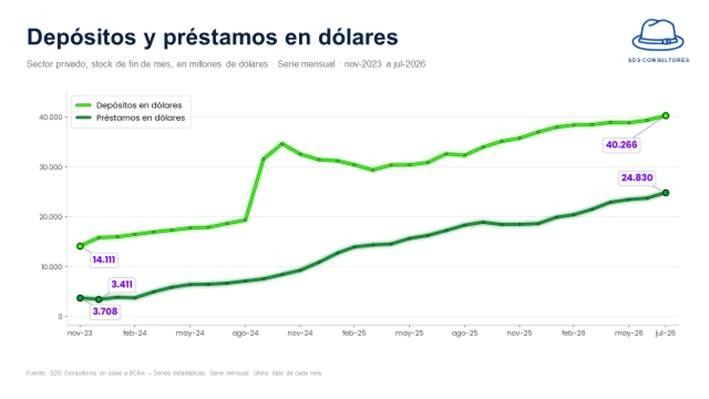
Loans in dollars increased from U$S 3.708 million to U$S 24.830 million, a substantial improvement, indicating the confidence of entrepreneurs to incur debt in hard currency. Starting in August, it will be allowed for legal entities not involved in the export chain to take on debt in dollars, which will enable a quota of U$S 6.000 million that will positively impact the Argentine economy.
Where are we headed in terms of financing
In summary, since the new government took office, Argentines have seen a significant increase in the stock of financing, in pesos and in dollars, rising from levels of 4.0% of GDP to 12% of GDP. We are still far from the credit stock that neighboring countries have, such as Chile with a financing stock around 70% of GDP, and Brazil with financing levels exceeding 100% of GDP.
The increase in the granting of loans was so abrupt that it generated an increase in the delinquency of the system, something absolutely natural in a market that grows in the mentioned dimensions.
The debate we must not have in the future is where we are headed in terms of financing; Argentines continue to save in dollars and use pesos for daily transactions. We believe that the increase in dollar deposits, and consequently Argentine reserves, shows a different behavior than in other times, when Argentines saved in dollars but kept them in safety deposit boxes. Today, savings are within the system, which is very positive, as it ends up financing productive activities.
The capital market as a new source of financing
The future of financing in our country will not only rely on the financial system; we need to further develop the capital market. Currently, economic agents who have invested in public bonds with annual return rates of 10% can use these bonds as collateral to obtain up to 70% of what they hold in their portfolio and secure short-term financing through a bond guarantee at an annual rate of 2.0%.
They can also pledge the bonds and issue a promissory note for more than a year at a market rate of 6.5% per annum.
We believe that future financing will come more from the capital market than from the financial system. Without genuine savings, there will be no new financing, and it seems that banks have lost their appeal to attract savers.
Placements in pesos are stagnant, while those in dollars are on the rise. The decision-making process in companies will have to lean towards financing in dollars, which is the channel where there are more resources to transact. Those who wait for financing in pesos will not have understood the logic of the saver, who despises the peso and prefers hard currency.
The Argentine financial system has lost the sensitivity of the saver. Savings in pesos are stagnant, with no attractive products, but companies demand loans in local currency. People save in dollars but do not want to incur debt in that currency. The capital market as an alternative.
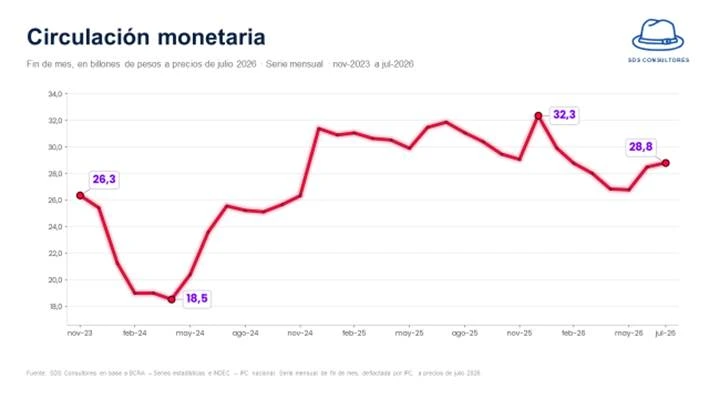
The Central Bank shows a very strict monetary behavior; since December 2023 to date, the money supply adjusted for inflation shows minimal variation, which implies that the amount of money in real terms has not increased. During the same period, we have seen significant adjustments in tariffs and fuels, which increased costs, but in many cases, these increases could not be passed on to prices. This supports the notion that inflation is a monetary phenomenon.
In recent months, the increase in fuel prices, due to the rise in oil prices internationally, generated a cost increase; however, inflation rose below these increases. Fuel prices increased by 50% between February and July, and this was not reflected in the same magnitude in price indices. This meant that companies had to absorb the higher costs and make an effort to improve competitiveness and productivity. In many cases, prices could be absorbed because we were coming from an economy where prices discounted a dollar increase greater than expected, and profitability did not align with periods of monetary and exchange rate stability.
In summary, companies are earning much less today than in the past; however, they coexist with a much more predictable economy.
Argentines do not increase their savings in pesos
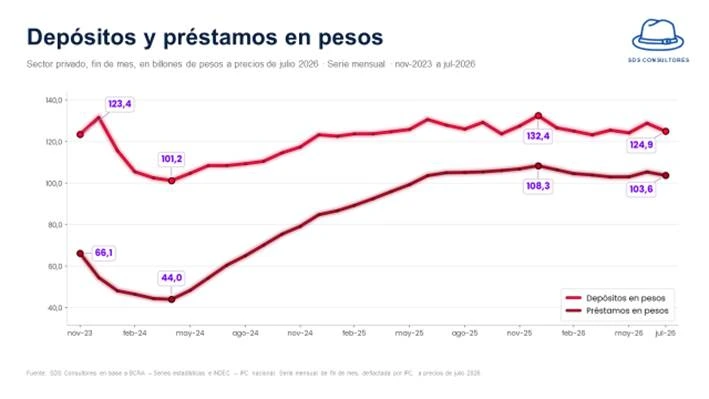
It is interesting to see the graph that reflects the evolution of deposits and loans in pesos adjusted for inflation. As can be seen, deposits in pesos have not increased in real terms, which implies that the market not only does not demand pesos but has also not increased the stock of savings in local currency. Regarding loans, they have shown positive evolution because the state stopped taking financing in the market, which allowed for a strong increase in financing to the private sector.
There is a constant demand for more financing in pesos, at low rates and long terms; however, in the financial system, Argentines prefer not to increase their exposure in savings in pesos, they demand higher rates, and place funds for short terms. It is worth analyzing the Argentine behavior; they demand higher rates and short terms for saving, and low rates and long terms for financing.
Savings in dollars gain ground within the financial system
It is interesting to show Argentines' preference for saving in dollars. During Javier Milei's government, savings in dollars increased from U$S 14.111 million to U$S 40.266 million, which is revealing, as Argentines buy dollars and leave them deposited in the system. In the middle of the analyzed period, a tax amnesty operated that contributed more than U$S 20.000 million, and the fiscal innocence promises to bring a similar figure during 2026 and 2027.