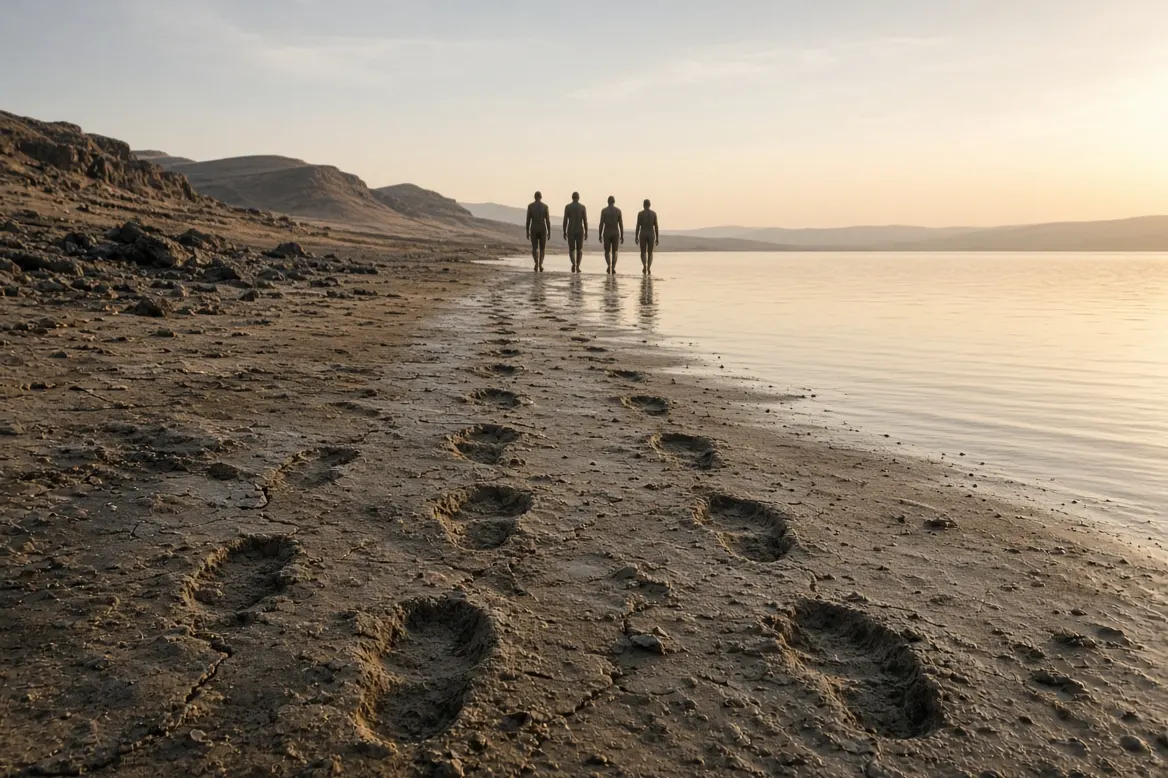
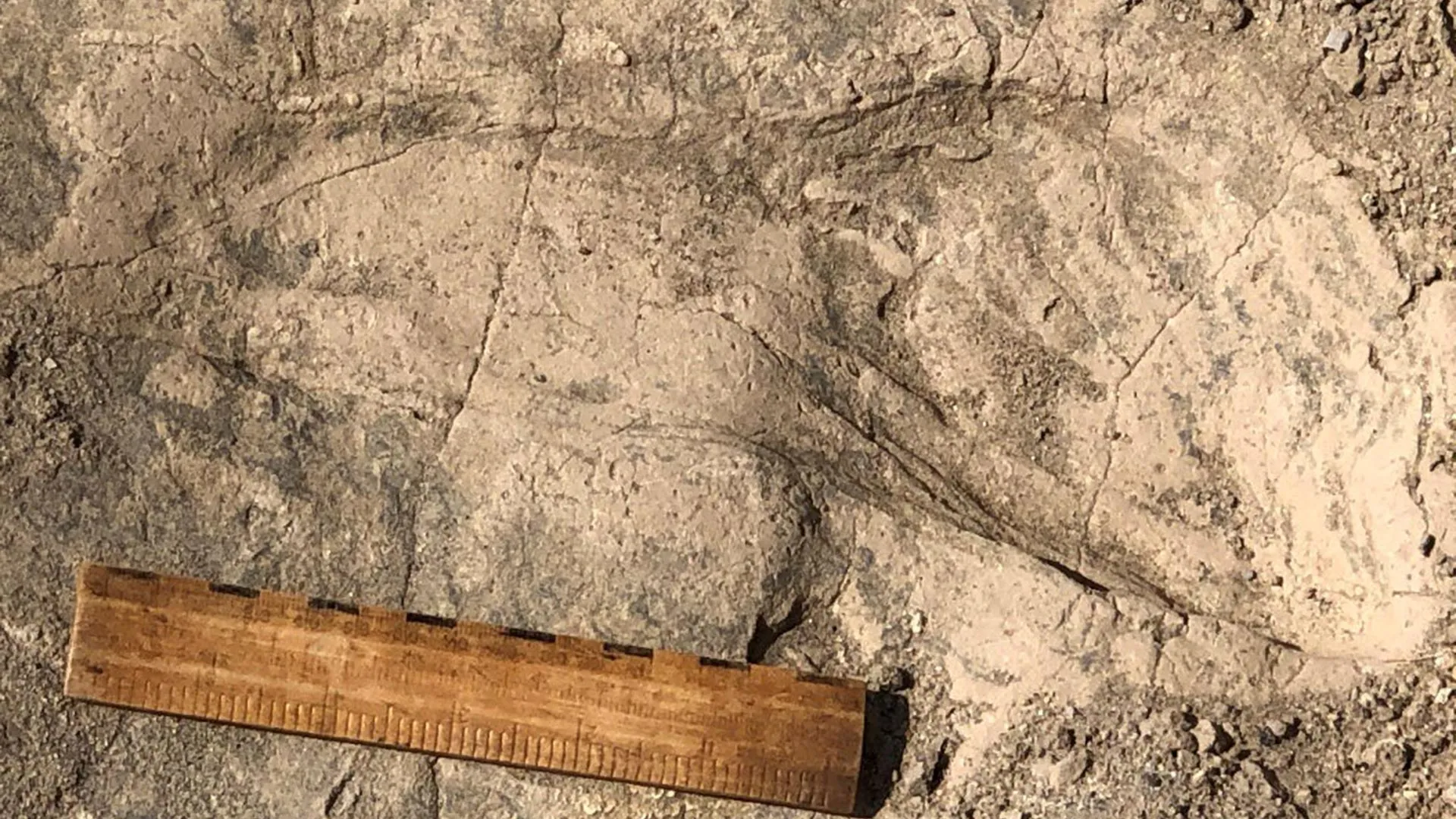
An exceptional set of fossilized footprints in northern Kenya offers an unusual glimpse into how extinct human relatives moved and interacted around 1.4 million years ago. The marks, preserved near an ancient lakeshore, appear to record the passage of eight individuals of Paranthropus boisei in the same place and within a short time span.
Unlike bones, which can accumulate over long periods, these footprints capture a specific moment in the lives of those individuals. The international team of researchers from the United States and Kenya determined that the eight were likely adults. Several of them turned out to be considerably larger than previous estimates based on limited skeletal remains suggested.
The scientists applied analytical techniques developed by the same group in 2024 to identify the footprints as belonging to Paranthropus boisei. The classification was supported by features of foot anatomy and the way they moved. The size of the footprints was surprising: “The sizes of the footprints indicate bodies of human dimensions, up to 1.8 meters tall and around 75 kilograms,” explained lead author Kevin Hatala from Chatham University and affiliated with the Max Planck Institute for Evolutionary Anthropology.
For decades, most known fossils of this species were skulls with exceptionally large jaws and teeth. Much less was known about the rest of the body because postcranial remains are scarcer. The new footprints challenge previous studies that claimed Paranthropus boisei was substantially smaller than Homo erectus, another contemporary hominid considered a possible direct ancestor of modern humans.
A Look at Group Life
The footprints not only inform about anatomy. As a walking surface can form and be preserved in a very short time, fossil traces provide direct evidence of movement, group size, and possible social interactions. In this case, the eight individuals appear to have traveled together.
Most were likely adult males, with no clear indications of females or juveniles. “The fact that eight individuals, mostly adult males of Paranthropus boisei, apparently moved together as a group, without females or children, suggests a complex social structure in this species,” noted co-author Neil Roach from Harvard University. “They may have lived in large groups, where males competed for mates, but also sometimes tolerated each other for safety in a dangerous environment.”
This possibility adds a new dimension to the understanding of Paranthropus boisei. The species shared the world with the early members of the genus Homo, although it followed a very different evolutionary path.
The finding is part of a much broader collection of hominid footprints in coastal environments of the ancient Lake Turkana. That pattern indicates that those areas were important habitats that provided valuable resources sufficient to repeatedly attract these extinct human relatives.
Why They Returned to the Lake Shore
“I find it astonishing that we have the same type of lacustrine margin deposits in two areas of eastern Turkana separated by 40 kilometers, of approximately the same age,” commented co-author Kay Behrensmeyer from the Smithsonian Institution. The researchers have already documented hundreds of footprints at more than half a dozen sites in the region.
Understanding why those traces were preserved may also help explain why ancient hominids continued to visit the lake shore over such a prolonged period. Behrensmeyer predicts that if the geological conditions that allowed preservation are understood, more will be known about why they returned to that environment over more than 100,000 years.
The team plans to return to Kenya this year to continue studying the footprint sites. Each new documented surface may preserve a distinct moment from the distant past and provide evidence about anatomy, walking patterns, social interactions, and environmental conditions that traditional fossils do not always reveal.
“Each site represents a snapshot of our past, and we are rapidly building a photo album with various windows into the anatomy, locomotion, behavior, and environments of hominids during the early Pleistocene,” stated Hatala. The discovery reinforces the global importance of the Lake Turkana region for the study of human evolution and the responsibility to protect that irreplaceable heritage.