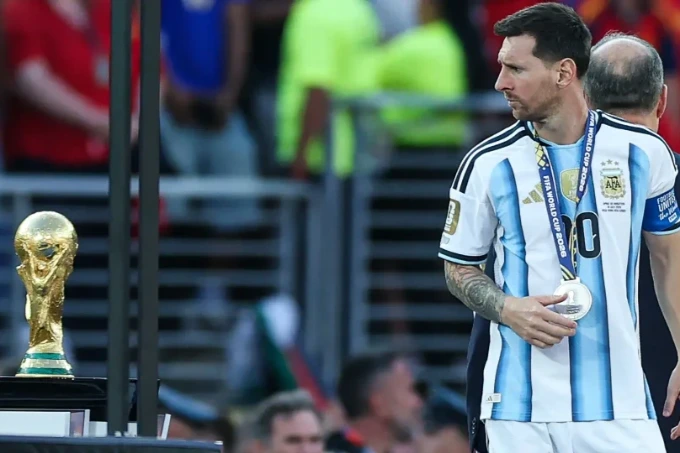
Let's start with what is not up for debate: Spain was a just and clear champion. La Gazzetta dello Sport summarized it in one number —twenty shots to two—and called it “one of the most deserved victories in a World Cup final.” It is right. Argentina played a poor match, with no offensive damage, and only shot on goal at 117 minutes. All of this is true, and we said it first: Scaloni acknowledged it at the foot of the field, asking to “be great in defeat.” And we were, without a single Argentine shouting robbery or swearing that we deserved to win. That point is settled.
The one that is not settled is another. What came after the final whistle was not sports criticism: it was a celebration. The press “thanked Spain for saving football”; a Croatian newspaper declared that “the Argentines reached the final by accident and behaved shamefully”; others spoke of “thugs from Buenos Aires,” “delinquents,” “criminals,” and the Spanish press concluded with a “they don’t exist, today it was 4-0.” FIFA opened a file. It was not analysis: it was a settling of scores. One thing is to criticize a bad match; another very different is the feast with which half the planet served the Argentine defeat.
And perhaps there lies the first clue. Developmental psychologist Mark van Vugt recalled before the final: a World Cup does not mobilize love for football, but ancient instincts of tribe, status, and coalition, and that is why “a defeat can feel like a national humiliation.” When the rejection far exceeds what happened in ninety minutes, it is sensible to ask whether the target was not the result, but what the team embodies.
Envy as the engine of resentment
The engine of that feast has an old name: envy, the joy in the misfortune of others. It is the silliest of sins: the others at least provide some pleasure; the envious only intoxicates himself with his own poison —he drinks cyanide toasting “to the other,” and the only one who falls is him—. It is what Nietzsche called resentment: the inability of one who cannot equal the best to do anything other than declare him guilty.
It is worth understanding why that poison circulates so easily today. It has always been an instinct of small communities: Helmut Schoeck showed that every society developed mechanisms to contain it, because without that brake cooperation ends up eroding. The difference is that today we live in a global village, where millions of strangers compete and observe each other without any of those limits. The instinct remains; the neighbor who moderated it has disappeared.
What civilizes it is not denying it, but channeling it: clear rules, a referee whose decision is accepted even if it hurts, the rule of law. Football, Orwell said, is “war without the shooting”; it is what Hayek called the extensive order, which does not eliminate rivalry but makes it fertile instead of bloody.
If this is the case, the question ceases to be why a sports defeat was taken badly. The real question is what this National Team represents today to provoke such a disproportionate reaction.
What this Argentine National Team represents
It is a squad that, deliberately or not, ended up becoming a cultural symbol. It is made up of family men: married, fathers, young men who talk about their wives and children without irony or shame. They cross themselves before entering the field and thank God both when they win and when they lose. Many come from humble homes and carry with them the memory of parents and grandparents who made extraordinary sacrifices to give them a chance. They are men who know where they come from and do not feel the need to apologize for it.
It is also a team of effort and merit, without shortcuts. Lionel Messi is 39 years old: he could be enjoying his fortune and his children, and he chose once again sacrifice and exposure to criticism. It is no coincidence that the most lucid letter about this National Team was not written by a sports journalist, but by Esteban Bullrich, who has been fighting his battle against ALS for years: he did not thank the result, but the values. “The most important battles are not always won —he wrote—; some are simply fought with dignity.” And dignity is, point by point, the opposite of resentment.
There lies the answer, or at least its most honest part: believers who do not hide their faith, children and grandchildren who honor their own, workers who arrived by merit and not by quota or narrative. All of that —family, faith, homeland, merit, gratitude— is precisely the catalog of what certain progressivism has taught to despise for decades. It is hard not to notice that the judgment far exceeds how that night was played.
From football to questioning against Argentina
It was even accused of being racist: a “too white” team. The objection hardly withstands historical scrutiny. Argentina had slavery —like all of America—, but dismantled it very early: it decreed the freedom of wombs in 1813, half a century before the United States abolished its own, and the full abolition was written into the Constitution of 1853. That there are few Afro-Argentines today responds to demographics —immigration, wars, epidemics, integration—, not to a plan of “erasure.” And it loses all strength against a country that offers free hospitals and universities to immigrants from all its neighbors.
The reproach, at its core, does not stem from a moral superiority: it stems from a decadence. A good part of the West —Europe at the forefront— has been managing its decline for years: it grows little, has no children, regulates faster than it competes, and entrusts bureaucrats and activists with the task of shaming citizens for their history.
It is what Jonathan Haidt —a liberal, not suspected of being right-wing— called the culture of the victim: one in which prestige is no longer earned by competing, but by displaying one’s own grievance before a moral referee.
The one who has surrendered detests the one who still fights: a place like that does not admire the one who dares, it discomforts them. And nothing irritates them more than a country that, having everything to sink, chooses to stand up.
An Argentina that decided to stop being ashamed
It does not seem coincidental that this image has ended up being associated, moreover, with the Argentina that emerged in December 2023. Beyond the fact that the players never engage in party politics, the team became associated with a country that has returned to speak of merit, effort, fiscal responsibility, national pride, and freedom without asking for permission. The same values that irritate on the field irritate off it; that is why the animosity is identical, and that is why it does not yield.
For weeks the theory was that the tournament was “fixed” for Messi to become champion again. Argentina lost 1-0. And yet, the contempt did not decrease: it increased. No sports explanation survives that fact.
The National Team gave the only possible response: it lost standing, without excuses, congratulated the rival, thanked God, embraced their families, and promised to return. Perhaps there lies, precisely, what is unbearable for so many, because defeats pass but symbols remain: this team ended up being that of a country that decided to stop being ashamed of itself, one that chose merit over victimization, effort over excuses, gratitude over complaints, family over individualism, and freedom over resignation. Because when a dignified defeat awakens more resentment than a proud victory, it becomes clear that the problem was never football.