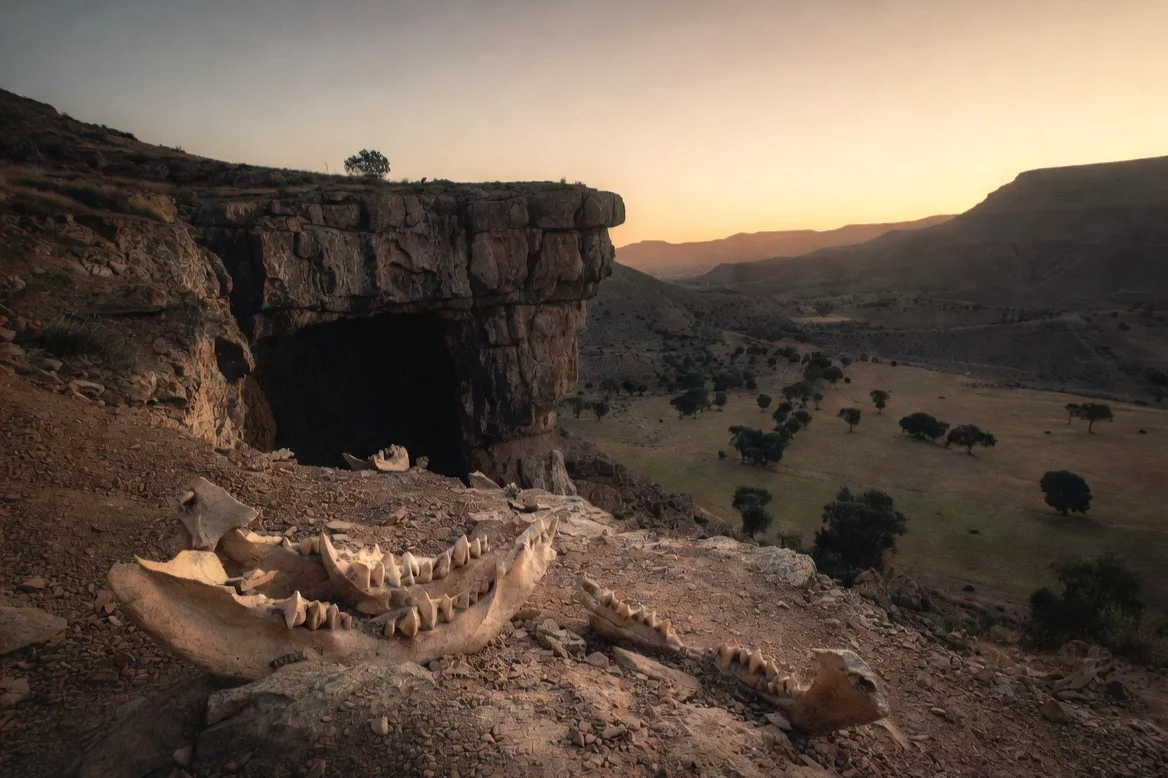

Researchers discovered hominid fossils in Morocco that could change what is known about the origins of Homo sapiens. The remains, found in the Grotte à Hominidés within the Thomas quarry near Casablanca, date back about 773,000 years, a key moment in human evolution.
At that time, the ancestors of our species were beginning to diverge into different lineages that would later give rise to Neanderthals and Denisovans. The finding, published in the journal Nature in January 2026, reinforces the idea that northwest Africa played a central role in this process.
The fossils include fragments of adult jaws, one from a child, and several teeth and vertebrae. Their gracility surprised scientists, as they do not entirely fit with what was expected for that region and period. Jean-Jacques Hublin, the lead author of the study, emphasized that these characteristics clearly differentiate them from other known specimens.
Previous genetic tests placed the oldest common ancestor of modern Homo sapiens between 765,000 and 550,000 years ago, but physical evidence was lacking. This new set provides concrete data from Africa, where the most indisputable ancient specimens of our species are also found.

Comparison with previous findings
Previously, the Homo antecessor from Atapuerca in Spain was one of the main candidates, with an estimated age between 950,000 and 770,000 years. However, the Moroccan remains lack dental and mandibular traits that link them to European Neanderthals, retaining more primitive characteristics associated with the African continent.
Researchers believe these fossils could belong to an isolated group of Homo erectus in the process of divergence. From this ancient population, both Homo antecessor and, eventually, Homo sapiens would have emerged.
 Additionally, the sediments around the fossils record the Matuyama-Brunhes transition, the last major reversal of the Earth's magnetic field that occurred about 773,000 years ago. This precise dating makes these remains some of the oldest and best temporally located.
 The Thomas Quarry archaeological site was already known for containing the oldest evidence of stone tool manufacturing in northwest Africa, at 1.3 million years. The Grotte à Hominidés now adds crucial information about the very humans who inhabited the area.