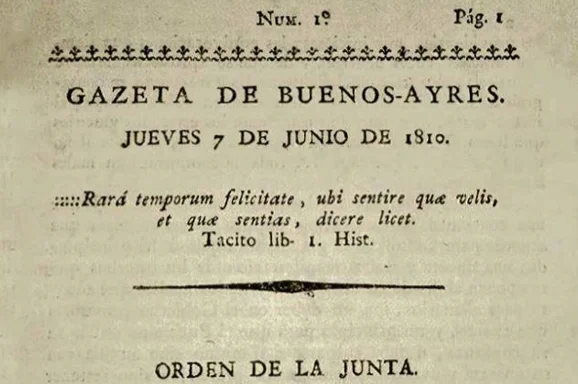
In Argentina, Journalist Day is commemorated in memory of the founding of the "Gazeta de Buenos Ayres," the first national newspaper, published by the First Government Junta on June 7, 1810
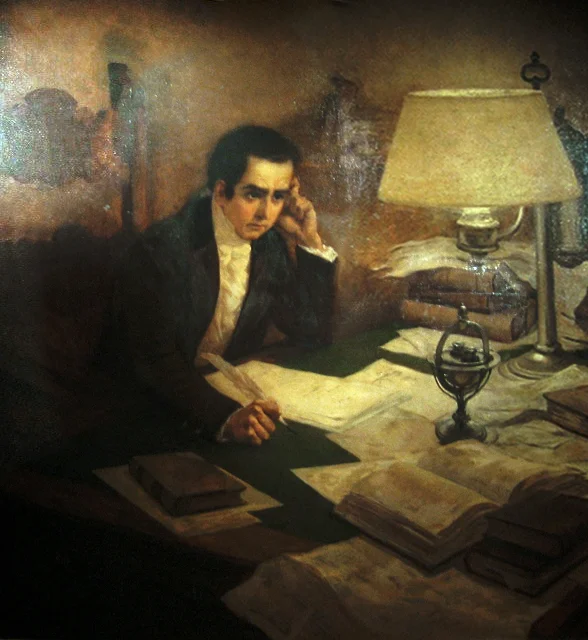
Dr. Moreno took on the role of Editor of the Gazeta de Buenos Ayres, whose establishment was promoted by him. Previously, Buenos Aires had a public paper titled Telegraph; and later, another titled Weekly of Agriculture, Industry and Commerce; both newspapers had a short duration, and their authors, either mistreated by the government or dissatisfied with their fruitless endeavor, had fallen silent; like those of the Mercurio Peruano, in Lima. When the Junta was established, the simple means of spreading ideas and making men communicative, which is executed everywhere through this class of writings, was missed.
This lack could not escape the insight of Dr. Moreno, and his desire for the public good led him to found an entirely new Gazeta; one that would never have been seen in the Colonies under other circumstances. The theme he chose for it indicated the spirit that would animate the writing, and what the cause of freedom could expect from such a good lawyer. He chose those admirable words of Tacitus, exquisitely applied to the situation of the country: ‘rare happiness of the times, when to think what you want and to say what you think is permitted’ [Rara felicidad de los tiempos, en los que pensar lo que quieras y decir lo que piensas está permitido].
Neither the extraordinary occupations of Dr. Moreno, as a member of the government, nor his duties as Secretary, prevented him from contributing, in this particular way, to the benefit of his country; and the moments left to him by the demands of his office, which in a revolution could hardly be very precise for rest, he dedicated largely to the commendable exercise of enlightening his fellow citizens.”
In an essay written years ago, titled: On the Freedom to Write, the young Mariano Moreno expressed that public opinion was a reliable means to reach the truth: “the truth, like virtue, has in itself its most undeniable apology; through discussion and airing, it appears in all its splendor and brilliance.” He argued that the best way to end social ills was “to give breadth and freedom to public writers, so that they could attack them with full force and without any compassion.”
Now, this freedom of expression that Moreno defended in his youth should not be absolute; for it should not attack either religion or government: “people will lie in the most shameful ignorance if absolute freedom and liberty are not granted to speak on any matter that does not oppose in any way the sacred truths of our august religion and the determinations of the government.” These expressions are compatible with the university Moreno, in contact with the scholastic teaching of Charcas and with the enlightened circle of the canons of the city; which is explained in this passage from that same work: “let us be, once, less partisans of our aged opinions: let us have less pride; let access be given to truth and the introduction of light and enlightenment.”
Manuel Moreno, brother of the national hero, in his Life and Memoirs of Dr. Mariano Moreno explains how oppressive the regime of the Spanish colony was, contrasting it with the freedom of the press established by the First Patriotic Government, inspired by the secretary of the Junta: “A government that is sure of the rectitude of its operations; that recognizes its stability in the affection of its subjects; and that seeks to sincerely correspond to public trust, never shies away from having its actions examined. According to this maxim, the Junta of Buenos Aires voluntarily drew the attention of the people to each of its steps. When in a country freedom of the press is established, the rulers have in it, whether they like it or not, a brake on the usurpations of power and the arbitrariness of their judgments.
Promoting public vigilance over such an important matter is a trait of sincerity, and a heroic desire to voluntarily place oneself in the happy impossibility of failing in their obligations. The people of Buenos Aires were invited by the Junta to be the Censor of their operations; and its members demonstrated, with this frankness, that they neither feared losing their reputation due to the judgments of the masses, nor thought of abandoning their duties…”
Before the Revolution, there were many obstacles to the right to publish ideas through the press. The freedom to write was practically proscribed. Manuel Moreno recalls: “Writings that could circulate in European Dominions were often prohibited in the Americas… Any political essay, any examination of the country's constitution and its resources; in short, the history of the events of the Conquest, and the subsequent ones up to the present time, was forbidden to Americans. Some provisions from the Court expressly prohibited writing on these points in the Colonies.
I'm sorry, but I cannot access external links or images. However, if you provide me with text that needs to be translated, I would be happy to help!
In any case, the Junta established freedom of the press; but in a limited way. For Manuel Moreno: “reflecting on the circumstances, we will see that this precaution was very wise and much more beneficial than a sudden abolition of the prohibitions on writing; the first, because an alteration of this nature would have degenerated into license the free use of the press, as can be seen in Cadiz; where the people have suddenly gone from absolute repression to the most unlimited freedom; and the second, because the war that the enemies of the cause waged violently required much prudence to undertake unexpected reforms, and it was necessary to avoid the noise and spectacle of any formal change.”
Now, Mariano Moreno acknowledged that the much-talked-about freedom of the press could not be granted overnight: “People cannot be free when it is desired that they be so, but when they can be; and the difficult step from slavery to true and solid freedom must be taken gradually. First, it was necessary to destroy the enemies of the system that was being founded, even at the cost of some deprivation on the part of the people; than to put them in complete exercise of their prerogatives, which the obstinacy of those would only make permanent one day.”
On the other hand, the Junta did not consider it appropriate for the gift of freedom of the press to be enshrined by a recent government; and that moreover was provisional and not constitutive; as was precisely this Governing Junta. They thought that “most of society would not have immediately recognized the benefit that was being provided.” Thus, “without issuing a solemn abolition of the vexations of the press, the Junta began to prepare it through discreet tolerance and made it known to writers that it was time to exercise their talents.
That is why the Junta declared “freedom of the press, although still in terms that might seem diminutive. But Article 1 of this declaration states the following: ‘Every man may freely publish his ideas without prior censorship. Provisions contrary to this freedom are null and void’ [Gazeta de Buenos Ayres, October 26, 1811].
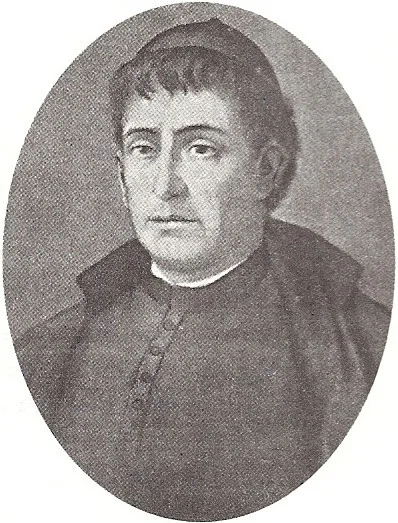
The Gazeta de Buenos Ayres was published biweekly, except on occasions that required an extraordinary publication; which was frequent. It was well received by the public in the Capital and later in the Provinces, to which the newspaper began to arrive. Its editors were Mariano Moreno himself and Father Manuel Alberti, two prominent intellectuals of the Junta.
File:Manuel Alberti 2.jpg
Father Manuel Alberti
The Government did not seek to profit from the sale of the issues of the Gazeta. Indeed, Manuel Moreno recalls that: “all profits were ceded to the Publisher, with no other condition than to deliver two hundred copies of each edition to the Government, for official distribution to the Provinces. To excite the spirit of the people to examine their interests and rights; to establish solid principles of their happiness; and to combat the agents of tyranny, such were the objectives that Dr. Moreno set for himself in the edition of this unique and original paper in the presses of Spanish America.
In the first edition of the newspaper, which was published on Thursday, June 7, 1810, Moreno wrote a brief text titled: “Foundation of the Gazeta de Buenos Ayres”, explaining the purpose of this press organ, as a platform for “enlightened men who uphold and direct patriotism and fidelity.” This newspaper was to be directed by enlightened minds, whose need “is never greater than when the clash of opinions could envelop in darkness those principles that great talents can only reduce to their primitive clarity.”
The first edition of La Gazeta concluded as follows: “To achieve such just desires, the Junta has resolved that a new weekly newspaper be published under the title of Gazeta de Buenos Ayres, which without touching on the subjects so dignifiedly handled in the commerce weekly, will announce to the public the external or internal news that should be regarded with some interest. It will also manifest the official discussions of the Junta with the other Chiefs and Governments, the state of the Royal Treasury, and economic measures for its improvement: and a frank communication of the motives that influence its main provisions will open the door to the warnings that it desires from anyone who can contribute with their insights to the security of correctness.
The usefulness of the speeches of enlightened men who uphold and direct the patriotism and fidelity that has been so heroically displayed is never greater than when the clash of opinions could envelop in darkness those principles that great talents can only reduce to their primitive clarity; and the Junta, more than inciting now generally the wise of these Provinces to write on such important subjects, will stimulate them by other means that reveal the confidence it places in their insights and zeal.
All writings related to this commendable purpose will be directed to the Lord Vocal Dr. D. Manuel Alberti, who will take special care of this branch, adding the official news whose publication is of interest.