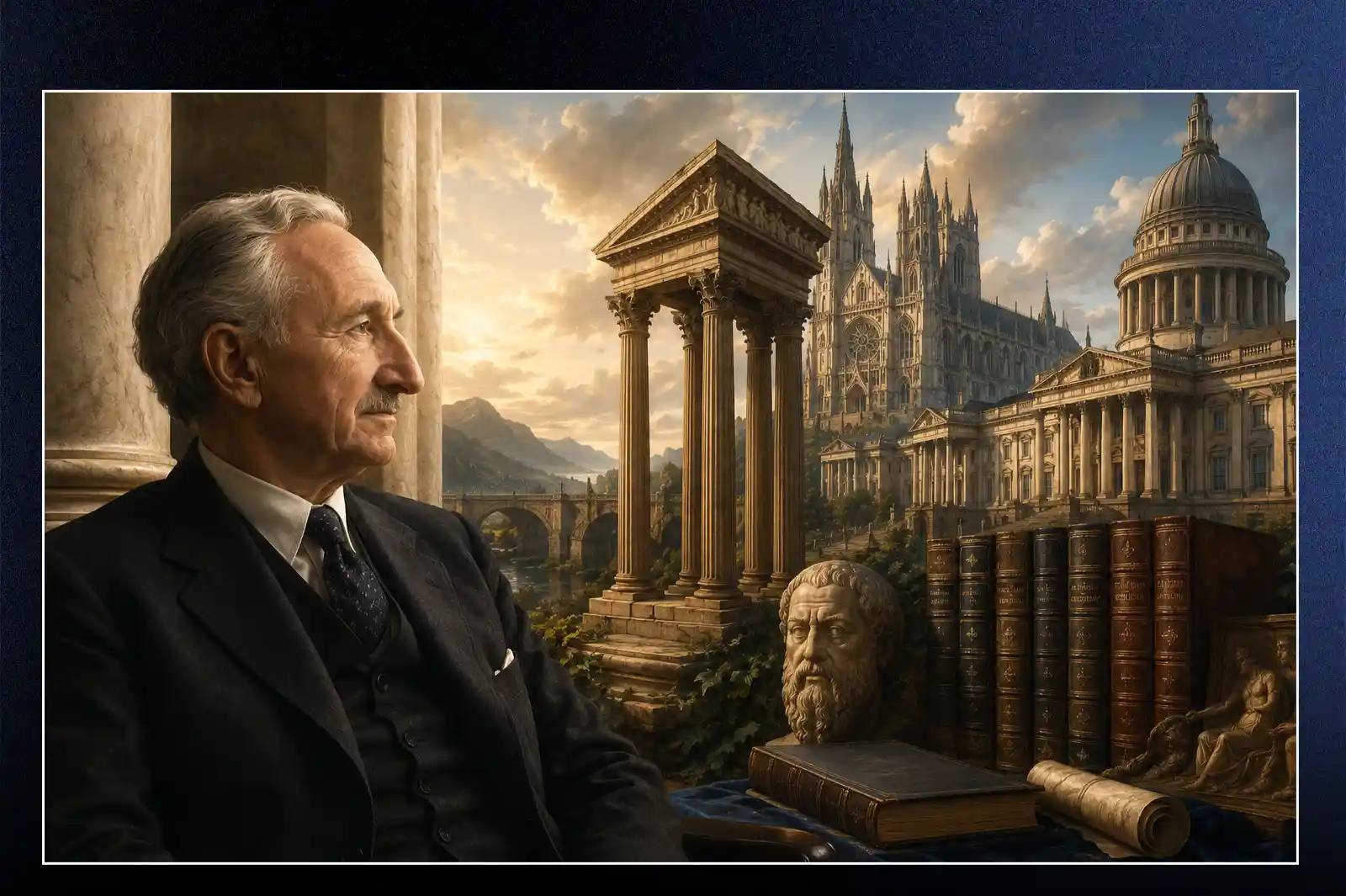
In the face of the current challenges and threats facing the West, it is worth reflecting on some questions and concepts that shape our ways of thinking about our civilization. These reflections can allow us to organize and deepen our understanding of the West.
The West is often associated with Modernity, and even used as synonyms. This association has led to confusing and problematic attitudes. Historically, Western civilization emerged in the 8th and 9th centuries and developed its own characteristics in the following centuries. The West began to modernize in the 18th century. The West was Western long before it was modern. Therefore, to become Western was neither equivalent to modernizing.
Thus, to defend Western civilization, we must review what makes the West Western. What is often taken for granted and is under attack. That is, the distinctive characteristics of Western civilization before it modernized.
Following the works of Samuel Huntington, at the end of the 20th century, we can almost verbatim enumerate a series of these fundamental characteristics:
The classical heritage. The West inherited much from early civilizations, most notably from classical civilization. The classical legacies are many and include Greek philosophy and rationalism, Roman law, Latin, and Judeo-Christian morality.
The European languages. Language ranks just after religion as the factor that distinguishes one culture from another. The West differs from most other civilizations in its multiplicity of languages. The West inherited Latin, but national languages developed, and by the 16th century, these languages had generally assumed their contemporary forms.
The separation of spiritual authority and temporal authority. Throughout Western history, first the Church and then many churches existed separately from the State. God and Caesar, Church and State, spiritual authority and temporal authority had been a prevailing dualism in Western culture. The separation between Church and State that characterizes Western civilization did not occur in any other civilization. This division of authority greatly contributed to the development of freedom in the West.
The rule of law. The concept of the centrality of law for civilized existence was inherited from the Romans. The tradition of the rule of law established the foundations of constitutionalism and the protection of human rights, including property rights against the exercise of arbitrary power.
Social pluralism and civil society. What has been distinctive for the West is the rise and persistence of various autonomous groups not based on blood or marital relations. For over a millennium, the West has had a civil society that distinguishes it from other civilizations.
Representative bodies. Social pluralism early on gave rise to estates, parliaments, and other institutions that represented the interests of the aristocracy, clergy, merchants, and other groups. These bodies provided forms of representation that evolved into the institutions of modern democracy during the course of modernization. In some cases, during the era of absolutism, they were abolished or severely limited in their powers. But even when that happened, they were able to resurge as a vehicle for the expansion of political participation. No other current civilization has a comparable heritage of representative bodies developed over a millennium.
Individualism. Many of the previous characteristics of Western civilization contributed to the emergence of a sense of individualism and a tradition of individual rights and unique freedoms among civilized societies. Individualism developed in the 14th and 15th centuries and the acceptance of the right to individual choice, which according to Deutsch constitutes "the revolution of Romeo and Juliet," prevailed in the West during the 17th century. Both Westerners and non-Westerners point to individualism as the central distinguishing mark of the West.
This list from Huntington is not an exhaustive enumeration of the distinctive characteristics of Western civilization, nor were these characteristics always and everywhere present in Western society. It does not claim that any of these characteristics have appeared in other civilizations. Individually, almost none of these factors is unique to the West. The combination of them is and has given the West its distinctive quality. They have been much more prevalent in the West than in other civilizations. They form the heart of the essential continuity of Western civilization. They are what is Western, but not modern, for the West. They generated the commitment to individual freedom that distinguishes the West from other civilizations. They are the factors that allowed the West to take the direction of its modernization. They make our civilization unique.
The future of the West largely depends on the unity of the West. The problem for the West, in this situation, is to maintain its dynamism and promote its coherence.
These distinctive characteristics of Western civilization find a deep support in the thought of Friedrich A. Hayek, who saw in them the conditions that allowed the emergence of the extensive order of modern freedom and prosperity. Hayek not only defended these traditions; he demonstrated how their erosion threatened civilization itself.
On the rule of law, Hayek wrote in The Road to Serfdom: “The rule of law means that government in all its actions is bound by rules fixed and announced in advance —rules that make it possible to reasonably foresee how authority will use its coercive powers in given circumstances and to plan one’s own individual affairs on the basis of this knowledge.” This tradition, which limits arbitrary power and protects property and individual freedom, is precisely one of the Roman and medieval legacies that distinguish the West and that the text highlights as the basis of constitutionalism.
The law as evolved order (nomos). In his work Law, Legislation and Liberty, Hayek distinguishes between law that arises spontaneously from customs and the interaction of people (nomos) and legislation deliberately imposed by an authority (thesis). As he notes: “Law is not the product of a deliberate design, but arises from the spontaneous interaction of individuals pursuing their own ends within abstract rules. Law is older than legislation.” This distinction reinforces that the foundations of the rule of law in the West are the result of a centuries-long evolutionary process, not of a modern rational construction.
On individualism and spontaneous order, in his essay “Individualism: True and False” (1945), Hayek pointed out that true Western individualism “recognizes that the spontaneous collaboration of free men often creates things that are greater than what their individual minds can comprehend or consciously design.” This principle explains how social pluralism, representative bodies, and civil society evolved organically over more than a millennium, without a central design, generating the dynamism that led to the modernization of the West. As Hayek emphasized, the social order is “the result of human action but not of human design.”
The extensive order of Western civilization. In The Fatal Conceit, Hayek argues that the great achievement of the West was the development of an “extensive order of human cooperation” that allows millions of people to collaborate peacefully even if they do not know each other or share concrete values. This order “is not the result of a plan or human design, but of an evolutionary process in which a large number of individuals, each pursuing their own ends, have contributed.”
The characteristics we have listed —social pluralism, individualism, general rules of conduct, representative bodies— are precisely the pillars of that extensive order that made modern prosperity and freedom possible.
The art of associating and the preservation of freedom. Alexis de Tocqueville, in Democracy in America, warned that in democratic societies the main risk is the atomization of individuals and the growth of central power. The great lesson he drew from the United States was the extraordinary development of the “art of associating.” He wrote that in democratic countries “association must replace the powerful individual who, in aristocracies, takes care of everything.” If men do not learn to form voluntary associations, they would fall “into despotism or anarchy.” For Tocqueville, these intermediate associations —cooperatives, churches, clubs, businesses, local communities— are the main bulwark against the tyranny of the majority and bureaucratic centralization. This observation reinforces the importance of social pluralism and civil society that we highlighted as a distinctive feature of the West.
Religion as a condition of democratic freedom. Tocqueville went even further by stating that religion —and particularly the Judeo-Christian tradition— is indispensable to sustain freedom in democracies. “Despotism can govern without faith, but freedom cannot,” he wrote. In his analysis, religion provides the moral limits and shared customs that laws alone cannot guarantee. Without that foundation, equality of conditions tends to produce either individual apathy or a tyranny of the majority devoid of checks.
In short, maintaining coherence around these evolved institutions of freedom, law, and spontaneous order is the best guarantee to preserve the civilizational dynamism in the face of current challenges. The future of the West depends on its fidelity to what made it unique long before Modernity.