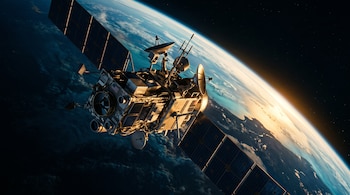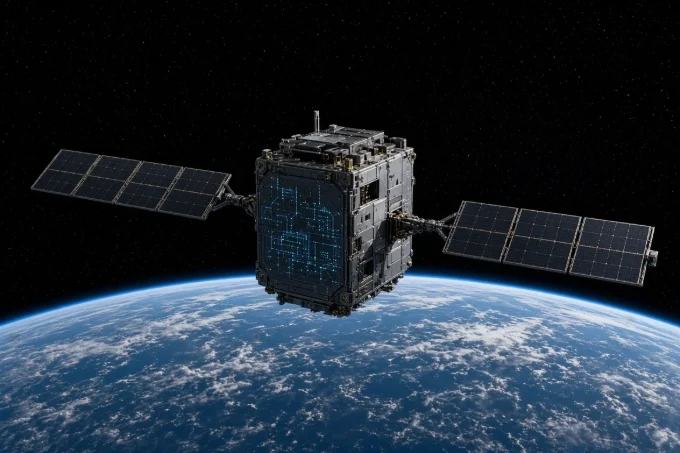

Google advances with its Suncatcher Project and prepares to launch a prototype satellite aboard a SpaceX rocket. The goal is to verify whether its Tensor Processing Units, known as TPUs, can operate under the demanding conditions of space.
The mission will travel on SpaceX's upcoming Transporter-18, in collaboration with Planet. During the flight, data will be collected on the behavior of these chips in response to radiation, temperature changes, and launch vibrations.
The company presented this initiative in 2025 as a long-term research project. It seeks to answer a key question: whether artificial intelligence hardware can withstand the space environment and, in the future, process large volumes of information outside of Earth.
In low Earth orbit, satellites receive sunlight almost continuously. According to Google, this would allow for generating up to eight times more solar energy than on the planet's surface. Over time, several constellations could work together for larger-scale AI tasks.

How the hardware is prepared for launch
The journey to low orbit lasts about ten minutes. During this time, the spacecraft faces intense vibrations and accelerations of up to ten times the force of gravity. Some components, such as the TPUs, can experience forces between 50 and 100 g.
To prepare, the team subjected the satellite to vibration tests on three axes that simulate the actual launch conditions. They also evaluated the chips in a proton beam facility at the Crocker Nuclear Laboratory at the University of California, Davis.
During those tests, the TPUs performed artificial intelligence tasks while monitoring for potential errors, such as a bit flip. Initial results showed that the Trillium TPUs can withstand a dose of ionizing radiation greater than what they would receive on a five-year space mission.
However, Google warned that some evaluations can only be conducted in real space. Therefore, this first mission is crucial to validate the hardware's behavior outside of laboratories.