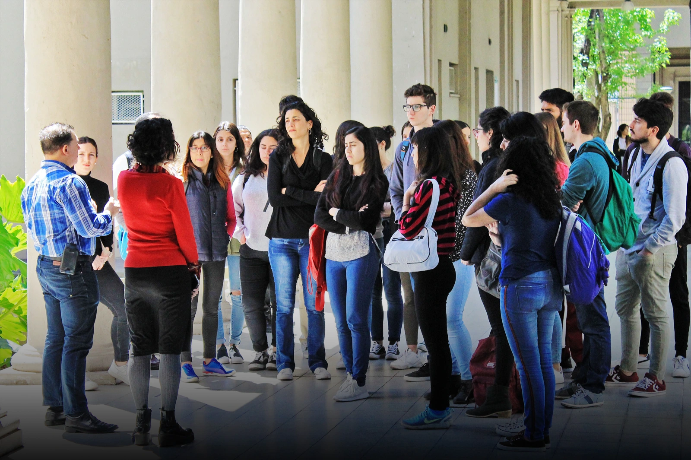
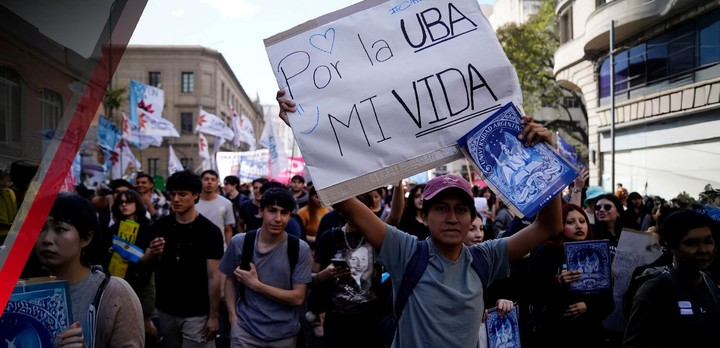
The national government once again targeted the narrative of “university underfunding” and brought to light an uncomfortable fact for the authorities of the University of Buenos Aires: in the Medicine program at UBA, 40% of the students are foreigners, while the faculties continue to refrain from implementing the charges allowed for those coming from other countries to study with resources funded by Argentinians.
The statement was disseminated in a spot published by the Minister of Human Capital, Sandra Pettovello, with the Undersecretary of University Policies, Alejandro "El Profe" Álvarez, as one of the main faces of the official explanation. There, the official questioned the narrative established by university sectors and emphasized that, since the beginning of Javier Milei's administration, fear has been sown with the idea that universities were going to close.
“They say that the government underfunds universities,” Álvarez stated, before presenting some numbers from the system. As an example, he mentioned the case of the National University of the Arts, where each graduate represents an expenditure of around 400 million pesos for all Argentinians, compared to a national average of about 57 million.
The official also pointed out one of the most serious structural problems of the Argentine university system: the low graduation rate. He argued that while the budget is exclusively discussed, almost no one asks why Argentina has one of the lowest graduation rates in the region, despite maintaining national universities with public funds.
In that vein, Álvarez also criticized UBA for its demands regarding university hospitals. According to the official statement, the university seeks to keep 95% of the budget allocated to those institutions, amid a political struggle that the academic authorities present as a merely financial conflict.
Another central point of the message was the charge to foreign students. The government reminded that it has already authorized universities to charge those who are not Argentinians, but the authorities of the faculties decided not to do so. For Human Capital, this refusal does not stem from a technical issue, but rather an ideological one: they prefer to maintain a scheme where the Argentine taxpayer funds even those who come from other countries to study at public universities.
40% of the students at FMED-UBA are foreign.
Finally, Álvarez announced that in the coming weeks the government will launch a microsite with all the data from the university system. The goal, as he explained, will be for any citizen to easily and clearly access information about costs, graduations, budget, and the actual functioning of national universities.