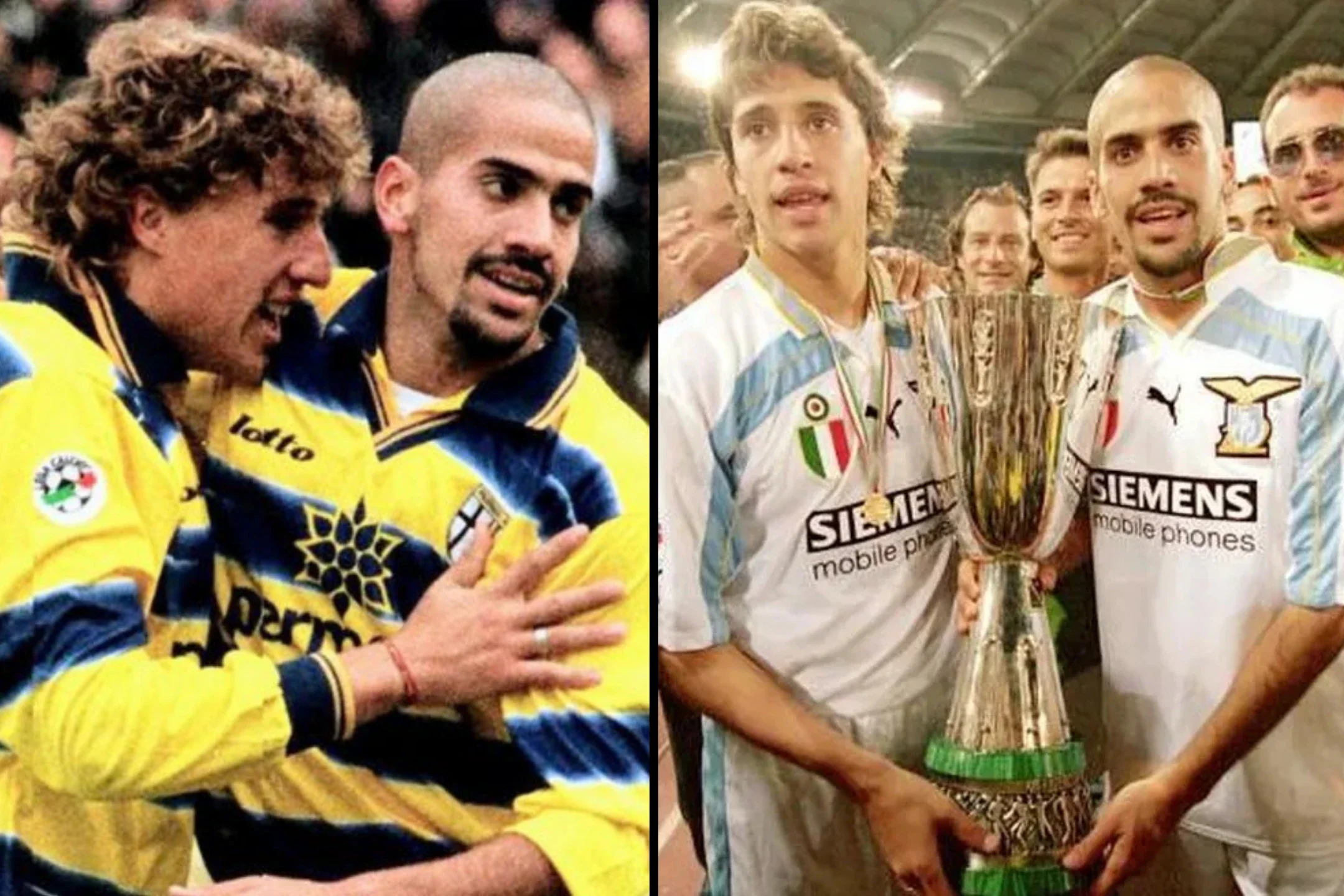

Recognizing the level of Juan Sebastián Verón as a footballer does not surprise anyone, but the assessment takes on a different weight when it comes from a reference in the field. Hernán Crespo, a historic forward of the Argentine National Team, publicly chose Verón as his best partner on the field and placed him among the most decisive figures of his career. In an interview with F90 (ESPN), the current coach explained that the influence of La Brujita went far beyond an assist: he was the player who built the play before the final pass.
The television inquiry led him to review names and roles, but Crespo was direct in defining his ideal partnership. “My partner was Verón. El Piojo (López) logically yes because he was the last pass, but Seba is, for me, the best player of the penultimate pass. He set up the other player so that they could give it to me,” he described. The phrase is not just a technical compliment: it defines a way of understanding football, where the true differential lies in the pass that organizes and conditions everything that comes after.
The “penultimate pass” as art: Crespo's tactical explanation
Crespo explained that the bond with Verón was not limited to a specific connection, but to a system that repeated itself game after game. In his view, the “penultimate pass” is the one that opens the scenario, accelerates the play, and leaves the team at an advantage, even before the final assist. That’s why he placed Verón above a simple statistic: he highlighted him as the player who “set up” the teammate so that the last pass arrived cleanly.
The former scorer also marked a difference that is often lost in superficial analysis. His idea is that the partner of the forward is not just the one who provides the goal pass, but the one who creates the context for that pass to exist and be simple. In that sense, Crespo positioned Verón as the type of footballer who understands timing, spaces, and receiving profiles, and who makes the forward receive the ball where it really hurts.
The way he said it also points to a football hierarchy. When Crespo states that Verón is “the best player of the penultimate pass,” he is placing him as an elite specialist in an action that defines rhythm, advantage, and emotional control of the match. That type of reading usually comes from those who have lived the area from the inside: the forward who needs the play to “start well” in order to finish it.
“Those who played with Verón…”: silent leadership and collective improvement
Crespo did not stop at the personal bond: he expanded the idea to Verón's impact on the entire group. “Those who played with Verón around hardly did not go to the National Team, anywhere in the world,” he began. The phrase suggests a contagious effect: around Verón, teammates elevated their performance, and that translated into recognition and call-ups.