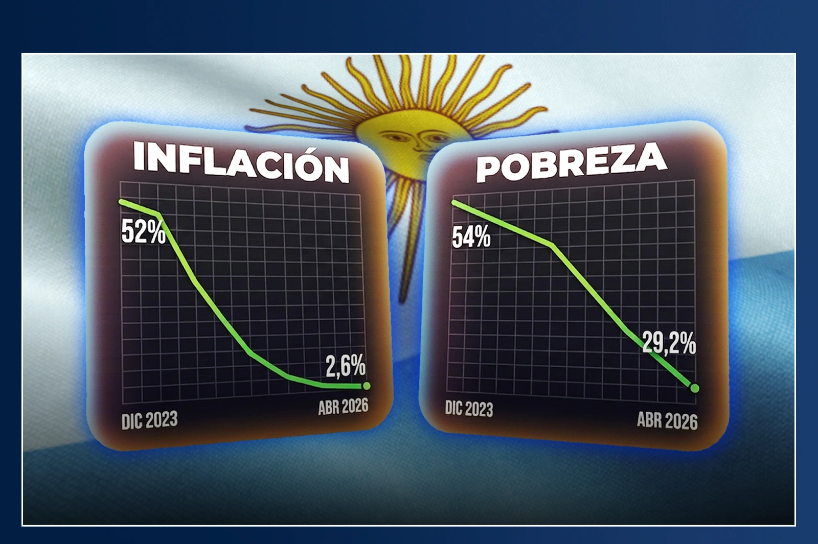
The inflation rate for April pleasantly surprised by registering at 2.6%, below the expectations set by the markets. This figure is not just a technical detail: it confirms that the process of disinflation is solid and that we are returning to a downward path. Without the strong adjustment of regulated prices (4.7%), driven by the necessary readjustment of overdue tariffs in the past and the conflict in the Strait of Hormuz, the number would have been much lower.
Meanwhile, core inflation stood at 2.3%, and the food basket —the one that most affects vulnerable sectors— barely rose by 1.1%.
I have no doubt that May will close even better, again on the decline. The first two weeks of the month have shown minimal or no variations. This is not a coincidence: it is the result of having made the right decisions in monetary and fiscal matters.
The implications of lower inflation
The recovery of real wages is already a concrete reality, and it mainly affects informal workers, who represent the largest proportion of the poor and indigent in our country. Their incomes have grown above inflation, and in many cases, substantially.
However, it is common to hear many journalists say that “it is not noticeable.” This happens because real wages are confused with disposable income. Disposable income is what remains after paying for public services and fixed household expenses. These expenses have been heavily impacted by the readjustment of regulated prices (energy, transportation, etc.), which had not been updated for years. In other words, inflation from previous years is being recognized. This is how investment fell and all the problems in energy services arose. This means that disposable income has indeed been hit.
On the other hand, the real income of formal private workers has also been experiencing a gentle recovery. Meanwhile, what has been losing ground is the salary of public employees.
Going forward, income improvement will come with increased productivity, and that is undeniable and is the logical outcome anywhere in the world. That is to say, as investment makes people's work more productive - just as a worker with tools is more productive than one without tools - there will be a greater improvement in real wages.
We are already seeing the first clear signs of this process. Amid the recovery of the downward path of inflation, economic activity is showing abundant signs of rebound, even in sectors that had been very lagging, such as industry and construction. That is why today this conviction is fully consolidated: I have no doubt that this will be an excellent year for Argentina.
Inflation is a moral problem
A good economic system is not only more efficient, it is more moral. Conversely, we can say that an economic system that respects morality is also more efficient. The open, competitive market economy based on price mechanisms is not only more efficient: it is morally superior because it rewards effort, work, and production, and distributes the fruits more justly, according to merit and contribution.
Inflation is not just an economic crime: it is a moral crime. It is systematic theft. When the State, through the Central Bank, issues money without backing it with the productivity of the economy, it is consciously defrauding Argentinians.
If we set aside the decline in the demand for money, it is common for inflation to be generated by an increase in the money supply. That is to say, when the State, through the Central Bank, issues money without backing it with the productivity of the economy, it is consciously defrauding Argentinians. This is because politicians make people believe that the bills they are being given are worth the same, when in reality they are worth much less. The immoral goes hand in hand with economic inefficiency and the impoverishment of the people.
However, if we analyze the decline in the demand for money: why can that happen? If we consider what happened in recent months, there has been a destabilizing and coup-like effort, not only from the political corporation but also from the patronage business, media, and union corporations, which are already hand in hand, doing everything possible to destabilize this administration.
But the poverty of their arguments and the absolute lack of leadership with real weight that they exhibit is so great that it strongly contrasts with our conviction, our determination, the clarity of direction with which we move forward, and the courage of this president, to not stop at anything, that I believe they will not be able to, they will not have enough.
Very good months are coming for Argentina. The deceleration of inflation continues its course, activity is recovering, and solid foundations are being laid for genuine and sustainable growth.