
La Derecha Diario logo
ESX logoInstagram logoYouTube logoTikTok logoFacebook
ARGENTINABOLIVIAECUADORISRAELMEXICOURUGUAYDERECHA DIARIO TV
  • ES
    XInstagramYouTubeTikTokFacebook
  • DERECHA DIARIO TV
  • Secciones
  • ARGENTINA
  • BOLIVIA
  • ECUADOR
  • ISRAEL
  • MEXICO
  • URUGUAY
  • Países
  • La Derecha Diario logoLA DERECHA DIARIO
  • La Derecha Diario México logoLA DERECHA DIARIO MÉXICO
  • La Derecha Diario Uruguay logoLA DERECHA DIARIO URUGUAY
  • La Derecha Diario Ecuador logoLA DERECHA DIARIO ECUADOR
  • La Derecha Diario Bolívia logoLA DERECHA DIARIO BOLÍVIA
  • La Derechadiario República Dominicana logoLA DERECHADIARIO REPÚBLICA DOMINICANA
  • La Derecha Diario Israel logoLA DERECHA DIARIO ISRAEL
  • La Derecha Diario Estados Unidos logoLA DERECHA DIARIO ESTADOS UNIDOS
  • Temas
  • GUERRA EN IRÁN
  • JUICIO POR YPF
  • El Diario
  • QUIENES SOMOS
  • AUTORES
  • PUBLICIDAD
  • DONAR

The "Becker Reform"

The "Becker Reform"
Imagen de Editorial Team
porEditorial Team
Argentina

For a new "University Reform" inspired by the ideas of Gary Becker.

NuevoAgregar La Derecha Diario en
Compartir:

When Javier Milei decided to create the Ministry of Human Capital, it was not merely a symbolic gesture or a randomly chosen name. It was an explicit and profound tribute to Gary Becker, one of the most influential economists of the 20th century. The President himself has repeated this in several speeches: “The Ministry of Human Capital is a tribute to Gary Becker.” He recently added, “they should put up a statue of him in front of the Ministry.”

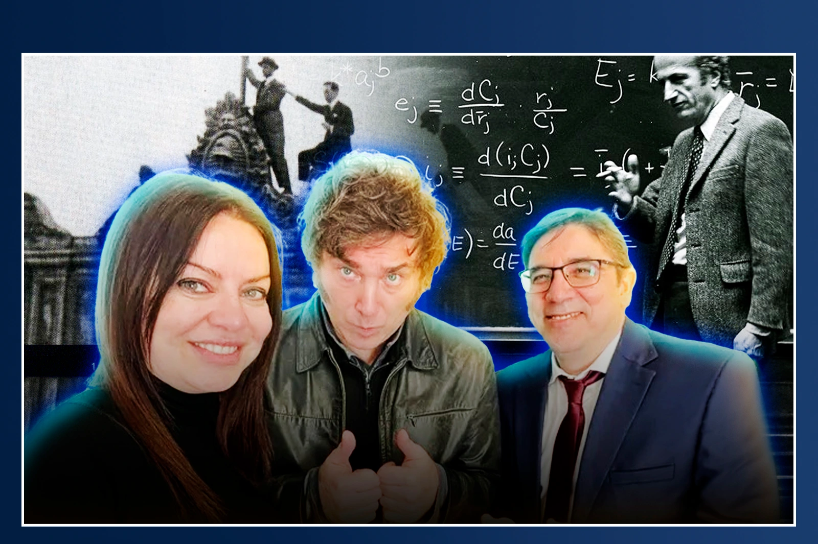
At the inauguration of the Human Capital Training Center, created at the initiative of Minister Sandra Pettovello, Milei detailed that in his apartment in Abasto, he had a huge painting of Becker deriving the intertemporal Slutsky equation, that he kept all his books, and that the idea of this ministry is undoubtedly a tribute to his theory. In an article published long before he thought of becoming president, on January 1, 2014, in his column for Infobae titled “Human Capital and Economic Growth,” he wrote verbatim: “Theodore Schultz pointed out the importance of human capital and its contribution to economic growth, which was formalized and tested by Gary Becker and embodied in a bisectorial growth model (where both physical capital and human capital are accumulated) by Hirofumi Uzawa, who made the time dedicated to education the main determinant of the rate of technological progress (PTF).” This is fundamental; the time and quality of time dedicated to higher education are decisive for our future development.

Becker, in his book Human Capital (1964), left us one of the most powerful and practical ideas of modern economics: education is not a social expense or an abstract right. It is an investment. Individuals and countries invest time, effort, and resources in training because it generates a stock of skills, knowledge, and capabilities that increase productivity, future income, and overall economic growth.

Becker clearly distinguished between general training (which serves any company or sector) and specific training (which adapts to a particular job). The key is that this investment must have a positive return: the benefits (higher salaries, greater productivity) must exceed the costs (cost of study materials, study time, lost opportunity to work). When the return is low or negative, we are not creating human capital; we are destroying it. That is exactly what we are seeking to apply in the reform of Argentine higher education.

This is not just a budgetary issue. It is about ensuring that every peso the State invests in national universities generates more quality human capital, more prepared graduates, and more growth and sovereignty for the country.

Look at the numbers we have been working with: the average cost per graduate in national universities during 2024 was 52.3 million pesos, this updated average cost must be calculated per year and per graduate. And the average time to graduate in many careers is around 9 or 10 years, even reaching in some cases up to 12 years. These data are not for criticism, but to understand where there is room for improvement: if we want public university to be a true investment in human capital, we must align incentives so that students finish on time and in the right manner, that the careers respond to the strategic needs of the country, and that resources are used with maximum efficiency.

The transformation we are making began with the generation of useful data, measuring to understand; without reliable data, we cannot undertake reforms that are truly effective. We want to translate Becker's ideas into the Argentine reality in a concrete and orderly manner.

The university reform in the style of Gary Becker

First, transparency and total auditing. As established by Article 59 of the Higher Education Law and Article 7 of the Financial Administration Law, national universities are subject to the control of SIGEN and AGN. Autonomy is a value, but it cannot mean opacity. Becker taught that for an investment to yield, its results must be measured; we are doing the same with public information on costs and graduates.

Second, a system of academic credits and real mobility. Today, many students, also responding to the speed of technological innovation characteristic of our time, desire greater mobility between disciplines, something very difficult with rigid and, in some cases, obsolete study plans. With transferable credits and recognition of subjects, the student will be able to invest their time in the most efficient way, changing careers or combining paths without losing years. Following Becker: maximizing the return on investment in general training.

Third, strong incentives for graduation and prioritization of strategic careers. The “Becas Belgrano” program is a clear example: we focus resources on areas of high social and private return such as science, technology, engineering, and health. Because Becker demonstrated that the profitability of education is greater when training is oriented towards skills that the market values. It is not about closing careers, but about encouraging those that multiply the human capital of the country.

Fourth, demand for regularity and equity mechanisms. A person from Chaco, Tucumán, or Salta cannot continue to indefinitely subsidize studies that last a decade, do not contribute to the country's development, and may just be a hobby. That is why we promote greater regularity (remembering the spirit of the original Article 50 of the Higher Education Law) and a reasonable cost for non-resident foreigners. It is a way to ensure that the effort of the Argentine taxpayer translates into more graduates who generate wealth and contribute to making Argentina greater. In the university case, that means a more demanding, more modern university that is more connected to the labor market. The university budget has grown above inflation in real terms; what we are doing is ensuring that this growth translates into concrete results.

The reform we propose is not against anyone. It is in favor of students, families, and the future of Argentina. It is about applying, in a practical way and without dogmas, the teachings of Gary Becker that Javier Milei has turned into state policy from day one; because human capital is not measured only in the number of enrollments or in the executed budget. It is measured in competitive graduates, in innovation, in quality jobs, and in sustained growth. That is the public university we need to build: one that honors the Argentine tradition of academic excellence and, at the same time, responds to the demands of the 21st century with seriousness and efficiency.


La Derecha Diario logo
TwitterInstagramYouTubeTikTokFacebook
Derecha Diario TV

Nosotros

  • Quienes Somos
  • Autores
  • Donar

Privacidad

  • Protección de datos
  • Canales
  • Sitemap
  • RSS

Contacto

  • info@derechadiario.com.ar
PUBLICIDAD

Noticias relacionadas

Inflation is a moral problem when the State issues money without productive backing.

Inflation is a moral problem when the State issues money without productive backing.

Keir Starmer would have communicated to his inner circle his intentions to resign.

Keir Starmer would have communicated to his inner circle his intentions to resign.

Alarm in the US: sharp rise in wholesale inflation

Alarm in the US: sharp rise in wholesale inflation

Ensure the benefits of freedom over time!

Ensure the benefits of freedom over time!

Milei celebrated the defeat of wokism and targeted the degenerate "French Theory."

Milei celebrated the defeat of wokism and targeted the degenerate "French Theory."

They pointed to Somali Congresswoman Ilhan Omar as the mastermind behind a $250 million scam in Minnesota.

They pointed to Somali Congresswoman Ilhan Omar as the mastermind behind a $250 million scam in Minnesota.