In cumulative terms, the national CPI registered an increase of 26.3% between January and October, while the year-on-year variation stood at 33.1%. This last figure represented a slowdown for the third consecutive month. When analyzing the components, core inflation accumulated 30.7% year-on-year, seasonal inflation by 28.2% and regulated inflation by 43.7%
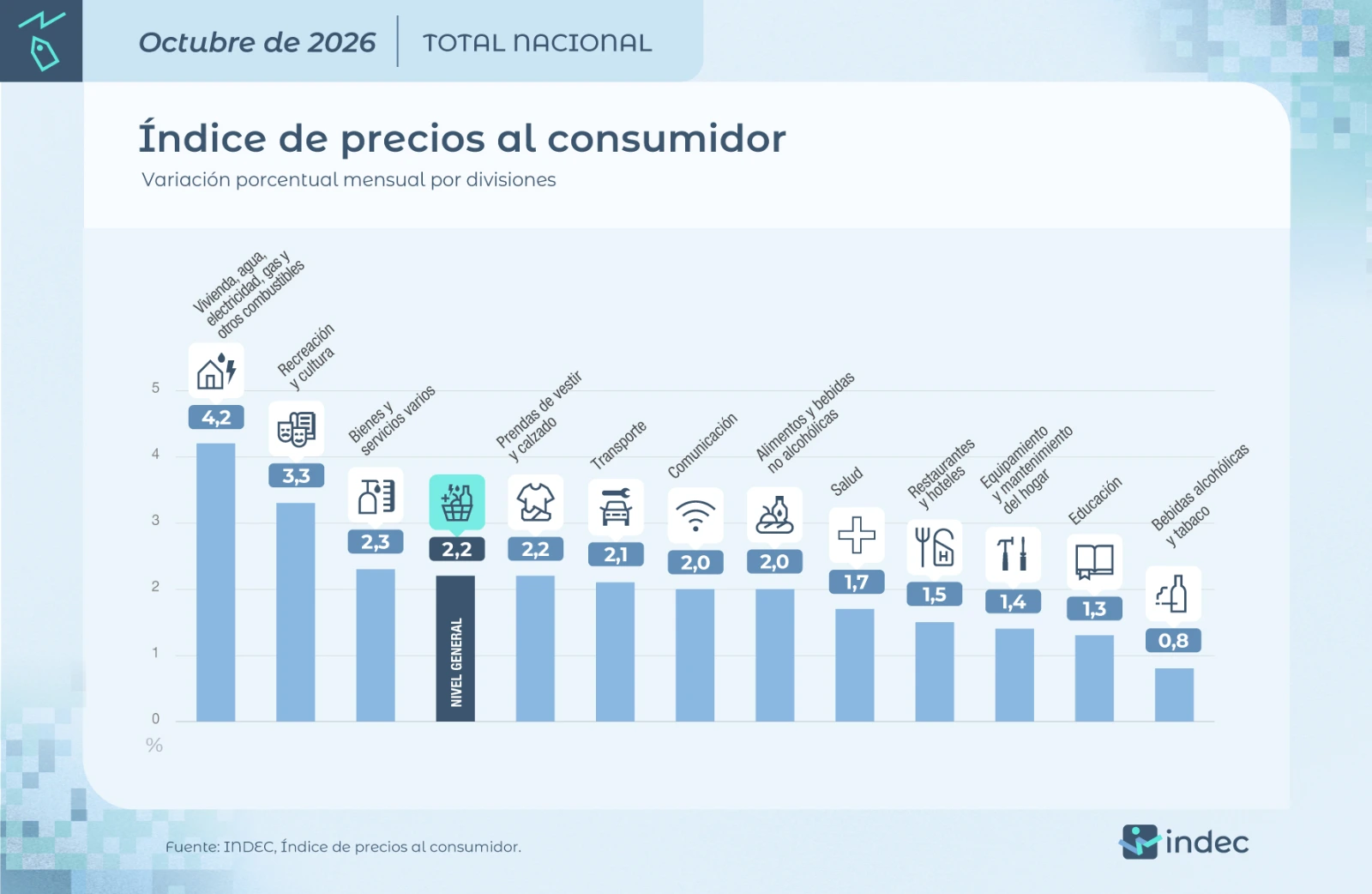
The national Consumer Price Index (CPI) for October was 2.2% and became the lowest record for that month since 2017, when it had reached 1.5%.
According to data published by the National Institute of Statistics and Censuses (INDEC), core inflation stood at 1.5%, its lowest level in 15 months and the lowest since January 2018, except for July 2025. In this way, CPI accumulated an increase of 26.3% in the first ten months of the year and of 33.1% year-on-year
.
The historical comparison allows us to measure the evolution of prices.
In October 2018, inflation had been 5.4%; in 2019, 3.3%; in 2020, 3.8%; in 2021, 3.5%; in 2022, 6.3%; and in 2023, 8.3%.President Javier Milei. Later, after Javier Milei took office, the indicator began to show lower records: 2.7% in October 2024, 2.3%in 2025 and 2.2% in 2026.
Thus, this year's result was the lowest for that month since 2017, when it had reached 1.5%
.
Inflation for October 2026
One of the most relevant data in the October report of this year was the behavior of core inflation, which excludes seasonal and regulated components.
This category registered a monthly increase of 1.5%, while seasonal prices increased by 5.5% and regulated prices by 2.9%.
According to official data, the monthly variation in core inflation was the lowest since July 2025. In addition, with the exception of that month, such a low record has not been observed since January 2018. The three-month moving average in this category also reached its lowest level since January 2018.
. INDEC data.
By division, housing, water, electricity, gas and other fuels led the October increases, with a variation of
4.2%.
The result was influenced by changes in the Cold Zone Regime, which had an impact on the prices of that chapter. At the opposite extreme, Alcoholic beverages and tobacco showed the lowest monthly increase, with 0.8%
.
Regarding regional behavior, the Pampas region registered inflation of 2.6%, followed by Patagonia, with 2.5%, and Cuyo, with 2.3%. Below the national average were Greater Buenos Aires, with 2%; the Northwest, with 1.7%; and the Northeast, with 1.5%
.
Another important fact was the behavior of clothing and footwear, which registered a year-on-year variation of 10%, one of the lowest among the divisions surveyed.
The October results show a sustained slowdown in inflation and a particularly low record in the core measurement, two central indicators for evaluating the evolution of the inflationary process and the direction of the Milei Government's economic program.