The reform was approved after almost twelve hours of debate with between 64 and 62 votes in favor and 48 against, it introduces executions, allows sentences by simple majority in military courts in the West Bank and tightens the regime for those convicted of terrorist murders.
Although the law allows appeals, it should be noted that military courts that try Palestinians in the West Bank have a conviction rate of more than 99%, according to Army data collected by the daily Haaretz.
In addition, those convicted by military justice may not receive a commutation of sentence or pardon from the commander of the Israeli Army, leaving only the possibility of delaying the execution if the Prime Minister requests it for “special reasons”.
In parallel, the Knesset continues to debate another bill known as the “Law on the prosecution of participants in the events of October 7”, which would allow the death penalty to be applied retroactively to defendants linked to the Hamas attacks of October 7, 2023. The recently passed law, however, will not be retroactive for those arrested for these attacks
.
NGOs also linked the reform to the prison policy implemented after the Hamas terrorist offensive. According to data from the organization Physicians for Human Rights Israel (PHRI), since October 7, nearly 100 Palestinian detainees have died in Israeli prisons, a record number that has not been updated
in months.
According to several NGOs mentioned in the report, in many cases the deaths apparently occurred as a result of torture, medical negligence and food deprivation, describing the detention system as a group of centers that would have been converted into “torture camps”.
In this context, Adalah stressed that the new legislation represents, in her opinion, one of the “most violent and discriminatory” rules approved in the country and warned that it could even constitute a war crime by violating international standards.
Israel took a significant step in tightening its criminal policy against terrorism by approving a legal reform that establishes the death penalty for those convicted of terrorist murders. The measure, promoted in a context of high regional tension and following the attacks of October 7, seeks to reinforce the State's deterrent capacity against those who resort to violence against the Israeli population and institutions. Historically, capital punishment has been extremely exceptional in Israel. Since the founding of the State in 1948, it has only been applied once, in 1962, when the Nazi criminal Adolf Eichmann, one of the main perpetrators of the Holocaust, was executed. Until now, Israeli legislation provided for the death penalty only for extraordinary cases linked to war crimes or genocide
.
The new reform was approved this Monday by the Knesset - the Israeli Parliament - after almost twelve hours of intense parliamentary debate. As reported by The Times of Israel, the project obtained 64 votes in favor and 48 against. However, in another part of the legislative process, a vote of 62 votes in favor and 48 against was also recorded for the final approval of the text introducing the death penalty by hanging for those guilty of terrorist murder. The new legal framework incorporates several provisions that substantially modify the judicial procedure in cases of terrorism. These include the possibility of executions by hanging, the authorization of secret executions, the limitation of judicial remedies and the power for a military court to sentence to death by a simple majority, thus eliminating the requirement of unanimity that
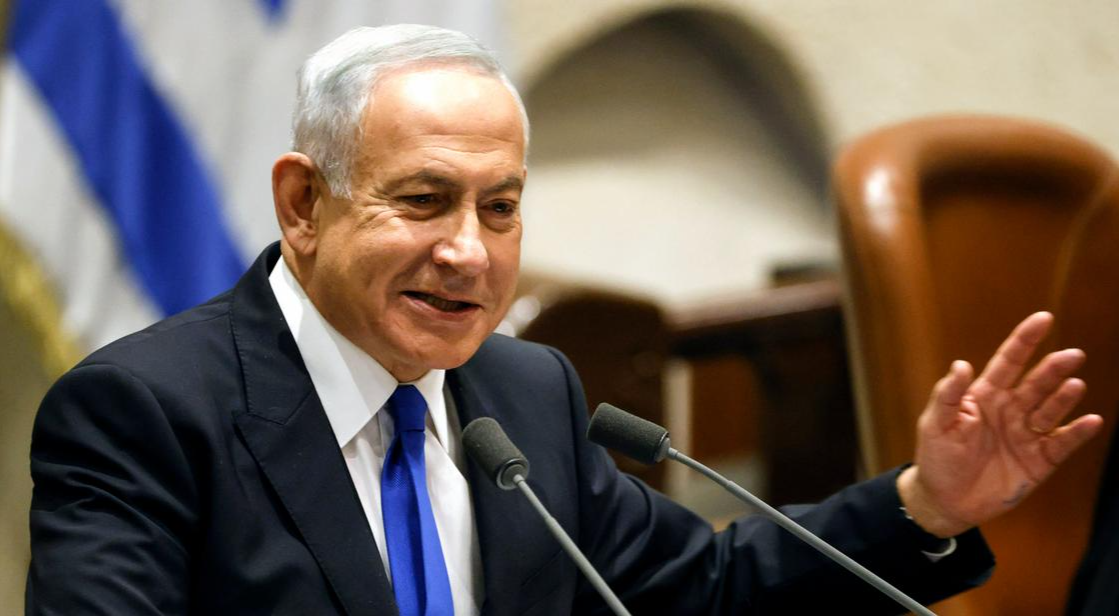
existed previously. Benjamin Netanyahu As
detailed by The Times of Israel, the law will be applied primarily in military courts in the West Bank, where Palestinian defendants are tried, while Israeli citizens continue to be tried in civilian courts. Although the legislative text formally states that its scope is general, one of its articles restricts its application to those who intentionally cause the death of a person with the objective of denying the existence of the State of Israel, a definition that in practice points to those who participate in terrorist actions against the country. The reform establishes that military courts that try those accused of terrorism in the West Bank will be obligated - except for “special circumstances” that are not defined - to impose capital punishment on Palestinians residing in that territory occupied by the Israeli Army. Instead, ordinary courts that try Israeli citizens will have the possibility of applying life imprisonment instead of the death penalty
.
Israeli Prime Minister Benjamin Netanyahu attended the vote in the Knesset plenary and voted in favor of reform. The initiative was promoted by the party of the Minister of National Security, Itamar Ben Gvir, leader of the ultra-right Jewish Power party. After the vote, Ben Gvir defended the measure with a strong message. According to The Times of Israel, he said: “This is a day of justice for the victims and a day of deterrence for our enemies. No more revolving doors for terrorists, but clear decisions. Whoever chooses terrorism, chooses death.”
The reform also had the support of the ruling Likud party, led by Netanyahu, as well as the opposition Yisrael Beitenu party and the ultra-orthodox Shas and United Judaism Torah formations.
The approved text was unchanged after passing through parliamentary committee the previous week. After the reform was approved, Ben Gvir tried to uncork a bottle of champagne inside the Parliament, although an usher prevented him from doing so. Minutes later, a missile launch was detected from Iran to the Tel Aviv region, an episode that reflected the climate of tension in which the legislation was approved
.
During the parliamentary debate, there was also strong criticism from opposition sectors. The deputy of the Yesh Atid (There is a Future) party, Matti Saratti, condemned the initiative, stating: “The law is populist, immoral, not egalitarian”, calling it “clearly unconstitutional”. Human rights organizations reacted immediately to the content of the reform. The Legal Center for the Rights of the Arab Minority in Israel (Adalah) argued that the law institutionalizes the “state and cold-blooded murder of individuals who pose no threat”. Its legal director, Suhad Bishara, denounced that the rule “is designed to apply only to Palestinians, which violates the fundamental principle of equality and the prohibition of racial discrimination
.” Israel approves a new law that establishes the death penalty for terrorists
Adalah also stated that the application of Israeli laws to the Palestinian population living in the West Bank constitutes a “flagrant violation of international law”, arguing that the Knesset lacks authority to legislate on occupied populations. The organization announced that it will file a most urgent appeal to the Supreme Court of Israel to challenge the rule. According to The Times of Israel, the reform also tightens the prison regime for those sentenced to death, establishing almost total isolation. The death sentence must be executed within 90 days of being final, by hanging, and the identity of the executioners will be hidden
.
The prison director, a judge, a clergyman, a doctor and a representative of the victims' families must be present during the execution. The convict will remain separated from the rest of the prisoners. In addition, military courts may impose capital punishment even if it has not been requested by the Public Prosecutor's Office, a body that in Israel usually acts as a counterweight to the Government. They can also decide the sentence by a simple majority of the court and without the judges having to hold a high military rank