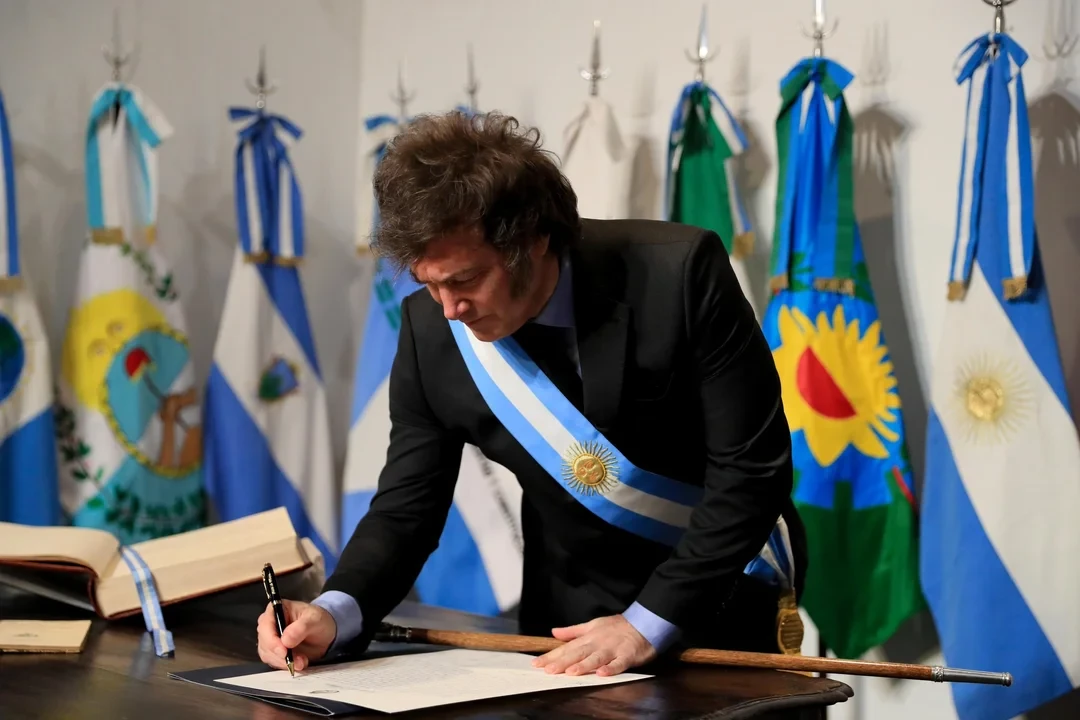

Javier Milei and the "second Argentine independence"

Javier Milei and the "second Argentine independence"
Imagen de Editorial Team
porEditorial Team
Argentina

Just as the congressmen of Tucumán broke free from Spanish domination, this generation must overcome the statist culture and consolidate the ideas of freedom at all levels of the State

Add La Derecha Diario on
Share:

Every July 9, we remember that extraordinary decision made by the delegates gathered in Tucumán in 1816. In the midst of an unfavorable military scenario, with patriotic forces retreating on various fronts and the Spanish power determined to reclaim its colonies, those men did exactly the opposite of what fear advised; they declared independence.

They did not choose the path of comfort or political prudence. They chose freedom.

The Act of Independence proclaimed the will to break "the violent ties" that bound the “United Provinces of South America” to the Spanish Crown and to recover the rights that had been stripped away. On the 19th, Congress would add a phrase that remains highly relevant, independence must be "from Spain and from any other foreign domination."

However, the greatness of those men did not consist solely in breaking with an empire. They also understood that political freedom had to transform into permanent institutions. That is why, while some proposed establishing a monarchy, the historic intervention of Fray Justo Santa María de Oro definitively tilted the national destiny. His famous "¡Republic or nothing!" encapsulated the conviction that no people can be truly free if they exchange one master for another.

Thirty-seven years later, the Constitution of 1853, inspired by Juan Bautista Alberdi, completed that work. There were born the guarantees that made Argentina great, the defense of private property, freedom of commerce, work, press, worship, and the limitation of political power through the division of powers.

But Alberdi left a warning; we could free ourselves from the fiscal machines of the metropolis only to end up becoming colonists of our own governments. And that is exactly what happened when we strayed from liberal ideas.

For decades, Argentina stopped trusting in freedom to increasingly rely on the State. Politics replaced the citizen. Public spending replaced private effort. Taxes ceased to finance essential functions and became the fuel for a state structure that grew without limits. Ministries, agencies, deficit-ridden public companies, absurd regulations, and privileges for a political class increasingly distant from those who sustained the entire system with their work multiplied.

In the name of sovereignty, isolation was justified. In the name of social justice, the culture of merit was destroyed. In the name of the present State, an omnipresent State was built.

The citizen ceased to be a protagonist to become a managed individual. The entrepreneur became suspect. The producer was treated as an inexhaustible source of fiscal resources. Inflation ceased to be an exception and became a permanent form of confiscation of the savings of Argentinians.

For years, we were told that it was impossible to reduce public spending, achieve fiscal balance, lower inflation without price controls, deregulate an economy suffocated by thousands of regulations, reduce the size of the State without causing chaos.

The facts began to demonstrate exactly the opposite

Since December 2023, Argentina has begun a process of transformation that seemed unthinkable a few years earlier. Fiscal balance ceased to be a promise and became a concrete objective. Unnecessary agencies were eliminated, the weight of the State was reduced, regulations that had hindered production and commerce for decades began to be dismantled, and an idea that seemed forgotten was reinstated, the State exists to guarantee rights, not to replace the initiative of citizens.

This does not mean that all problems are solved. Decades of decline do not disappear in a few years. But it does demonstrate something very important, the ideas of freedom have ceased to be academic theory to become possible public policies.

The political independence achieved in 1816 today needs to be completed with economic, institutional, and cultural independence.

Because a citizen burdened by confiscatory taxes is not fully free.

Because a merchant subjected to arbitrary regulations is not fully free.

Because a young person who depends on a political favor to get a job is also not fully free.

Freedom does not consist solely of choosing rulers every four years. It consists of each person being able to develop their life project with the least possible level of state interference, always respecting the rights of others.

This discussion also calls on the provinces

It is not enough to accompany national transformations if each province maintains intact the bureaucratic structures that discourage investment, uphold political privileges, and punish the private sector with distorting taxes. It is not enough to celebrate freedom while maintaining oversized provincial states, inefficient public companies, and administrative systems that consume resources without improving the lives of citizens.

It is the call of history to governors, legislators, mayors, councilors; freedom must reach every province and municipality in Argentina.

It must be expressed in a true reform of the State, in the reduction of unproductive spending, in the elimination of taxes that hinder production, in the transparency of public administration, and in the recovery of the most important principle of all, money belongs to the citizen and not to the State.

The delegates of Tucumán had the courage to break with the greatest power of their time.

Our generation faces a different but equally significant challenge, to definitively break with the culture of statism that for decades convinced millions of Argentinians that the solution always had to come from a government and never from freedom.

The responsibility of our generation is no longer just to recover the ideas of freedom, but to consolidate them and carry them to the farthest corners of the country.

Because independence is not a fact of the past. It is a conquest that each generation has the obligation to defend.


La Derecha Diario logo
ESX logoInstagram logoYouTube logoTikTok logoFacebook
ARGENTINAUNITED STATESECUADORISRAELMEXICODERECHA DIARIO TV
  • ES
    XInstagramYouTubeTikTokFacebook
  • DERECHA DIARIO TV
  • Sections
  • ARGENTINA
  • UNITED STATES
  • ECUADOR
  • ISRAEL
  • MEXICO
  • URUGUAY
  • Countries
  • La Derecha Diario logoLA DERECHA DIARIO
  • La Derecha Diario México logoLA DERECHA DIARIO MÉXICO
  • La Derecha Diario Uruguay logoLA DERECHA DIARIO URUGUAY
  • La Derecha Diario Ecuador logoLA DERECHA DIARIO ECUADOR
  • La Derecha Diario Israel logoLA DERECHA DIARIO ISRAEL
  • La Derecha Diario Estados Unidos logoLA DERECHA DIARIO ESTADOS UNIDOS
  • Topics
  • FINAL DEL MUNDIAL 2026
  • GUERRA EN IRÁN
  • The Newspaper
  • QUIENES SOMOS
  • AUTORES
  • PUBLICIDAD
  • DONAR
La Derecha Diario logo
TwitterInstagramYouTubeTikTokFacebook
Derecha Diario TV

Nosotros

  • Quienes Somos
  • Autores
  • Donar

Privacidad

  • Protección de datos
  • Canales
  • Sitemap
  • RSS

Contacto

  • info@derechadiario.com.ar
PUBLICIDAD

Related news

Historic: India enabled the commercial import of Argentine yerba mate

Historic: India enabled the commercial import of Argentine yerba mate

Investigating links between Brazilian drug trafficking and the financing of Hezbollah and Al Qaeda

Investigating links between Brazilian drug trafficking and the financing of Hezbollah and Al Qaeda

Investigating links between Brazilian drug trafficking and the financing of Hezbollah and Al Qaeda

Investigating links between Brazilian drug trafficking and the financing of Hezbollah and Al Qaeda

Friedrich Hayek and the Defense of the West

Friedrich Hayek and the Defense of the West

In a frantic match, England defeated France 6-4 and secured the bronze medal at the 2026 World Cup

In a frantic match, England defeated France 6-4 and secured the bronze medal at the 2026 World Cup

The stones in tribute to the victims of COVID-19 were removed preventively from Plaza de Mayo

The stones in tribute to the victims of COVID-19 were removed preventively from Plaza de Mayo






